When a hazardous or storm-damaged tree is felled, property owners breathe an immediate sigh of relief. The overhead danger of falling branches is gone, sunlight returns to the yard, and the canopy feels open and safe. However, when a crew packs up their saws and leaves the base behind, you are left with an incomplete project. Deciding to ignore old tree stumps is an understandable initial choice for homeowners looking to defer short-term expenses, but assuming nature will quickly break down the leftover wood is a costly mistake.
At Branching Out Tree Service in Hilton, NY, our ISA-certified arborists regularly help homeowners throughout Monroe County, Greece, Parma, Spencerport, and Brockport deal with the fallout of neglected stumps. What begins as a weathered chunk of wood rapidly evolves into an active incubator for carpenter ants and termites, an expensive blade-shattering obstacle for lawn equipment, a severe trip-and-fall liability, and an underground reservoir for destructive tree diseases. Investing in complete stump grinding and root flare remediation protects your soil chemistry, lawn usability, and property value.
1. The Ecological Decay Trap: Termites, Carpenter Ants, and Pest Infestations
A tree stump does not simply remain inert, weathered lumber. Once a tree’s vascular system is severed, biological decomposition takes over immediately. In upstate New York, persistent lake-effect moisture along the Lake Ontario shoreline, heavy spring runoff, and humid summer weather create the exact microclimate needed for accelerated wood rot. While natural breakdown is beneficial in deep woodland environments, having decomposing hardwood twenty feet from your porch or wooden siding invites serious structural risk.
| Wood-Dwelling Pest | Primary Target Zone | Direct Property Risk |
| Subterranean Termites | Softened underground root core | Migrates to sill plates & framing |
| Black Carpenter Ants | Damp sapwood / heartwood flare | Carves satellite structural nests |
| Wood-Boring Beetles | Cambium layer beneath old bark | Attacks nearby living hardwoods |
| Yellow Jackets / Hornets | Hollow subterranean root pockets | Serious sting hazards for lawn work |
| Field Mice & Voles | Decayed interior cavities | Overwinters, enters home crawlspace |
Termites and Carpenter Ants
Softened, decaying cellulose acts as an open invitation for wood-destroying insects:
- Subterranean Termites: These pests enter decaying wood at or below ground level. Once established inside an expansive subterranean root system, colonies swell into tens of thousands of workers, building mud transit tubes and foraging outward into structural sill plates, floor joists, garden borders, and privacy fences.
- Carpenter Ants: Unlike termites, carpenter ants do not eat wood; they hollow out moist, decomposing timber to build intricate nesting galleries. An old silver maple, red oak, or green ash stump serves as an ideal primary nursery before satellite nests branch out directly into nearby home wall cavities.
Rodents, Beetles, and Stinging Insects
As the center of the stump rots out, hollow voids naturally develop. These dark cavities provide warm, protected nesting habitat for mice, voles, raccoons, and snakes seeking shelter from freezing Monroe County winters. In late summer, aggressive yellow jackets routinely turn hollowed-out root flares into underground nests. Striking one of these hidden colonies with a weed trimmer or footstep introduces serious physical danger.
Frequently Asked Questions
Q: How quickly will termites or carpenter ants find a neglected stump in Western New York?
A: Subterranean termites and carpenter ants can detect and colonize an untreated stump within 6 to 12 months. Because expansive lateral roots spread underground, these insects move beneath lawns unseen, following root pathways directly toward home foundations without ever crossing open ground.
Q: Can I stop pest infestations by pouring chemical insecticides on top of the stump?
A: Surface chemical applications only kill exposed insects and are washed away by rain. They fail to penetrate the subterranean root flare, where the queen, eggs, and the bulk of the colony remain safely sheltered. Mechanically pulverizing the wood down to fine sawdust with a commercial grinder eliminates the food and moisture source completely.
2. Hidden Safety Hazards and Property Liability
Every exposed stump on a residential or commercial parcel represents an active premises liability. Whether your yard hosts children at play, family pets, or delivery couriers, an irregular stump creates a persistent tripping hazard.
Turfgrass, dandelions, broadleaf weeds, and creeping ivy grow rapidly across Monroe County from May through September, completely concealing low-cut stumps. When friends, family, or delivery couriers walk or run across your lawn, they cannot spot an obstacle rising just three or four inches off the ground. Fractured ankles, stubbed toes, torn ligaments, and head trauma from sudden trips are frequent, preventable home injuries. For commercial landlords and rental property owners, leaving an unmarked trip hazard on pedestrian paths opens the door to costly premises liability claims.
The hazard rarely stops at the central trunk. Mature native trees feature sprawling lateral root networks that push upward through topsoil as heavy rain washes top layers away and winter frost heaves the surface. These hardened root ribs trip pedestrians, buckle concrete sidewalks, heave asphalt driveways, and crack nearby paver patios.
Frequently Asked Questions
Q: Am I legally responsible if a delivery courier or neighbor trips over a stump on my property?
A: Yes. Under New York premises liability principles, property owners are expected to keep grounds free of foreseeable hazards. An obscured, unground stump sitting in a walking zone can be deemed negligence if it causes personal injury.
Q: Will roots continue to heave sidewalks after the top of the tree has been removed?
A: While roots no longer grow outward once the trunk is felled, large root anchors swell with groundwater and expand during winter freeze cycles. Until the primary root collar is ground away and structural tension is eliminated, roots will continue to displace adjacent concrete walkways and patios.
3. Expensive Turf and Lawn Care Equipment Damage
Mowing the lawn should be routine property upkeep, but leaving an old tree stump turns cutting the grass into a stressful obstacle course.
| Lawn Care Equipment | Point of Impact | Common Equipment Failure | Estimated Repair Expense |
| Push / Walk-Behind Mower | Steel cutting blade & motor spindle | Bent motor crankshaft, sheared flywheel key | $150 – $400 (Often requires engine replacement) |
| Zero-Turn Commercial Mower | Heavy undercarriage deck & drive pulley | Warped deck shell, snapped spindle, broken belt | $350 – $1,200 |
| String Trimmer / Weed Edger | Bump feed head & drive gearbox | Cracked gear head, shattered spool housing | $40 – $120 |
| Lawn Aerator / Dethatcher | Spring tines and hydraulic lifting arms | Snapped-core spoons, twisted axle | $200 – $600 |
Severe Mechanical Damage to Mower Drive Systems
Hitting an immovable oak or maple heartwood stump at blade speeds exceeding 3,000 RPM causes immediate mechanical shock. The force transfers up the spindle shaft, shearing flywheel keys, bending cutting blades, and warping the engine crankshaft. When a crankshaft bends, the engine suffers balance failure, often requiring a total engine replacement that costs nearly as much as a new mower.
Patchy Lawns and Weedy Perimeters
Operating a lawn mower around an irregular stump requires awkward maneuvering, leaving tall, unmanaged rings of grass and weeds. Homeowners are forced to use string trimmers every weekend, chewing through expensive trimmer lines against abrasive tree bark. Over time, these neglected perimeter zones fill with dandelion, thistle, and crabgrass infestations that blow seeds across the rest of your lawn.
Frequently Asked Questions
Q: Can I use a chainsaw to cut the stump flush with the ground so my mower clears it?
A: Cutting flush with the dirt is extremely dangerous. Soil, small stones, and grit will dull or ruin a chainsaw chain within seconds. Furthermore, soil shifts and winter frost heave will push the remaining wood back above blade height within a season, creating an invisible, blade-destroying trap.
Q: How soon can I safely mow over the area after professional stump grinding?
A: Once our team grinds the stump 8 to 12 inches below grade, the area is backfilled with topsoil and seeded. You can run your mower directly over the area as soon as the newly sprouted grass reaches a normal cutting height of 3 to 4 inches.
4. Aggressive Sprouting and Parasitic Regrowth
Many property owners assume that once a tree is cut down, it is permanently dead. In reality, hardy deciduous species across Western New York—such as box elders, silver maples, black locusts, poplars, and willows—house extensive carbohydrate reserves deep inside their subterranean root network.
Deprived of its primary trunk, the root mass initiates an emergency survival mechanism by pushing out clusters of vigorous “sucker” sprouts around the base and along lateral roots. These shoots grow at a rapid rate, quickly forming dense, thorny scrub brush. Simply cutting them down with shears or running them over with a mower does not resolve the issue. Pruning suckers without eliminating the root flare triggers denser, multi-stemmed growth that transforms an unobtrusive stump into an unsightly thicket.
These active sprouts continue drawing high volumes of moisture, nitrogen, phosphorus, and essential minerals from the surrounding lawn. Nearby turfgrass, ornamental shrubbery, and perennial beds become visibly stunted as the buried root system siphons soil vitality to feed its aggressive regrowth.
Frequently Asked Questions
Q: Why does my tree stump continue sprouting new branches years after removal?
A: The root system stores extensive starch reserves that remain alive long after the canopy is removed. Until the primary root collar and crown are mechanically ground down and separated, the cambium tissue will continue using that stored energy to generate leaves.
Q: Will pouring bleach or motor oil stop a stump from sprouting?
A: Never pour motor oil, bleach, or concentrated salt on a stump. These toxic substances permanently contaminate topsoil, kill beneficial soil microbes, harm earthworms, and kill surrounding lawn grass, and can leach into local groundwater. Grinding is the only environmentally sound, permanent solution.
5. Underground Fungal Networks: Spreading Disease to Healthy Trees
Wood rot breaks down dead cellular material, but harmful fungi do not stay confined to dead timber. Leaving an untreated stump creates a subterranean nursery for plant pathogens that travel through the soil to attack valuable, healthy shade and ornamental trees.
Armillaria Root Rot (Honey Fungus)
One of the most destructive tree pathogens in New York is Armillaria mellea, commonly known as honey fungus. It feeds on decaying hardwood roots and spreads underground through durable, cord-like fungal strands called rhizomorphs. These cords travel dozens of feet through the topsoil, penetrating the root collars of healthy, living trees. Once infected, the host tree suffers vascular blockage, internal decay, branch dieback, and structural failure, eventually requiring complete removal.
Toxic Mushrooms and Structural Shelf Fungi
As internal decay breaks down wood cellulose, fungi push out visible fruiting structures:
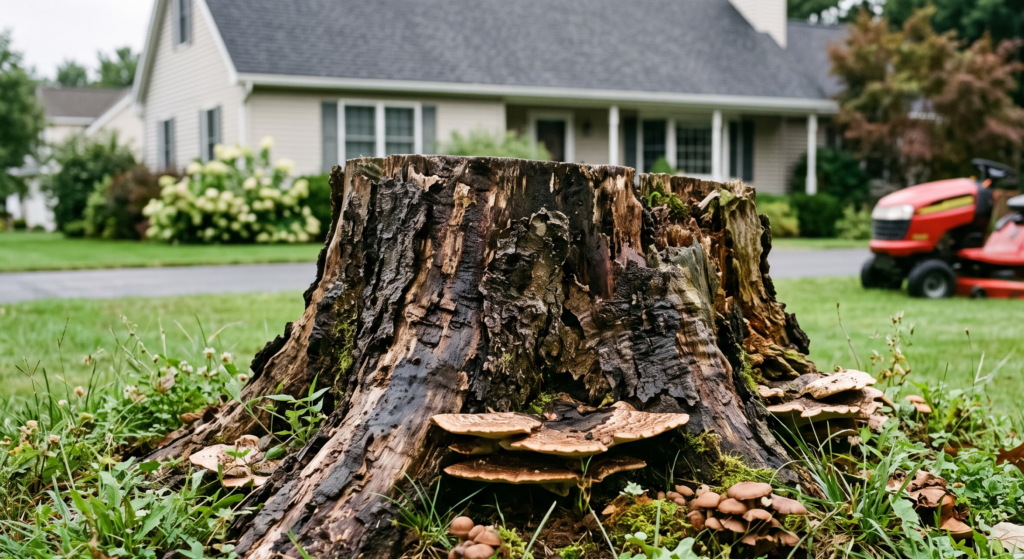
- Bracket / Shelf Fungi (Polypores): Tough, woody brackets that emerge from lower bark plates, releasing millions of airborne fungal spores across your yard.
- Toxic Lawn Toadstools & Fairy Rings: Dense clusters of mushrooms that shoot up through the turf during wet spring and fall seasons. Many of these species, including certain Amanita and Inocybe fungi, are toxic to curious toddlers and domestic pets.
Leaving a rotting stump in your lawn is functionally equivalent to maintaining an active fungal reservoir that threatens the rest of your landscape.
Frequently Asked Questions
Q: Are the mushrooms growing around my old tree stump toxic to dogs?
A: Yes, many common lawn mushrooms associated with decaying wood can cause severe poisoning in dogs and cats. Ingesting wild fungi can trigger gastrointestinal distress, liver failure, seizures, and neurological complications.
Q: Does stump grinding completely get rid of honey fungus in the soil?
A: Grinding eliminates the main host stump and central root flare, which cuts off the primary food supply the fungus needs to survive. Without a large hardwood base, the fungus cannot sustain the thick rhizomorph networks required to infect adjacent healthy trees.
6. Curb Appeal, Property Values, and Landscape Versatility
From a landscape design standpoint, an unmanaged tree stump is an immediate eyesore. If you take pride in your home’s exterior appeal, an aged, blackened, splintering stump in the front or backyard undermines your entire property.
Blocking Outdoor Improvements and Backyard Projects
A lingering stump prevents you from making full use of your outdoor living space. It makes it difficult or impossible to:
- Pour a concrete patio, build an outdoor kitchen, or set up a fire pit area over wood that will eventually settle and collapse.
- Install a continuous privacy fence without running into buried, impassable root barriers.
- Plant a new shade tree, ornamental bed, or raised garden because of root competition.
- Set up safe, flat play structures like swing sets, trampolines, or above-ground pools.
Damaging Home Appraisals and Resale Value
First impressions carry significant weight in real estate. When prospective buyers evaluate your home, a neglected stump signals deferred maintenance and extra work. Buyers recognize they will have to hire an arborist to correct the issue, and they will often reduce their offer price to offset the expense.
Frequently Asked Questions
Q: Can I build a stone patio or deck directly over an unground tree stump?
A: No. As the underground wood slowly rots over the course of 5 to 10 years, the soil above it collapses and settles. Concrete poured over an unground stump will crack, paver patios will sag, and deck footings will settle unevenly, creating severe structural damage.
Q: Does grinding an old stump provide an immediate return on investment?
A: Yes. Professional stump grinding immediately restores usable square footage, improves lawn aesthetics, and eliminates a visible maintenance liability, enhancing overall marketability for appraisers and potential buyers.
7. Underground Utility and Foundation Damage
A tree may be cut down, but its expansive root network does not vanish overnight. Until those massive roots decay, they can continue to create serious problems for underground home infrastructure.
Sewer and Storm Drain Infiltration
Large lateral roots naturally grow toward moisture and nutrients. In older residential neighborhoods, aging clay, cast iron, or unsealed PVC sewer pipes frequently develop hairline stress cracks. Thirsty roots enter these openings, forming dense internal root masses that catch debris and cause catastrophic sewage backups into basements.
Foundation Settling and Driveway Damage
In areas with heavy clay soils, dense root systems pull massive volumes of moisture out of the earth during dry summer spells. This localized dehydration causes the surrounding clay soil to shrink. When soil sinks unevenly beneath garage floors, driveways, or home foundation footings, it leads to cracked drywall, uneven floors, and foundation settlement.
Frequently Asked Questions
Q: Can dead tree roots continue damaging underground pipes?
A: Yes. Even after a tree is removed, roots wrapped around plumbing or drain lines remain under pressure. As the wood slowly rots, softens, and shifts under the weight of the soil, the surrounding dirt settles unevenly, which can shear or crack aging pipes.
Q: How do professionals avoid hitting buried utility lines during stump grinding?
A: Certified arborists always coordinate with utility locators (such as Dig Safely New York / 811) before grinding. Utility technicians mark all buried gas, electric, telecommunication, and water lines so our machine operators can work safely around underground services.
8. DIY Stump Removal vs. Professional Stump Grinding
When property owners decide to get rid of an old stump, many consider tackling it themselves using hardware store products or internet shortcuts. Unfortunately, DIY methods are almost always slow, ineffective, and hazardous.
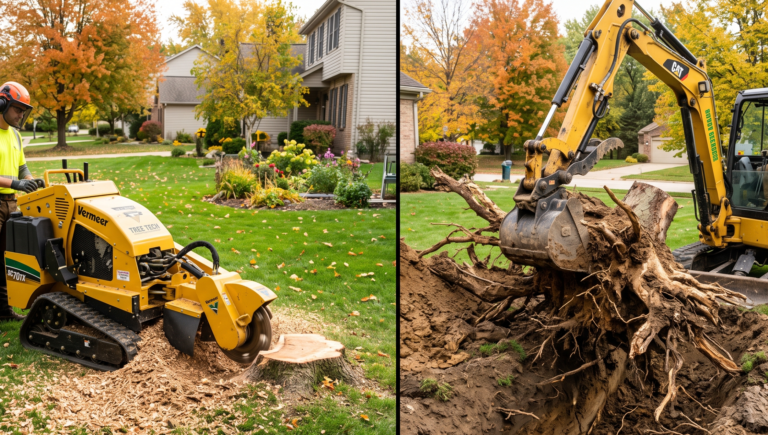
| Removal Method | Typical Timeframe | Primary Drawback | Risk Level / Effectiveness |
| Chemical Rot Acceleration | 12 – 36 Months | Slow; uses caustic salts | Low effectiveness; chemical hazard |
| Controlled Burning | 2 – 4 Days | Smoldering underground fire | High fire risk; local burn bans |
| Vehicle Pulling / Chains | 1 – 2 Hours | Snapped chains, bent frames | High risk of vehicle/bodily injury |
| Manual Pickaxe & Shovel | Multiple Days | Exhausting, blisters | Low; leaves major root mass behind |
| Professional Grinder | 1 – 3 Hours | Modest professional cost | 100% complete; fast, clean, safe |
The Pitfalls of Chemical Treatments and Fire
- Chemical Accelerators: Chemical rot products use concentrated potassium nitrate to soften the wood. This requires drilling dozens of deep holes, pouring in the granules, and waiting up to three years for the fibers to soften enough to chop out with an axe.
- Controlled Burning: Lighting a chemical-soaked stump is hazardous. Open burning ordinances across Monroe County towns strictly prohibit burning yard waste in this manner. Furthermore, underground root fires can smolder unnoticed for days, traveling along root paths to ignite buried peat pockets, utility lines, or dry landscape mulch.
The Real Dangers of Vehicle Towing
Hooking a tow strap or logging chain from a pickup truck to an anchor root is dangerous. The tensile anchoring strength of a mature tree root system easily exceeds the towing capacity of passenger vehicles. Snapped chains can whip through rear windshields, bend truck frames, and ruin transmissions, turning an unground stump into thousands of dollars in mechanical repairs.
The Proven Solution: Hydraulic Stump Grinding
Professional tree services rely on commercial hydraulic stump grinders equipped with high-torque cutting wheels and carbide-tipped teeth.
- Subsurface Grinding: Commercial machines grind the stump, crown, and primary root flare down 8 to 12 inches below grade, breaking up the structural heartwood.
- Immediate Lawn Restoration: The process turns dense wood into clean, usable mulch chips, filling the hole flush so the area can be easily prepped, topsoiled, and seeded with lawn grass.
- Low-Impact Yard Access: Self-propelled track grinders distribute machine weight evenly, passing through standard 36-inch backyard gates without tearing up turf or damaging sprinkler heads.
Frequently Asked Questions
Q: Why shouldn’t I just rent a small stump grinder from a local equipment rental shop?
A: Rental units are lightweight, often have dull cutting teeth, and lack the hydraulic power needed to tackle mature hardwood stumps. Without ballistic shielding and training, operators risk injury from flying rocks and debris, all while dealing with equipment transportation, refueling, and strenuous physical labor.
Q: How long does professional stump grinding take for an average yard?
A: Our commercial hydraulic grinders take between 45 and 90 minutes to grind an average-sized residential stump down 8 to 12 inches below grade, clean up the site, and place safety barriers.
9. What to Do with the Area After Stump Grinding
Once our crew has ground out the stump, removed excess debris, and raked the workspace smooth, you have a clean slate. Taking the proper restoration steps ensures your yard recovers quickly:
- Repurpose or Clear Woodchips: The grinding process produces an abundance of rich, coarse wood mulch. You can use these chips around walking paths or mature landscape shrub beds. Avoid packing fresh, uncomposted woodchips directly around annual flower beds, as raw decomposing wood temporarily uses up soil nitrogen at the surface.
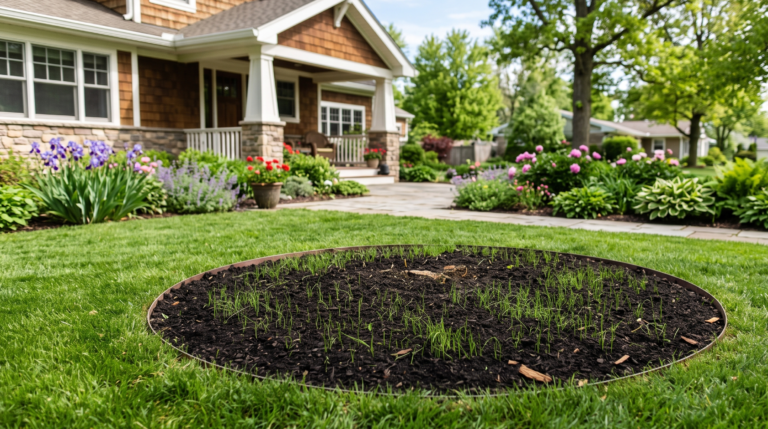
- Backfill with Quality Topsoil: Fill the ground cavity with a 70/30 mixture of screened topsoil and compost. Mound the dirt 1 to 2 inches higher than the surrounding lawn grade to account for natural settling over the first few soaking rainfalls.
- Overseed with Cool-Season Grass: Plant a durable turfgrass blend suited to upstate New York conditions (such as a mix of Kentucky Bluegrass, Perennial Ryegrass, and Fine Fescue). Keep the seedbed consistently moist until the young grass takes root.
- Build New Landscape Features: If you do not plan to seed grass, the cleared, level space is ideal for a raised stone planter, a birdbath feature, an outdoor bench, or a pollinator garden filled with native perennials.
Frequently Asked Questions
Q: Can I plant a new tree directly in the spot where the old stump was ground out?
A: We recommend planting a new tree at least 3 to 5 feet away from the old location. While the central root crown is pulverized, deep root structures below 12 inches take a few years to fully decompose, which can make digging difficult and temporarily tie up available soil nitrogen for new tree roots.
Q: How long does it take for grass to grow over a ground stump site?
A: With quality screened topsoil and consistent daily watering, high-grade cool-season grass seed will germinate within 10 to 14 days, establishing a seamless, mowable lawn over the old stump area within 4 to 6 weeks.
Professional Stump Grinding & Removal Near Me: Monroe County Service Areas
When searching for reliable “stump grinding near me” or a dependable “tree service near me” in the greater Rochester and Lake Ontario region, local knowledge makes all the difference. The sandy-loam soils along the Lake Ontario shoreline present different working conditions than the heavy, compacted clay found further inland across Monroe County.
At Branching Out Tree Service, our headquarters in Hilton allows our crews to deploy compact, turf-friendly hydraulic grinders directly to residential and commercial properties within minutes across:
- Hilton & Parma (14468): Quick-response stump grinding along Route 259, Route 18, and throughout the Village of Hilton.
- Greece (14612, 14616, 14626): Yard-safe root flare removal from North Greece down to the Rochester city line.
- Spencerport & Ogden (14559): Backyard gate-accessible grinding along the Erie Canal corridor and Route 31.
- Brockport & Hamlin (14420, 14464): Lakefront property, orchard, and rural acreage stump grinding near Route 19 and Hamlin Beach State Park.
Whether you need a massive 42-inch decayed oak stump ground out of your front yard or multiple surface roots cleared along a fence line, hiring a local, fully insured specialist ensures your project is completed quickly, safely, and without high travel surcharges.
Reclaim Your Lawn with Branching Out Tree Service
Leaving old tree stumps to rot on your property invites wood-destroying pests, creates unnecessary tripping hazards, ruins expensive lawn equipment, and exposes your healthy trees to root rot pathogens. Getting rid of stubborn stumps is an easy, straightforward process when handled by an experienced, fully insured tree service team.
Based in Hilton, NY, Branching Out Tree Service provides professional, dependable tree care and stump grinding throughout Monroe County and surrounding areas. Our modern, turf-friendly grinding equipment makes quick work of any size stump, leaving your property clean, flat, and ready for your next project.