A sudden crack during a Lake Ontario windstorm, a heavy thud against your roof, or a massive limb blocking your driveway are nightmares no homeowner wants to experience. Living in Hilton, NY, means enjoying lush, mature tree canopies across quiet residential neighborhoods, but it also means dealing with intense lake-effect snow, heavy spring rains, and severe wind gusts that put immense structural stress on local trees. Knowing when a tree shifts from a scenic backyard asset to an immediate safety threat can save you thousands of dollars in structural property damage. When structural integrity is compromised beyond recovery, scheduling professional tree removal in Hilton NY before the next major weather event hits is the smartest, safest decision a property owner can make.
At Branching Out Tree Service, located right on Walker Road, our ISA-certified arborists regularly inspect residential properties across Hilton, Parma, and northwestern Monroe County. Over the years, we have seen countless preventable property emergencies where a failing tree displayed clear warning signs weeks or even months before it finally collapsed. Trees rarely fail without giving off subtle—and sometimes glaring—biological and structural distress signals. Understanding how to read these early warnings allows you to act proactively rather than waiting for an emergency crew in the middle of a midnight gale.
Below, our certified arboriculture team breaks down the five most critical signs that a tree on your Hilton property is losing its structural stability and may be dangerously close to falling.
1. Sudden or Worsening Trunk Lean Accompanied by Heaving Soil
Not every leaning tree is an emergency. Many native Western New York hardwoods, such as sugar maples, red oaks, and Eastern white pines, naturally grow at a slight angle as they reach toward gaps in the forest canopy for sunlight. If a tree has leaned at a steady 10-degree angle for twenty years and shows healthy foliage, its root system has likely adapted by growing thicker “tension” and “compression” wood to anchor itself.
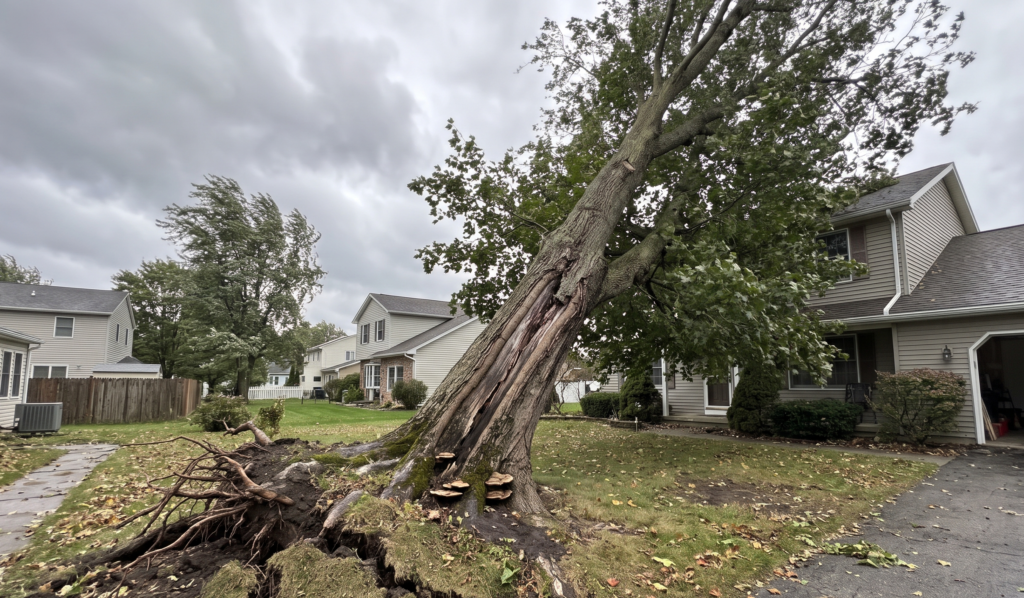
However, a sudden lean—or an existing lean that noticeably increases after a heavy rainstorm or high wind event—is one of the most urgent red flags in tree care. When a tree begins to tip unexpectedly, it almost always indicates acute root plate failure.
What to Look For Around the Base
Walk slowly around the trunk of the leaning tree and inspect the ground carefully, especially on the side opposite the direction of the lean:
- Heaving or Mounded Soil: Look for soil that appears pushed upward, cracked, or freshly mounded. As the tree tips forward, the anchoring roots on the opposite side act like a lever, prying the earth upward as they pull free from the ground.
- Exposed Fresh Roots: Seeing dark, damp, newly exposed woody roots lifting out of the turf means the tree’s underground anchor system is actively tearing apart.
- Gaps Between the Trunk and Soil: Check the base where the trunk meets the dirt (the root flare). If you see a newly formed gap or crevice on one side of the trunk, the tree is rocking in the wind.
How to Tell a Stable Natural Lean Apart from an Imminent Falling Hazard
If you are unsure whether a leaning tree in your yard is dangerous, compare its physical posture against the ground beneath it. A stable natural lean has maintained the exact same angle for years, often features an upper trunk that curves back upward toward sunlight, and sits in flat, firm, completely undisturbed soil. By contrast, an imminent falling hazard appears suddenly or worsens noticeably after a storm, shows cracked or raised soil mounds behind the direction of the lean, and reveals freshly lifted roots or open gaps around the base.
In Hilton, our proximity to Lake Ontario frequently brings saturated spring soils combined with 40 to 60 mph wind gusts. Wet, softened soil loses its friction and holding capacity, making even large, seemingly healthy trees susceptible to uprooting. If you notice soil heaving alongside a fresh lean, keep family members, pets, and vehicles away from the drop zone immediately.
Frequently Asked Questions
Q: Can a leaning tree be straightened back up using cables or stakes?
No. Once a mature tree’s root plate has lifted or torn loose from the soil, attempting to pull it upright with cables or winches will only cause further root damage and create a severe safety hazard. Unlike small newly planted saplings, mature trees with root plate failure cannot be re-anchored and must be safely dismantled.
Q: How many degrees of lean is considered dangerous for a backyard tree?
A lean greater than 15 degrees from vertical is generally classified as high-risk, especially if the tree leans toward a house, driveway, or power line. However, a brand-new 5-degree lean accompanied by cracked or heaving soil is far more dangerous than a 20-degree lean that has remained stable for decades.
2. Deep Vertical Cracks, Splits, and Missing Bark Along the Main Trunk
The trunk is the structural backbone of your tree, responsible for supporting tons of overhead canopy weight while transporting water and nutrients from the roots to the leaves. While minor, shallow flaking of outer bark is completely normal as a tree expands in diameter, deep structural wounds in the main stem are a severe threat.
When inspecting your trees along West Avenue, North Greece Road, or near Salmon Creek, pay close attention to the integrity of the main trunk from the ground up to where the primary limbs branch out.
Types of Dangerous Trunk Defects
- Deep Vertical Cracks (Frost Cracks & Shear Splits): Severe Western New York winter temperature swings—where sunny afternoons warm the bark and sub-zero nights cause rapid contraction—can trigger vertical splits. While small frost cracks sometimes seal over, deep cracks that extend into the heartwood or run all the way through the trunk severely weaken torsional strength, causing the tree to twist and snap in high winds.
- Missing Bark and Cankers: Large patches of sloughing bark exposing smooth, dead, dry wood underneath (often called a dead spot or sunken canker) indicate that the vascular tissue in that section has died. Because trees cannot heal dead wood—they can only grow new wood around it—a large area of missing bark creates a permanent structural weak point.
- Included Bark in V-Shaped Unions: Look at where large limbs meet the main trunk, or where a tree splits into two main trunks (codominant stems). Strong branch attachments form a wide “U” shape with a raised ridge of bark. Weak attachments form a tight “V” shape where bark gets pinched inside the joint. This “included bark” prevents the wood fibers from knitting together, turning the union into a natural wedge waiting to split apart under heavy snow or ice loads.
If a deep split appears in a codominant trunk or main stem, cabling and bracing can occasionally save a high-value specimen if caught early, though severe structural splits typically require safe sectional dismantling by an experienced tree crew.
Frequently Asked Questions
Q: Should I fill a vertical crack or wound in my tree trunk with cement, foam, or wound paint?
Never fill a tree cavity or crack with concrete, spray foam, or pruning tar. These materials trap moisture inside the wood, accelerating fungal rot and preventing the tree from forming natural protective callus wood around the wound edges.
Q: Are winter frost cracks always fatal to a tree?
Not always. Shallow frost cracks that only penetrate the outer bark and sapwood often close back up when spring temperatures arrive, eventually sealing over with a raised vertical ridge of wood. However, if a crack stays wide open in summer, oozes dark fluid, or appears on two opposite sides of the trunk, the tree’s structural integrity is compromised.
3. Mushrooms, Shelf Fungi, and Cavities at the Root Flare
One of the most deceptive aspects of hazardous trees is that they can look lush, green, and full of leaves right up until the day they topple. Because the living vascular tissue (xylem and phloem) sits just beneath the bark, a tree can transport water to its canopy even while its interior structural heartwood is completely hollowed out by decay.
Fungi are nature’s recyclers, and when you spot fungal fruiting bodies growing on or around your tree, they are only the tip of the iceberg. By the time mushrooms or brackets emerge on the outside, extensive internal wood rot has usually been progressing inside the trunk or roots for years.
Fungal Indicators You Should Never Ignore
- Conks and Bracket Fungi (Shelf Mushrooms): Hard, woody, shelf-like growths attached directly to the trunk or major roots—such as Ganoderma (artist’s conk) or Laetiporus (chicken of the woods)—are unmistakable signs of advanced heartwood or sapwood decay.
- Clusters of Mushrooms at the Base: Soft mushrooms (like honey fungus or Armillaria) growing directly out of the root flare or along surface roots indicate active root rot. Root rot destroys the fine feeder roots and structural anchor roots, leaving a massive tree balancing on decaying stubs.
- Hollow Cavities and Carpenter Ant Activity: Raccoon dens, large open cavities at the base, or columns of carpenter ants marching up and down the bark are strong clues that the interior wood has softened. Note that carpenter ants do not eat healthy wood; they excavate tunnels inside wood that has already been softened by moisture and fungal decay.
Reading the Four Stages of Internal Decay
When diagnosing internal rot, each external clue points to a specific structural issue beneath the bark. Bracket conks growing out of the main stem indicate advanced internal heartwood decay, while soft mushroom clusters emerging around the root flare point directly to underground root rot. If you notice peeling bark paired with fine sawdust (frass) at the base, wood-boring pests or carpenter ants are actively tunneling through softened timber, and a hollow drum-like echo when tapping the trunk with a rubber mallet confirms an advanced internal cavity.
During an on-site evaluation, our ISA-certified arborists use sounding mallets and specialized resistance tools to determine how much sound outer “shell” wood remains compared to the internal decay column. When decay compromises more than a third of the trunk’s structural wall, the risk of sudden catastrophic failure increases dramatically.
Frequently Asked Questions
Q: If I scrape the mushrooms off the bark or spray fungicide, will it stop the rot?
No. The mushroom or bracket you see on the surface is simply the reproductive fruit of a vast fungal network (mycelium) already established deep inside the wood. Scraping off the conks will not halt internal decay; only an arborist can evaluate whether enough sound structural wood remains to keep the tree safe.
Q: Can a tree still stand safely if the center of its trunk is hollow?
Yes, up to a point. A hollow cylinder retains significant strength as long as its outer walls are thick and intact. Arborists use an industry-standard threshold: if the sound outer wood wall measures at least 30% to 35% of the trunk’s total radius all the way around, the tree may remain stable—provided there are no open cracks or severe canopy leans adding extra stress.
4. Extensive Deadwood, Dying Canopy Tips, and Early Leaf Drop
A tree’s canopy is the most visible report card of its underground health. Because the tips of the highest branches are the farthest points from the root system, they are the very first areas to suffer when roots are damaged, compacted, girdled, or diseased.
When a tree begins to die from the top down—a condition arborists call “crown dieback“—it is signaling systemic stress that often goes hand-in-hand with structural decline.
Warning Signs High in the Canopy
- Widowmakers (Large Dead Branches): Dead limbs measuring two inches or more in diameter that lack bark or buds are brittle and unpredictable. Unlike live wood, which bends and flexes in the wind, dead wood dries out and snaps cleanly without warning, even on calm, sunny afternoons.
- One-Sided Canopy Dieback: If the entire left half of a maple or ash tree is bare while the right half is full of leaves, look directly below the bare side. Almost without exception, severe root damage—such as trenching for a utility line, driveway construction, or localized root rot—has killed the roots feeding that side of the tree.
- Premature Autumn Color or Leaf Drop: In Hilton, healthy deciduous trees typically hold their green foliage well into late September or October. If a tree turns yellow, scorches brown, or drops its leaves in July or August, its vascular system is failing to supply adequate water.
- Epicormic Shoots (Water Sprouts): Seeing clusters of frantic, thin, leafy sprouts growing directly out of the main trunk or lower limbs is a classic stress response. The tree is burning its last stored energy reserves to produce emergency foliage because its upper canopy is failing.
If you have mature ash trees on your property that were never treated for the Emerald Ash Borer (EAB), this sign is especially critical. EAB-killed ash trees become extraordinarily brittle within two to three years of infestation, making them too dangerous even for arborists to climb and requiring specialized crane or bucket-truck operations for safe removal.
Frequently Asked Questions
Q: If a tree only has a few dead branches at the top, does the whole tree need to come down?
Not necessarily. If less than 25% of the canopy is dead and the trunk and root system are structurally sound, selective deadwood pruning can remove the falling hazards and improve air circulation. However, if more than 50% of the crown is dead or dying, the tree is beyond recovery, and full removal is recommended.
Q: Why are dead ash trees in Hilton considered especially dangerous to leave standing?
Once the Emerald Ash Borer kills an ash tree, the wood loses moisture rapidly and develops internal fractures known as “ash brittleness.” Dead ash trees frequently snap at the base or drop massive limbs unpredictably even in light breezes, and they become unsafe for climbers to rig manually.
5. Damage from Recent Construction, Soil Compaction, or Grade Changes
Sometimes a tree’s impending failure has nothing to do with disease or old age and everything to do with recent changes made to the yard around it. A tree’s root system does not grow straight down like a carrot; instead, 80% to 90% of a tree’s roots live within the top 12 to 18 inches of soil, spreading outward two to three times wider than the edge of the branches (the dripline).
Because these structural roots sit so close to the surface, everyday residential projects in Hilton can inadvertently sever or suffocate a tree’s life support system.
Common Yard Changes That Destabilize Trees
- Trenching Near the Trunk: Digging trenches for invisible dog fences, sprinkler systems, drainage pipes, or electrical lines within 10 to 15 feet of a mature trunk slices straight through critical anchor roots. A tree might remain standing for a year or two afterward, only to blow over in a moderate storm because its support cables on one side were severed.
- Adding Fill Dirt or Raised Beds: Piling six inches of topsoil or heavy mulch directly against the trunk buries the root flare, suffocating the roots by cutting off oxygen exchange and trapping moisture against bark meant to stay dry.
- Heavy Equipment and Parking Over Roots: Driving heavy construction machinery, delivery trucks, or regularly parking vehicles under a tree’s canopy compacts the soil, crushing microscopic air pockets that roots need to survive.
- Standing Water and Drainage Shifts: Regrading a neighbor’s lot or altering backyard drainage so that water pools around a tree’s base causes anaerobic soil conditions, quickly killing structural roots.
If you recently completed landscaping, patio installation, or utility work near a large tree and notice it beginning to thin or lean, having an arborist evaluate root stability promptly can prevent an unexpected collapse.
Frequently Asked Questions
Q: How long after root damage or trenching does a tree typically show signs of failure?
Trees store significant energy reserves in their woody tissues, so construction damage often exhibits a “delayed reaction.” A tree whose roots were severed during a summer patio or utility project may look normal for 1 to 3 years before suddenly developing crown dieback or toppling during a high-wind storm.
Q: Can compacted soil around a mature tree be fixed before the tree dies?
Yes, if caught early. Certified arborists use a pneumatic tool called an AirSpade to safely loosen compacted soil around the root zone without damaging delicate feeder roots, followed by vertical mulching and organic compost top-dressing to restore oxygen and water infiltration.
Comparison Summary: Assessing Tree Risk on Your Property
Use the quick reference table below to evaluate what you are seeing in your yard and determine how quickly you should call a professional.
| Warning Sign | Primary Cause | Risk Level | Recommended Immediate Action |
| Sudden Lean + Soil Heaving | Acute root plate failure in wet or windy conditions | Extreme / Immediate | Evacuate the fall zone; call for 24/7 emergency assessment immediately. |
| Deep Vertical Trunk Split | Frost cracking, storm twisting, or weak V-shaped union | High / Urgent | Keep people and cars clear; schedule an urgent structural inspection. |
| Mushrooms / Conks at Base | Internal heartwood decay or advanced root rot | High | Do not ignore green leaves; have an arborist test wood soundness. |
| Large Dead Limbs in Canopy | Crown dieback, Emerald Ash Borer, or drought stress | Moderate to High | Avoid walking or parking beneath the canopy; schedule pruning or removal. |
| Recent Trenching / Soil Fill | Severed anchor roots or root suffocation | Moderate (Escalating) | Monitor closely during windstorms; request a root-zone health evaluation. |
Frequently Asked Questions
Q: Will my homeowners insurance cover the cost of removing a hazardous tree before it falls?
In most cases, standard homeowners insurance policies do not pay for preventive removal of a standing tree, even if it is dead or leaning. However, paying out-of-pocket for proactive removal is typically a fraction of the cost of paying your deductible and dealing with structural roof, siding, or vehicle damage after a collapse.
Q: What happens if my neighbor’s visibly dead tree falls onto my Hilton property?
Under New York property law, if a healthy tree falls due to an “Act of God” storm, each property owner’s insurance covers damage to their own structures. However, if a neighbor’s tree was visibly dead, decaying, or hazardous and you notified them in writing beforehand, they can be held legally liable for negligence and resulting property damages.
Why Proactive Action Beats Emergency Tree Cleanup
Many homeowners hesitate to call a tree service because they worry about the disruption or cost, hoping a questionable tree will survive “just one more winter.” Unfortunately, waiting until a tree fails almost always multiplies both the danger and the expense.
- Zero Control Over Where It Lands: A failing tree does not care whether it falls into an open lawn, onto your master bedroom roof, across overhead power lines, or onto a neighbor’s garage.
- Higher Emergency Extraction Costs: Removing a standing hazardous tree in controlled sections using ropes, rigging, and aerial lifts is far more predictable than lifting a tangled, multi-ton oak off a crushed roof structure in the middle of a storm.
- Homeowners Insurance Complications: While most standard homeowners policies cover sudden, accidental storm damage from healthy trees, insurance adjusters routinely deny or dispute claims if evidence shows the tree was visibly dead, rotting, or neglected prior to falling. Documenting proactive tree maintenance protects both your home and your coverage.
Looking for Fast, Trusted Tree Removal Near You in Hilton & Surrounding Areas?
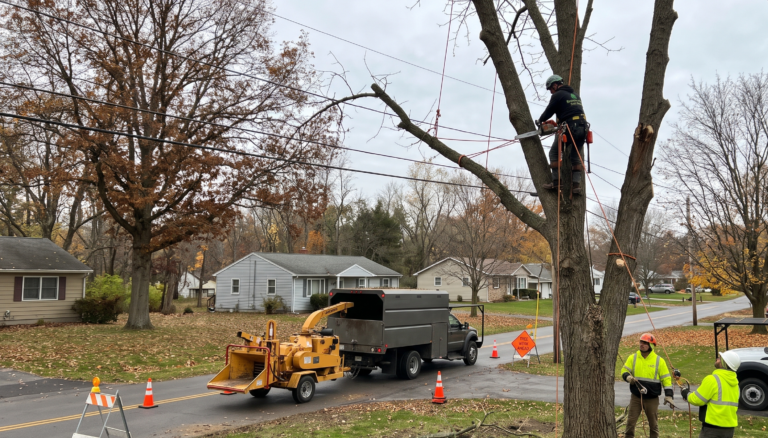
When a storm damages a backyard maple or you spot a splitting trunk close to your home, you don’t want an out-of-town contractor driving an hour across the county—you need a local crew already stationed right in your neighborhood. Because Branching Out Tree Service operates directly out of 259 Walker Rd in Hilton (14468), our bucket trucks, cranes, and ISA-certified arborists are only minutes away from properties across northwestern Monroe County.
Whether you live right in the Village of Hilton, near Hilton Central High School, along Route 259 (Lake Avenue), or closer to the Lake Ontario shoreline, our local dispatch allows for rapid on-site inspections and 24/7 emergency storm response. We also provide fast local coverage for homeowners searching nearby in:
- Town of Parma & North Greece (14612 / 14626): Quick access via North Avenue, Parma Center Road, and Manitou Road.
- Hamlin & Kendall (14464 / 14476): Serving rural acreage, wooded lots, and lakefront properties along Route 18 and Route 19.
- Spencerport & Ogden (14559): Fast response along Route 259 South and Ridge Road for residential pruning and hazardous tree removal.
- Clarkson & Brockport (14430 / 14420): Comprehensive structural tree evaluations and safe sectional dismantling for mature neighborhood trees.
Frequently Asked Questions
Q: How quickly can your crew reach my property in Hilton or Parma for a dangerous tree?
Because our equipment yard is located right on Walker Road in Hilton, we typically reach properties within Hilton, Parma, and North Greece in 15 to 30 minutes for urgent storm emergencies, and we offer same-day or next-day appointments for standard safety assessments.
Q: Do you charge extra travel fees for nearby towns like Hamlin, Spencerport, or Greece?
No. All communities within our immediate northwestern Monroe County service radius—including Hilton, Parma, Hamlin, Spencerport, and Greece—receive standard local pricing with zero distance surcharges and free written estimates.
Schedule a Free On-Site Tree Safety Assessment in Hilton, NY
If you recognized one or more of these five warning signs while walking your yard, don’t leave your home’s safety to chance. At Branching Out Tree Service, we believe cutting wood is only one part of responsible tree care—preventing emergencies before they happen is our top priority.
When you reach out to our local team at 259 Walker Rd, Hilton, NY 14468, an ISA-certified arborist will walk your property with you, inspect the trunk, canopy, and root zone, and give you an honest, transparent assessment. If a tree can be safely preserved through corrective pruning or deadwood removal, we will tell you. If tree removal in Hilton, NY, is the safest option for your family and property, we will explain exactly why and provide a clear, written estimate with zero surprise fees.
Frequently Asked Questions
Q: Do I need a permit from the Village or Town of Hilton to remove a hazardous tree on my property?
For most single-family residential properties in Hilton and the Town of Parma, you do not need a municipal permit to remove a dead or hazardous tree located strictly within your private property lines. However, trees situated in the road right-of-way (between the sidewalk and street) belong to the municipality, and properties near protected wetlands or Lake Ontario coastal erosion zones may have local restrictions—our team helps verify property boundaries before any work begins.
Q: How long does it take to remove a large hazardous tree from a residential yard?
Most single-tree removals in Hilton take between 3 and 6 hours from arrival to final cleanup, depending on the tree’s size, proximity to structures or power lines, and whether crane assistance is required. Our crew uses protective ground mats to prevent turf ruts and leaves your yard clean and free of debris.