After taking down a hazardous tree or clearing space in your yard, you are inevitably left with one stubborn, unsightly reminder: the remaining tree base. Homeowners across Upstate New York frequently ask us whether they should opt for stump grinding or complete stump removal. Deciding between these two methods comes down to understanding how each process works, what happens beneath the soil line, your budget, and what you ultimately plan to do with your outdoor living space. While both techniques resolve the hazard of an exposed stump, their long-term impact on your soil, landscape aesthetics, and wallet look vastly different. At Branching Out Tree Service, our local arborists help property owners weigh these practical trade-offs every day across Hilton and Monroe County.
What Happens When a Tree Comes Down?
Felling a tree is only the first stage of property transformation. The moment the canopy, trunk, and lower limbs are safely hauled away, property owners face an immediate choice. An untreated stump does not simply stay frozen in time; it triggers biological shifts across your entire yard.
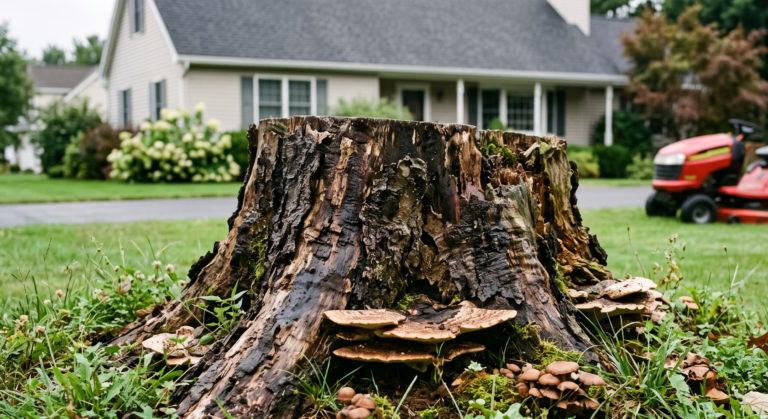
Some species—such as willows, boxelders, and certain maples—sprout vigorous suckers (adventitious shoots) within weeks of cutting. These small, bushy stems divert energy from the still-living root system, creating an ongoing pruning chore. Meanwhile, stumps that die naturally become breeding grounds for wood-boring insects, carpenter ants, and fungi like honey fungus (Armillaria), which can spread through root grafts to infect neighboring healthy trees.
Understanding the difference between mechanical grinding and physical extraction lets you resolve these risks without overspending or unnecessarily tearing up your lawn.
Frequently Asked Questions
Q: Can I just leave a tree stump in my yard to rot away naturally?
A: While a tree stump will eventually decompose on its own, the process takes anywhere from 10 to 20 years for dense hardwoods like oak and maple. Throughout that time, the stump remains an active trip hazard, damages lawnmower blades, and serves as an open invitation for carpenter ants, wood-boring beetles, and termites near your foundation.
Q: Why do green shoots keep sprouting out of my freshly cut stump?
A: When a living tree is cut down, its underground root network remains alive and loaded with stored carbohydrates. Without a canopy to feed, the tree pushes out rapid shoots (called suckers or water sprouts) around the root flare in a biological survival attempt to regenerate foliage and resume photosynthesis.
1. What Is Stump Grinding?
Stump grinding is the most widely selected method for handling tree remnants in suburban yards, commercial properties, and manicured landscapes.
The Mechanical Process
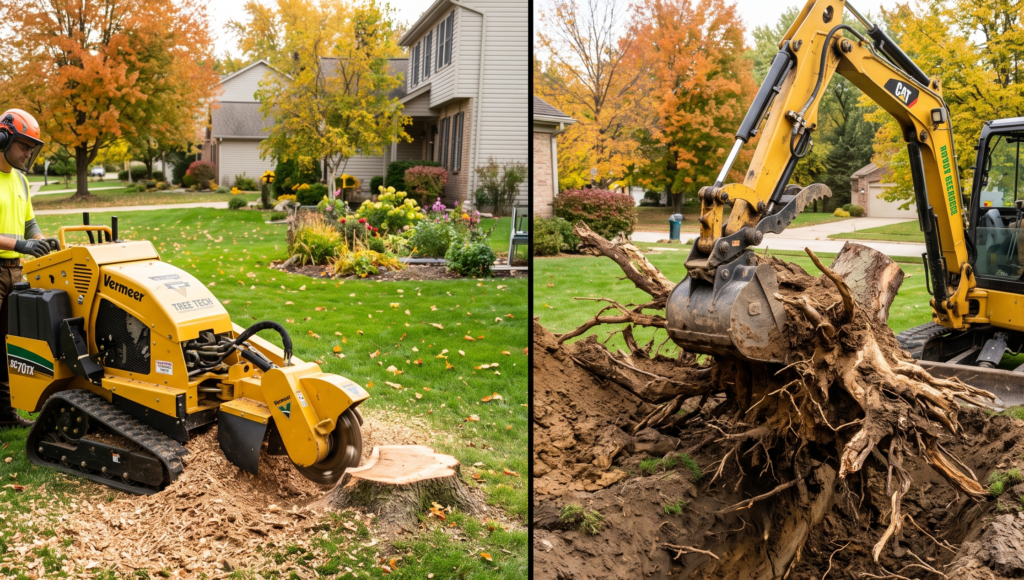
A professional stump grinder is a specialized machine equipped with a heavy steel cutting wheel. This wheel is lined with rugged, carbide-tipped teeth that spin at high RPMs.
An operator sweeps the cutting wheel back and forth across the stump, shaving the wood down layer by layer. The machine chips away at the trunk until it sits well below grade—usually between 4 and 12 inches below the surface, depending on your plans for the area.
What Happens to the Roots?
With grinding, the primary underground root plate and secondary lateral roots remain in the soil. Because the trunk has been eliminated well below the crown, the root system is starved of sunlight and photosynthesis. Over the next five to ten years, subterranean microorganisms, beneficial beetles, and fungi break down these buried roots, transforming them into rich organic matter. For complete details on our machinery and turnaround times, explore our specialized stump grinding services in Hilton, NY.
Frequently Asked Questions
Q: Will the root system keep growing or sprouting after the stump is ground?
A: No. Grinding the trunk and crown 4 to 12 inches below ground level removes the tree’s growth meristems. Without foliage to absorb sunlight and conduct photosynthesis, the subterranean root network starves, halts outward growth, and steadily decomposes.
Q: How much property damage does a stump grinder typically cause?
A: Professional-grade stump grinders operate on low-impact rubber tracks or turf-friendly pneumatic tires designed to distribute machine weight and protect healthy turfgrass. Ground disturbance is isolated almost entirely to the immediate cutting radius of the stump.
2. What Is Total Stump Removal?
Total stump removal is an intensive, excavation-based procedure designed to extract not just the visible wooden base but the entire root ball and primary radial root flares.
The Excavation Process
Complete extraction cannot be done with cutting wheels alone; it requires heavy earthmoving machinery such as an excavator or backhoe.
The crew digs a wide trench surrounding the root flare to expose the lateral anchoring roots. Using mechanical root shears, heavy axes, or hydraulic saws, the technicians sever these root anchors one by one. Once the root ball is freed from its lateral moorings, the machine bucket applies hydraulic leverage to pry the central root mass and taproot out of the earth.
What Happens to the Site?
Pulling a full root ball leaves an expansive crater that is often four to eight times larger than the diameter of the original trunk. The surrounding turf is disturbed by equipment tracks, displaced subsoil, and severed perimeter roots. The extracted root structure must then be hauled off-site with heavy transport trailers. Learn how we handle complex extractions on our tree removal services
Frequently Asked Questions
Q: Why does total stump removal require such large excavation equipment?
A: Mature trees develop extensive anchoring root flares and deep vertical taproots engineered to withstand gale-force winds. Overcoming that subterranean tensile resistance requires tons of breakout force from excavators or backhoes, alongside heavy cutting tools to sever roots.
Q: What is done with the giant root ball after it is extracted?
A: Because extracted root balls are tangled with dense clay, stones, and dirt, standard municipal recycling depots do not accept them as clean brush. Tree contractors must haul the root mass on heavy-duty trailers to commercial wood-waste and aggregate recycling facilities.
Comprehensive Head-to-Head Comparison
| Comparison Factor | Stump Grinding | Total Stump Removal |
| Typical Cost | Moderate ($150–$500+ depending on diameter) | High ($450 – $1,500+, requiring heavy machinery) |
| Time Required | 30 minutes to 2 hours for most residential trees | Half a day to a full day of extensive excavation |
| Lawn Disturbance | Low; confined strictly to the cutting radius | High; creates large craters, ruts, and trench lines |
| Underground Utilities | Lower risk; work stays near the surface | High risk; requires deep trenching and utility flags |
| Replanting Options | Ideal for turf grass, sod, perennials, or garden beds | Necessary if you plan to plant a large canopy tree in the exact spot |
| Foundational Work | Not suitable for immediate building footers | Required for house additions, concrete pads, or pools |
| Debris Generated | Fresh wood mulch that can be used on-site | Massive root ball requiring commercial hauling fees |
Frequently Asked Questions
Q: Why is total stump removal so much more expensive than grinding?
A: Full removal demands heavy earthmoving equipment, multiple operators, extensive trenching, importing clean topsoil to backfill the large crater, and paying commercial disposal fees for hauling a multi-ton root ball.
Q: Which option takes less time to complete in a standard backyard?
A: Stump grinding is significantly faster. A trained arborist can grind a standard 24-inch residential stump down in under an hour, whereas mechanical extraction, root cutting, backfilling, and site clearing typically require half a day or more.
Key Decision Factors: Which Should You Choose?
Deciding between grinding and full extraction requires evaluating several environmental, financial, and structural considerations.
1. Future Land Use
The clearest deciding factor is what you plan to build or plant directly on that footprint:
- You Want Grass, Sod, or Flower Beds: Choose Stump Grinding. Grinding the wood down 6 to 8 inches provides ample depth to backfill with topsoil, spread grass seed, or lay fresh sod. Turfgrass root networks rarely penetrate deeper than 4 to 6 inches, meaning the decomposing wood beneath will not restrict growth.
- You Are Pouring Concrete, Installing a Driveway, or Digging a Pool: Choose Total Removal. You cannot pour a permanent structural foundation over buried wood. As old roots decay, the soil shifts, collapses, and settles unevenly. This leads to cracked concrete footers, compromised retaining walls, and sinking patios.
- You Want to Plant a New Tree in the Exact Same Spot: If you intend to drop a substantial shade tree right where the old one stood, the remaining root core will block the new root ball. In this case, complete extraction is best. Alternatively, you can grind the stump and simply offset your new planting by 5 to 10 feet.
2. Budget and Property Impact
Stump grinding is faster, uses lighter machinery, and avoids disposal fees. Total stump removal involves heavy equipment, operators, transportation logistics, dump fees, and multiple cubic yards of fill dirt to level the site. If preserving your lawn’s aesthetic and keeping project costs reasonable are top priorities, grinding is almost always the preferred path.
3. Underground Utilities and Infrastructure
Water mains, natural gas lines, irrigation tubes, and buried electrical cables frequently run through suburban front lawns.
- Stump grinding can be calibrated with high precision, keeping the cutting wheel safely clear of mapped underground services.
- Total removal tears through wide swathes of soil, carrying a much higher risk of snagging hidden lines or damaging nearby sidewalks and retaining walls. In all cases, professional tree services call Dig Safely New York (UDig NY / 811) before breaking ground.
4. Pest Control and Disease Mitigation
A decaying stump above ground attracts carpenter ants, termites, wood wasps, and rodents. Stump grinding eliminates this habitat.
If the tree died from a systemic, root-borne fungal pathogen such as Verticillium wilt or Armillaria (honey fungus), the pathogen can linger within remaining root segments. Homeowners seeking to protect adjacent, susceptible trees may choose full root extraction to clear the subterranean zone.
Frequently Asked Questions
Q: Can I pave an asphalt or concrete driveway over a ground stump?
A: No. As the buried roots decompose, voids form beneath the subbase. The weight of vehicles will cause the pavement to sag, crack, and fail over time. Paved driveways, patios, and structural additions require full stump extraction and compacted gravel fill.
Q: Can I plant a new tree directly over a ground stump?
A: Not in the exact center. While turfgrass thrives over a ground stump, a new tree requires unobstructed root depth and nutrient-rich soil rather than dense wood shavings. If you choose grinding, offset your new tree by 5 to 10 feet to give its roots room to grow.
What Happens to the Leftover Mulch After Grinding?
When our crew finishes grinding a stump, you are not left with an empty hole—you have a clean pile of blended wood shavings and topsoil.
Fresh wood shavings pull nitrogen from the surrounding surface soil as they begin decomposing. For this reason, we advise letting freshly ground mulch age for a few months before placing it around tender annual flowers or vegetable gardens. It works well right away as a natural weed barrier along fence lines, around mature trees, or throughout walking paths.
Frequently Asked Questions
Q: Will fresh stump grindings pull nitrogen away from my garden plants?
A: Yes, raw wood shavings draw surface nitrogen as soil microbes start breaking down the high-carbon wood. If you spread fresh mulch directly into garden beds, balance the soil with a slow-release nitrogen fertilizer or let the chips age in a compost pile for 60 to 90 days first.
Q: Can the grindings just be left in the hole to fill it up?
A: Avoid packing the hole solely with wood shavings. As the concentrated wood decomposes, it shrinks substantially, causing the ground to sink within a year. Remove the bulk of the grindings, leave a small amount mixed with soil, and top the hole with clean screened topsoil.
Local Considerations for Hilton and Upstate New York Homeowners
Tree care in Hilton, Parma, Greece, Hamlin, and across Monroe County comes with unique geographic and environmental conditions that directly influence root removal:
Lake Ontario Weather and Saturated Soils
Our proximity to Lake Ontario brings lake-effect snow, slow spring thaws, and high soil moisture. The high water table and dense clay-loam soils along the southern lakeshore mean that large root balls stay damp, heavy, and tightly bound. Digging out a complete root plate during wet spring conditions can churn your yard into deep mud. Stump grinding minimizes heavy equipment traffic across saturated turf.
Native Hardwood Root Profiles
The trees dominating Upstate backyards have vastly different underground architectures:
- Oaks and Hickories: Develop deep, stubborn taproots that plunge straight downward, making total physical excavation labor-intensive and costly.
- Norway Maples and Silver Maples: Spread wide, shallow lateral roots that snake right along the surface. For these species, a wider-diameter stump grind that addresses surface flares is critical to prevent mower blade damage.
- Green and White Ash: Many area ash trees succumbed to the Emerald Ash Borer over the last decade. Dead ash wood becomes brittle quickly, making both tree removal and subsequent stump grinding necessary before rot spreads to surrounding grounds.
Seasonal Timing: When Should You Schedule?
Stump grinding in Western New York runs from early spring through late autumn, right until the ground freezes solid. Late summer and autumn are often ideal, as drier ground provides solid traction for machinery while minimizing soil compaction across your lawn.
Frequently Asked Questions
Q: Can stump grinding be performed in winter in Monroe County?
A: Grinding can continue through November and December as long as the frost line has not deeply frozen the ground. Once the top 6 to 8 inches of Monroe County clay freezes solid, cutting-tooth wear increases dramatically, making work less efficient until the early spring thaw.
Q: How does our heavy lake-effect moisture affect underground root decay?
A: Dense, poorly draining clay soils along the Lake Ontario plain retain moisture around remaining root channels. While this supports natural fungal breakdown, it also keeps subsurface wood damp. Proper site leveling and aerated topsoil are essential to prevent low, soggy spots on your lawn.
Step-by-Step: How to Restore Your Lawn After Grinding
Once the grinding equipment has left your property, follow this straightforward protocol to return your lawn to smooth, seamless turf:
- Clear Out the Excess Grindings: Shovel out the bulk of the wood chips until the depression sits roughly 4 to 5 inches below your surrounding lawn level. Keep the extra mulch for landscape beds.
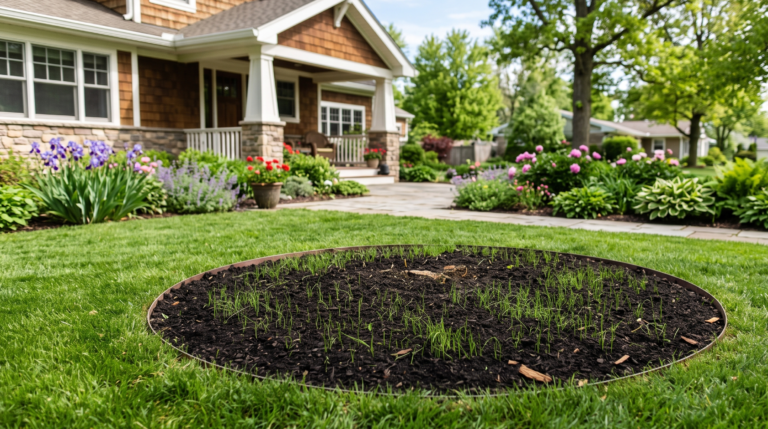
- Backfill with Clean Topsoil: Fill the void with a quality screened topsoil or a 50/50 loam and compost blend. Tamp the soil down lightly with the back of a rake or your boots to prevent excessive settling later. Crown the soil about one inch above the lawn line to account for natural settling over the first couple of rainfalls.
- Spread Regional Grass Seed: For Upstate New York lawns, select a hardy cool-season blend containing Kentucky Bluegrass, Perennial Ryegrass, and Fine Fescue. Rake the seeds gently into the top quarter-inch of soil.
- Mulch Lightly and Water: Lay down a thin layer of clean straw to retain moisture and protect the seeds from birds. Water lightly once or twice daily, keeping the bed moist until the seedlings reach approximately three inches in height.
Frequently Asked Questions
Q: Why does the seeded area often sink a few months after grinding?
A: As buried wood fragments decay and backfill soil settles with rainfall, the ground settles naturally. Mounding your topsoil 1 to 2 inches higher than the surrounding lawn line during planting accounts for this settling and keeps your yard level.
Q: What type of grass seed performs best over ground stump areas in Upstate NY?
A: A cool-season mixture of Kentucky Bluegrass, Perennial Ryegrass, and Turf-Type Tall Fescue works best in our climate. The ryegrass germinates quickly to stabilize the soil, while the fescue and bluegrass establish a durable, uniform lawn over the backfilled area.
Finding Reliable Stump Grinding & Tree Services Near You
When looking for certified tree care and stump grinding specialists nearby, homeowners throughout the northwestern Monroe County lakeshore corridor require a contractor equipped for regional soil conditions, varied lot sizes, and seasonal moisture levels. Tree root systems along the Ontario plain behave differently than those further inland, making local proximity and familiarity essential for long-term yard restoration.
Our crews operate daily throughout Hilton, NY (Village & Town of Parma), and quickly deploy across adjacent communities, including:
- Hamlin & Clarkson: Addressing storm-damaged tree remnants, large windbreak pines, and deep hardwood taproots across rural residential acreages along Route 19 and Lake Road.
- Greece & North Gates: Tight-access suburban backyard stump grinding along residential subdivisions off Latta Road, Dewey Avenue, Long Pond Road, and North Greece Road.
- Spencerport & Brockport: Resolving aggressive surface roots, weeping willows, and mature silver maples lining the Erie Canal corridor and Route 31.
If you are located within our service radius, our dispatch team provides free on-site safety assessments, underground utility coordination through UDig NY (811), and comprehensive yard backfilling and turf renovation.
Frequently Asked Questions
Q: How quickly can a local stump grinding crew arrive at my property?
A: Because Branching Out Tree Service is based locally in Hilton, routine estimates and standard grinding jobs within the Hilton, Greece, and Parma areas are typically scheduled and completed within a few business days of utility mark-outs. Emergency fallen tree removal and storm hazards receive priority dispatch.
Q: Why should I hire a local Monroe County tree service instead of an out-of-area contractor?
A: Regional tree services understand Monroe County’s dense glaciated clay soils, local municipal brush codes, and the frost line challenges specific to Western New York. Out-of-area companies often lack quick access to specialized track-mounted equipment needed to navigate wet lakeside turf without causing ruts.
Expert Care for Your Property’s Landscape
Whether you are clearing out a hazardous tree, cleaning up storm damage, or reclaiming usable lawn space for your family, resolving the leftover stump is the final step toward a safe, attractive yard.
For the vast majority of residential homeowners in our region, stump grinding delivers the ideal balance of efficiency, budget-friendly pricing, and minimal yard disruption. When construction, building footers, or immediate canopy replanting are on the horizon, total excavation remains the necessary engineering solution.
Frequently Asked Questions
Q: How do I get an estimate for stump grinding or removal?
A: You can request an on-site consultation or submit your stump diameter measurements along with photos through our website. A tree specialist will evaluate access paths, tree species, buried utility clearances, and site goals to provide an upfront quote.
Q: Does your team coordinate underground utility marking before work begins?
A: Yes. Professional tree care standards prioritize safety above all else. For any deep grinding or excavation work, Dig Safely New York (UDig NY / 811) is alerted in advance to mark municipal power, communication, water, and gas services before machines break ground.