When homeowners, builders, or property managers evaluate landscaping changes or storm mitigation in Monroe County, securing professional tree removal in Hilton, NY, often begins with understanding the legal and environmental frameworks governing your land. A common assumption is that owning private property gives an individual unrestricted authority to felled any standing timber within their property boundaries. However, local ordinances across the Village of Hilton, the Town of Parma, surrounding municipal jurisdictions, and New York State conservation authorities establish clear boundaries between individual land ownership and community environmental preservation. Removing a tree without proper municipal clearance can trigger costly stop-work orders, steep municipal fines, and disputes regarding property boundaries or utility easements.
Navigating municipal tree ordinances requires understanding boundary rights, zoning setbacks, utility rights-of-way, and shoreline or wetland conservation overlays. Whether addressing a hazard tree leaning precariously over your roofline after a severe Lake Ontario windstorm, thinning dense woodland for construction, or managing property aesthetics, this guide outlines the regulatory requirements, municipal permitting processes, and arboricultural criteria governing tree removal across Hilton and neighboring upstate New York communities.
1. Local Municipal Framework: Village of Hilton vs. Town of Parma
In Monroe County, tree regulation is largely determined by whether your parcel lies inside an incorporated village or within the unincorporated town jurisdiction. Hilton is an incorporated village nestled entirely within the Town of Parma. Consequently, municipal rules and code enforcement procedures differ based on your precise street address and parcel tax map ID.
The Village of Hilton Jurisdiction
Within the Village of Hilton limits—administered through the Village Building and Code Enforcement Department located at 59 Henry Street—emphasis is placed on neighborhood aesthetics, pedestrian safety, and public infrastructure protection.
- Public Right-of-Way (Street Trees): Trees situated in the municipal right-of-way—typically the grassy verge or tree lawn between the paved road curb and the private sidewalk—are managed directly by the Village Department of Public Works (DPW). Property owners are legally prohibited from felling, topping, or altering these trees without formal authorization or DPW coordination.
- Private Property Removals: For trees fully positioned on private residential property outside designated conservation easements, permits are generally not required for standard maintenance felling, provided the tree does not pose an off-site hazard or violate site-plan approvals. However, commercial properties, multifamily developments, and properties undergoing active subdivision reviews must adhere to Village Planning Board landscape preservation conditions.
The Town of Parma Jurisdiction
For parcels located outside village boundaries in the Town of Parma, zoning regulations governed by the Town Building and Code Department take precedence.
- Rural and Agricultural Zones: Rural residential (RR) and agricultural (AG) zoning districts offer broad discretion for domestic land clearing, woodlot harvesting, and hazard tree abatement.
- Subdivision and Preservation Deed Restrictions: Many planned residential developments in Parma feature deed-restricted “no-cut” greenways or conservation buffers designed to prevent stormwater runoff, preserve neighborhood windbreaks, or shield natural drainage swales. Clearing trees within these designated conservation buffers without Town Planning Board relief is a direct zoning violation.
Frequently Asked Questions
Do I need a permit to cut down a dead tree in my backyard in the Village of Hilton?
If the tree is completely situated on private residential property and outside any designated stormwater or conservation easement, a municipal permit is generally not required for single-tree removal. However, you must verify that no deed restrictions or site-plan buffer requirements apply to your lot.
Who owns the tree located between the sidewalk and the street curb in front of my home?
That area is typically classified as the public right-of-way or municipal tree lawn, making the tree public property managed by the Village of Hilton Department of Public Works. Homeowners may not remove, prune, or felled street trees without DPW authorization.
How do I find out if my property in the Town of Parma has a conservation easement?
You can check your original deed, the subdivision map filed with the Monroe County Clerk’s Office, or consult the Town of Parma Building and Code Department with your tax parcel identification number.
2. When Do You Need a Permit? Key Regulatory Triggers
Understanding when a municipal permit, site assessment, or state-level clearance is necessary requires evaluating specific property triggers. Rather than relying on assumptions, property owners should review four primary conditions:
Evaluating Location on the Parcel
The physical location of the tree dictates the governing authority. A tree in the public right-of-way or village tree lawn requires Village DPW authorization before any cutting occurs. If the tree sits within a dedicated conservation or drainage easement, a town or village planning board review is mandatory. For trees situated entirely within an interior private lot, the owner must verify zoning setbacks and clear boundary lines.
Proximity to Protected Waters and Wetlands
Western Monroe County encompasses environmental wetland corridors tied to Salmon Creek, Braddock Bay, and the Lake Ontario basin. The New York State Department of Environmental Conservation (DEC) regulates freshwater wetlands and their designated 100-foot adjacent buffer areas under Article 24 of the Environmental Conservation Law. Cutting trees, removing root networks, clearing understory brush, or grinding stumps within an Article 24 zone without a state-issued Freshwater Wetlands Permit carries substantial environmental fines.
Scope of Work and Ground Disturbance
Removing an individual diseased or hazardous tree generally requires only an ISA Certified Arborist assessment to document the hazard. However, large-scale clearing projects that disturb more than one contiguous acre of soil require a State Pollutant Discharge Elimination System (SPDES) General Permit and a formal Stormwater Pollution Prevention Plan (SWPPP) to prevent sediment runoff into local drainage basins and municipal streams.
Utility Corridors and Rights-of-Way
Any tree positioned within reach of overhead high-voltage power lines requires coordination with regional utility providers like Rochester Gas and Electric (RG&E) or National Grid. Tree work near energized distribution equipment must never proceed without utility clearance.
Frequently Asked Questions
What happens if I remove trees within a New York State-regulated wetland buffer?
Removing trees, clearing soil, or operating heavy machinery within an Article 24 freshwater wetland or its 100-foot adjacent area without a DEC permit can trigger civil enforcement, significant monetary penalties, and mandatory site restoration orders from the NYS DEC.
Does clearing brush and saplings for a driveway require a Stormwater Pollution Prevention Plan (SWPPP)?
A SWPPP is generally required when planned clearing, grading, or excavation disturbs one acre or more of soil. Smaller residential driveways disturbing less than an acre typically only require standard local building department and highway curb-cut permits.
Can the Town of Parma stop me from clearing trees on my own vacant building lot?
Yes. If the parcel is undergoing site plan approval, or if the trees are part of an approved preliminary subdivision plat or designated environmental protection overlay, clearing trees before obtaining site plan approval or a building permit is a violation of local zoning ordinances.
3. Boundary Line Arboriculture: The Legal Framework in New York
One of the most frequent legal disputes surrounding tree care in Upstate New York centers on boundary-line ownership and cross-property encroaching vegetation.
The Trunk Rule: Defining Ownership
Under long-standing New York Common Law, ownership of a tree is determined exclusively by the location of its trunk where it emerges from the ground, regardless of where its canopy spreads or its roots travel.
- Single-Owner Trees: If the entire base of the trunk sits within your deeded survey pins, you own the tree. Your neighbor cannot cut it down, poison it, or intentionally compromise its structural integrity.
- Boundary (Border) Trees: If the trunk straddles the boundary line between two properties—even by a matter of inches—it is legally classified as a “boundary tree” or “tenancy in common.” Neither property owner may prune it into instability or fell it without the express, mutual, written consent of the adjoining landowner.
The Right to Self-Help vs. Property Damage
Under New York law, a property owner possesses an inherent right to “self-help.” This allows you to trim overhanging branches or encroaching roots from a neighbor’s tree back to your exact property line, subject to two strict legal limitations:
- No Trespassing: You may not enter your neighbor’s property to perform the work without explicit permission.
- Preservation of Tree Health and Stability: You cannot trim branches, sever structural root systems, or use techniques that compromise the tree’s health, destabilize its root anchorage, or cause it to die or fail.
Important Legal Reference (NYS RPAPL § 861): Under Section 861 of the New York Real Property Actions and Proceedings Law, removing, girdling, despoiling, or cutting down timber or trees on another person’s land without permission carries severe civil liability. Courts may award treble damages (three times the actual stumpage value or replacement cost of the timber) plus mandatory statutory costs and legal fees against anyone who wrongfully fells a neighbor’s tree.
Frequently Asked Questions
Can my neighbor cut down branches that hang over into their yard from my tree?
Yes. Under New York’s self-help doctrine, your neighbor has the legal right to trim overhanging branches or invading roots back to the boundary line, provided they stay on their side of the property and do not cause irreparable damage or instability to the tree.
What should I do if a tree trunk sits right on the property line?
A boundary tree is shared property. Neither party can remove it, severely prune it, or grind its roots without mutual, signed consent from both property owners. Unilateral removal can lead to legal action under NYS RPAPL § 861.
Who pays for damages if a neighbor’s healthy tree falls onto my garage during a severe storm?
In New York, an act of nature involving an apparently sound, healthy tree is usually treated as a no-fault occurrence, meaning your homeowner’s insurance policy covers the damage to your structures. However, if the tree was visibly dead, diseased, or previously documented as hazardous, the tree owner can be held liable for negligence.
4. Overhead Utilities, Right-of-Way, and Roadside Clearances
A significant portion of tree-related hazards involves utility infrastructure. In our region, electrical distribution is managed primarily by Rochester Gas and Electric (RG&E) and National Grid.
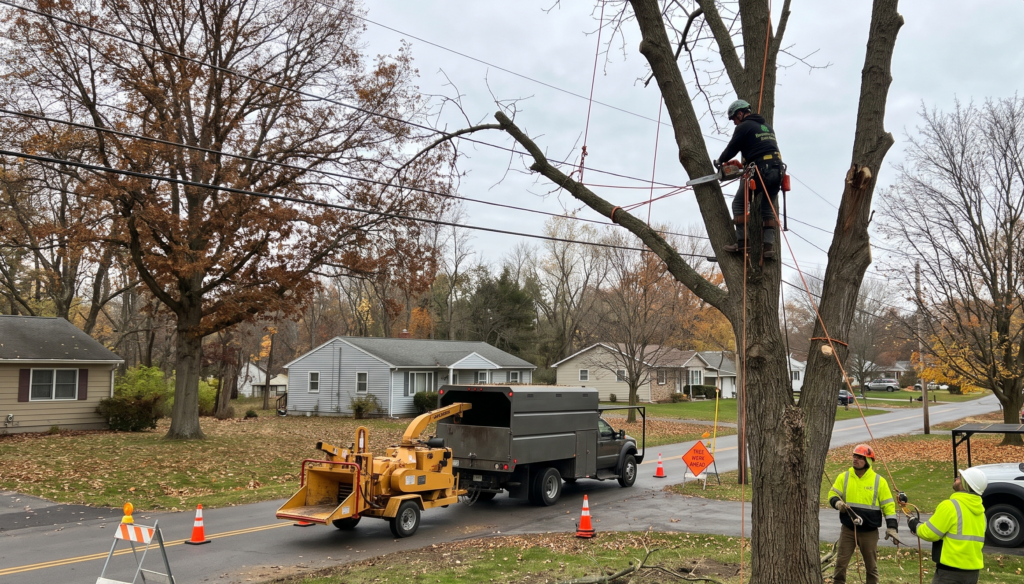
High-voltage overhead distribution lines carry severe, lethal electrical risks. Homeowners must never attempt to prune or cut down a tree that has branches growing within 10 feet of energized electrical conductors. This zone is classified as a hazardous approach distance, and work within this space is strictly restricted by law to OSHA-compliant and EHAP-certified arborists.
The Utility’s Responsibility
The primary utility provider maintains vegetation management easements along public roads and distribution corridors. If a diseased tree or hazardous limb threatens a high-voltage wire, the utility company will send clearance crews to prune or drop the hazardous sections down to a safe working height.
The Homeowner’s Responsibility
Utility clearance teams generally do not perform complete tree removals on private property; their mandate is limited to clearing line hazards. Once the utility crew makes the line safe, the property owner remains responsible for dismantling the rest of the tree and handling wood disposal.
Contractor Safety Requirements
Any private tree service operating within 10 feet of energized lines must be OSHA 1910.269 certified and carry Electric Hazard Awareness Program (EHAP) credentials. Homeowners who hire uncertified, uninsured day laborers or tree services to work near live power lines take on severe legal and civil liability risks in the event of an electrocution or area-wide power outage.
Frequently Asked Questions
Will RG&E or National Grid remove an entire dead tree on my private property for free?
No. Utility companies generally only remove the portions of the tree that directly threaten their primary overhead distribution lines. Once the hazardous limbs or top trunk sections are cut back to establish a safe clearance, the remaining trunk and wood disposal remain the homeowner’s responsibility.
Why can’t my regular landscaper prune limbs touching overhead lines?
Federal OSHA standard 1910.269 mandates that only qualified line-clearance arborists with certified electrical hazard training (EHAP) may work within 10 feet of energized high-voltage conductors. Uncertified operators face severe electrocution hazards, and employing them creates significant civil liability.
What is the process if a tree needs removal near secondary service drops leading to my house?
For secondary lines (the service drop running directly from the pole to your electric meter), you or your tree contractor must contact the utility provider to schedule a temporary service disconnection or “drop-and-reconnect” so the tree can be safely dismantled without tearing down the power line.
5. Emergency Situations, Diseased Trees, and Severe Weather Protocols
Western New York’s microclimate features intense lake-effect snowstorms, severe sub-zero cold fronts, heavy ice accumulation, and high-velocity wind events off Lake Ontario. These weather conditions place extraordinary dynamic loads on mature canopies.
Distinguishing Imminent Hazards from Chronic Decline
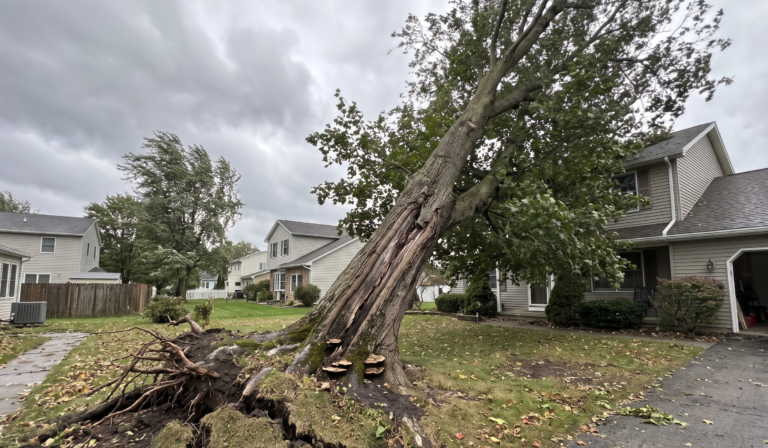
Municipalities distinguish between a planned tree removal and an emergency abatement. When a tree fails partially—such as a split crotch, root plate heave, or structural trunk crack—or leans over an occupied dwelling or public thoroughfare, formal municipal wait times are typically waived.
- Routine Removals: Driven primarily by aesthetics, sunlight access, landscape expansion, or general property development. These require standard permit reviews, boundary surveys, and adherence to zoning codes before machinery arrives on site.
- Emergency Hazard Removals: Driven by an immediate risk to human life, impending structural collapse, or downed electrical lines. Immediate emergency intervention is permitted, with post-event documentation, time-stamped photographs, and arborist reports submitted afterward to satisfy any local reporting obligations.
Forest Health Threats in Monroe County
Local ecosystems face aggressive biological threats that weaken native tree canopies, turning trees into unexpected hazards:
- Emerald Ash Borer (EAB): Tens of thousands of green and white ash trees across Monroe County have been killed by EAB. Ash wood deteriorates quickly once infested, becoming dry and brittle. Dead ash trees can lose limbs or collapse without the standard warning signs of decay, making early removal critical.
- Oak Wilt (Bretziella fagacearum): A destructive fungal disease affecting northern red oaks and white oaks. To avoid spreading oak wilt vectors through sap-feeding beetles, municipal and state foresters strongly discourage non-emergency trimming or cutting of oak species between April and July.
- Beech Leaf Disease (BLD): Caused by a foliar nematode, this rapidly spreading condition weakens American beech stands throughout the Lake Ontario lowlands, necessitating canopy evaluation and risk assessments.
Frequently Asked Questions
How do I prove that a storm-damaged tree was an emergency if code enforcement questions the removal?
Take clear, high-resolution photographs with time stamps showing the failure, structural splits, or target threats (such as a roof or public sidewalk) prior to work. Have an ISA-certified arborist provide a written tree risk assessment confirming the immediate failure risk.
Why are dead ash trees considered more dangerous to cut down than other trees?
Ash trees killed by the Emerald Ash Borer lose moisture rapidly, causing wood fibers to shatter unpredictably under mechanical tension. Arborists avoid climbing brittle ash trees and instead rely on bucket trucks or cranes to dismantle them remotely.
Is it illegal to prune or cut down oak trees during late spring in Monroe County?
While not outright illegal on private property, state foresters and arborists strictly advise against pruning or felling oaks from April through July to prevent the spread of Oak Wilt spores carried by sap-feeding beetles attracted to fresh wounds.
6. The Homeowner’s Compliance & Due-Diligence Checklist
Before starting any cutting on your property, complete this step-by-step checklist to avoid municipal citations or civil liabilities:
Step 1: Verify True Property Boundaries
- Pull your recorded instrument survey map from your closing documents or the Monroe County Clerk’s Office.
- Locate physical boundary iron pins at your lot corners with a metal detector.
- If a tree is close to a boundary line, never guess where it sits. An arborist must visually inspect whether the root flare or trunk tissue straddles the boundary.
Step 2: Check for Zoning and Environmental Overlays
- Review your property on the Monroe County GIS mapping portal to check for mapped freshwater wetlands, agricultural conservation districts, or municipal drainage easements.
- If you reside within the Village of Hilton, call the Village Code Enforcement Office at 59 Henry Street to confirm your plans comply with right-of-way and visual sight-triangle codes.
- If you live in the Town of Parma outside village lines, confirm your parcel does not contain a deed-restricted conservation buffer or stormwater easement.
Step 3: Hire an ISA-Certified Arborist with Proper Insurance
- Request a Certificate of Insurance (COI) sent directly from the tree care company’s insurance underwriter to you.
- The policy must explicitly list Commercial General Liability ($1,000,000 to $2,000,000 minimum) and Statutory Workers’ Compensation (NY State Form C-105.2 or U-26.3).
- Homeowner Risk Warning: Standard personal liability riders will not shield you if an uninsured tree worker sustains a serious injury on your property. Under New York State Labor Law, property owners can face financial exposure if uninsured contractors are injured while performing hazardous tree work on their land.
Step 4: Secure Necessary Authorizations in Writing
- If working near municipal right-of-way lines, obtain a written tree work permit or email confirmation from the Village DPW.
- If removing a tree in a shared drainage easement or border strip, secure signed mutual authorization from adjacent property owners.
- Keep a physical and digital record of an arborist’s risk assessment report certifying any hazardous condition prior to removal.
Frequently Asked Questions
What specific workers’ compensation form should I look for from a New York tree service?
You should look for NYS Form C-105.2 (Certificate of Workers’ Compensation Insurance) or Form U-26.3 (issued by the NY State Insurance Fund). An Accord form alone is often insufficient under New York State regulations to confirm active statutory workers’ comp coverage for arboricultural operations.
Can an existing property survey from when I bought my house suffice for boundary checks?
Yes, provided no physical improvements or fence lines have changed since the survey was stamped. Locate the iron boundary pins noted on the survey map to visually verify that the tree’s entire root flare and trunk base sit completely within your deeded boundary lines.
What should I do if a tree contractor asks me to pull the municipal permit as the homeowner?
Be cautious. Reputable tree services licensed and insured to work in municipal jurisdictions routinely pull the necessary permits themselves. If a contractor asks you to pull the permit, it often indicates they lack the required municipal licensing, commercial insurance, or bonding credentials.
7. Professional Arboriculture vs. Unregulated Tree Cutters
Safely cutting and dismantling large trees requires high-risk rigging, controlled directional felling, physics-based load distribution, and heavy machinery operations. Understanding the difference between a fully credentialed tree care firm and an unregulated crew, it protects both your property value and your legal standing.
Regulated, Certified Arboricultural Contractors
- Mandatory Insurance Coverage: Carries verified New York State Workers’ Compensation (Form C-105.2) and comprehensive general liability insurance specifically covering tree care operations.
- Certified Expertise: Employs International Society of Arboriculture (ISA) credentialed specialists qualified in Tree Risk Assessment Qualification (TRAQ) standards.
- Engineered Equipment: Uses articulating bucket trucks, dedicated mobile cranes, heavy-duty chippers, and high-tensile friction rigging to control every descent.
- Full-Site Cleanliness: Coordinates brush chipping, log hauling, sub-grade stump grinding, surface chase root excavation, and lawn remediation.
- Code Familiarity: Proactively checks municipal zoning, wetland maps, and public right-of-way boundaries to ensure work complies with local codes.
Uninsured, Informal Tree Cutters
- Absent Coverage: Lacks statutory New York Workers’ Compensation, leaving the property owner directly exposed to injury claims under state labor statutes.
- Inadequate Rigging: Relies on uncontrolled “free-falling” cuts, which pose high risks of crushing roofs, outbuildings, fences, and septic systems.
- Debris Abandonment: Leaves heavy trunk wood, branches, and high stumps behind, creating costly disposal problems for the homeowner.
- Regulatory Blindness: Ignores village street lawn rules, state wetland regulations, and boundary laws, resulting in stop-work orders or fines for the property owner.
Frequently Asked Questions
Why is an ISA TRAQ credential important for tree removal evaluations?
An arborist with Tree Risk Assessment Qualification (TRAQ) is trained to evaluate structural defects, disease progression, root zone viability, and failure probabilities. Their standardized written assessment provides legitimate, defensible documentation for municipal code officers, insurance carriers, and mortgage companies.
What happens if an uninsured tree cutter damages my neighbor’s property or injures themselves?
If the contractor lacks commercial general liability and New York Workers’ Compensation insurance, the claims can revert directly to you as the property owner. Your homeowner’s insurance could face substantial injury or property damage claims, potentially leading to policy non-renewal or legal action.
Does professional tree removal automatically include stump grinding and debris removal?
Not always. Written proposals should specify whether stump grinding (including depth below grade), surface root removal, wood hauling, chip cleanup, and topsoil fill are included in the quote or offered as separate line items.
8. Local Service Coverage: Finding Trusted Tree Removal Near You
When severe lake-effect snowstorms, microbursts, or seasonal freeze-thaw cycles cause limb failure or tree disputes on your boundary lines, having an established, certified crew nearby is essential. Property owners searching for professional tree removal near me across the Village of Hilton, the Town of Parma, and surrounding Monroe County communities rely on Branching Out Tree Service for safe, code-compliant, and fully insured arboricultural care.
Working directly out of our local yard, our crews provide rapid-response hazard mitigation, crane-assisted dismantlement, stump grinding, and full site restoration throughout our primary service sectors:
- Village of Hilton: Rapid dispatch throughout downtown, West Avenue, East Avenue, Lake Avenue, and surrounding residential subdivisions.
- Town of Parma: Comprehensive acreage clearing, agricultural windbreak management, and hazard tree pruning along Ridge Road (Route 104), Parma Center Road, Manitou Road, and Route 259.
- Lake Ontario Shoreline & Western Monroe County: Routine care and 24/7 storm response across Greece, Hamlin, Brockport, and Spencerport.
Visit Our Service Hub or Schedule an On-Site Consultation
Bring in foliar samples for disease evaluation, discuss site plan clearance, or schedule a comprehensive tree risk assessment with an ISA-certified arborist:
Frequently Asked Questions
How quickly can your emergency tree crew arrive at my home in Hilton or Parma?
Because our staging equipment and crew are stationed directly within the Hilton area, our emergency response teams arrive on-site within 45 to 90 minutes to secure hanging limbs, stabilize trees leaning on structures, or clear blocked driveways following severe weather.
Do you handle municipal right-of-way permits for homeowners in the Village of Hilton?
Yes. As a licensed and fully insured contractor, Branching Out Tree Service coordinates directly with the Village Building Department at 59 Henry Street and the Town of Parma code enforcement office to pull necessary permits and arrange lane closures where required.
Are on-site estimates free for homeowners in western Monroe County?
Yes. We provide transparent, written, zero-obligation estimates covering complete tree removal, precision crane operations, wood chipping, and below-grade stump grinding across Hilton, Parma, Greece, Hamlin, and adjacent towns.
Practical Takeaways for Property Owners
Local environmental regulations and municipal codes across the Village of Hilton and the Town of Parma are structured to preserve community tree canopy cover, protect municipal stormwater systems, and maintain open, hazard-free public roads. Property owners who confirm boundary markers, consult regional wetland overlays, coordinate around utility lines, and verify statutory contractor insurance avoid the substantial legal and financial risks associated with unpermitted tree work.
When facing severe tree decay, winter storm fractures, or complicated lot-line situations, partnering with a credentialed, local tree service ensures that municipal filings, safety standards, and controlled removals are handled with professional precision from start to finish.