Why Timing Matters: The Biology of Dormancy
To master tree pruning in Upstate NY, property owners must understand how woody plants balance energy storage, wound closure, and defensive compartmentalization. Deciduous trees undergo dramatic physiological shifts as daylight hours change. During the spring and summer months, trees allocate energy to foliar expansion, photosynthetic carbohydrate production, flower and seed generation, and cambial growth. Cutting branches during peak metabolic periods forces the tree to expend stored starches on wound repair rather than root and canopy defense, while also exposing fresh vascular tissue to active pathogens.
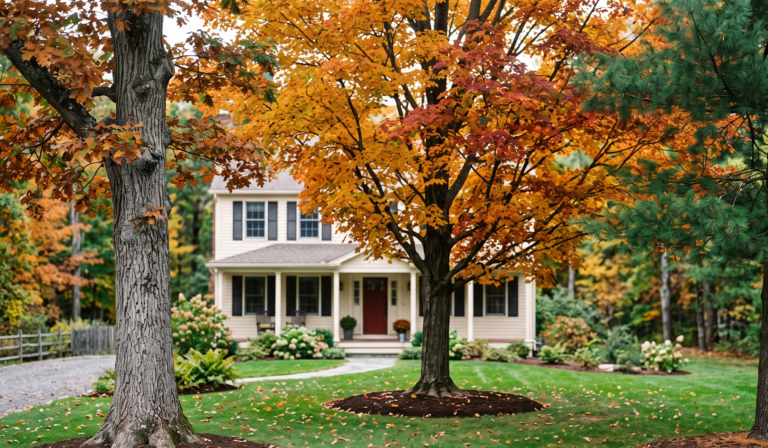
When autumn arrives, decreasing temperatures and shorter daylight trigger the onset of true dormancy. Deciduous trees resorb essential nutrients from their foliage, drop their leaves, and consolidate starches within their root systems and deep trunk tissues. Pruning while the tree is in this dormant phase provides profound biological advantages:
- Unobstructed Structural Assessment: Without foliage masking branch unions, arborists can visually inspect trunk tapers, identify included bark, locate fungal conks or decay pockets, and spot crossing or rubbing limbs with total clarity.
- Minimal Pathogen and Pest Vectors: Most destructive insects, such as emerald ash borers, bark beetles, and sap-feeding nitidulid beetles, are dormant or dead during freezing winter months. Airborne spores of wood-decay fungi and bacterial leaf scorch are similarly suppressed by winter temperatures.
- Reduced Sap Loss: Vascular pressure drops significantly during dormancy. Pruning prior to the spring sap surge prevents excessive oozing in “bleeder” species like maples and birches, keeping vital moisture and minerals inside the plant.
- Immediate Spring Callus Formation: Trees compartmentalize injuries through specialized walling-off mechanisms (CODIT: Compartmentalization Of Decay In Trees). Cuts made in late winter sit dormant for a brief period before rapid cell division in April and May forms a protective margin of woundwood around the pruning collar.
Frequently Asked Questions
Q: What is CODIT, and why does the pruning technique impact it?
A: CODIT stands for Compartmentalization Of Decay In Trees. Rather than healing or regenerating damaged cells like mammals, a tree builds four distinct chemical and physical walls around an injury to isolate decay. Cutting outside the branch bark ridge and branch collar respects these defense walls, while a flush cut violates them and invites trunk rot.
Q: Is it harmful if my tree “bleeds” sap after a winter or early spring cut?
A: While heavy sap flow on species like sugar maples, paper birches, or American elms can look alarming to property owners, it is rarely dangerous to the plant’s long-term health. The fluid consists mostly of water and trace sugars pulled up from the root system. Pruning in mid-winter rather than late March minimizes this cosmetic issue.
Q: What is “included bark,” and why does it need to be pruned?
A: Included bark occurs when two stems grow closely together at a narrow, V-shaped angle, pinching bark between them instead of forming solid wood. This creates a structurally weak attachment that easily splits in wind or snow storms. Dormant pruning allows arborists to eliminate co-dominant stems before they become massive structural hazards.
Late Winter: The Golden Window for Upstate NY
For the vast majority of hardwood and canopy trees native to Monroe County and Upstate New York—including sugar maples, red oaks, white oaks, black cherries, green ashes, and American basswoods—late winter (January through March) serves as the undisputed golden window for major pruning.
Beyond the biological benefits of dormancy, late winter brings critical operational advantages that preserve the integrity of your property:
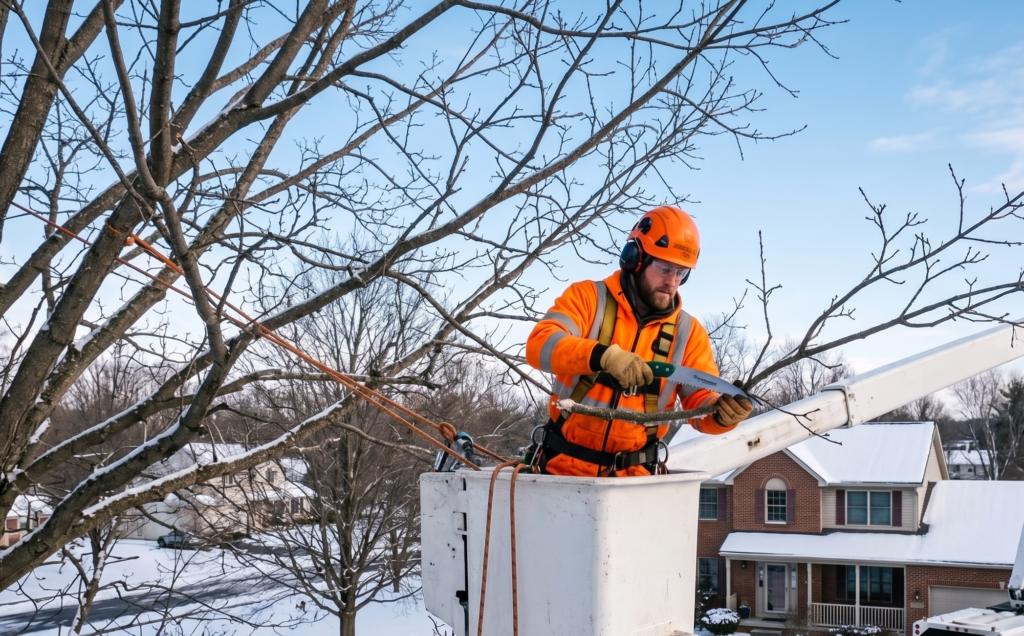
- Frozen Ground Turf Protection: Pruning mature trees often requires specialized equipment, including aerial lift bucket trucks, heavy chip trucks, and skid steers. When the topsoil is frozen solid during January and February, this heavy machinery can traverse driveways and lawns with negligible soil compaction or turf rutting. Attempting identical work during wet spring thaws can tear up lawns and damage shallow tree root systems.
- Winter Storm Load Mitigation: March in Western and Central New York frequently delivers dense, wet snowstorms and freezing rain. Lightening branch ends, removing overextended lateral limbs, and cutting out structural deadwood prior to these late-winter events keeps branches from collapsing onto homes, driveways, or fences under ice weight.
- Streamlined Debris Management: Brush and limb removal is far more efficient when foliage is absent. Branches pack tighter into industrial wood chippers, reducing job site impact and expediting cleanup.
| Pruning Season | Primary Objective | Key Regional Advantage / Hazard |
| Late Winter (Jan – Mar) | Structural pruning, crown thinning, deadwood removal | Frozen soil protects turf; insect and fungal vectors are dormant; rapid spring wound closure. |
| Late Spring (May–Jun) | Ornamental flowering trees (lilac, crabapple, magnolia) | Preserves current-year flower buds; performed immediately after petal drop. |
| Mid-Summer (Jul – Aug) | Deadwood removal, vista pruning, water sprout removal | Easy visual contrast between dead and living wood; slows unwanted aggressive sucker growth. |
| Autumn (Sep – Nov) | EMERGENCY HAZARDS ONLY (split limbs, storm damage) | High vulnerability: active airborne fungal spores paired with inactive tree cambial defenses. |
Frequently Asked Questions
Q: Can trees safely be pruned when outdoor temperatures dip below freezing?
A: Yes. Professional tree crews work in temperatures well below 32°F throughout Upstate New York. Clean, sharp cutting equipment slices crisply through frozen wood cells without tearing bark, and the absence of moisture prevents fungal spores from establishing on cut surfaces.
Q: Does late winter pruning stimulate rapid growth in the spring?
A: Yes. Because root systems remain undisturbed and store a high volume of reserves, removing select branches redirects those stored nutrients into fewer, higher-quality buds when spring breaks, yielding healthy, balanced canopy development.
Q: How does frozen ground protect underground root zones?
A: Heavy tree equipment can crush the delicate macropores in wet topsoil, starving fine root hairs of oxygen. When soil water freezes solid, it forms a rigid matrix that withstands equipment weight, protecting soil structure and root health.
Summer Pruning: Strategic Corrective Measures
While late winter remains the premier window for structural corrections, summer pruning (specifically late June through August) plays an indispensable role in maintaining landscape aesthetics and addressing safety issues. Rather than extensive limb removals, summer work focuses on precision corrections:
- High-Accuracy Deadwood Identification: During winter, an unpracticed eye may struggle to differentiate between dormant branches and completely dead limbs. In mid-summer, deadwood is immediately visible as bare, brittle branch sections set against a backdrop of vibrant green foliage. Removing these dead limbs during summer halts wood rot and prevents them from falling unpredictably.
- Taming Rampant Water Sprouts and Root Suckers: Trees that underwent heavy winter pruning or experienced stress often push out dense clusters of vertical “water sprouts” along trunk lines and scaffold limbs. Summer pruning selectively strips these energy drains before they harden into poorly attached, crowded branches.
- Clearance and Vista Trimming: Heavy summer foliage weighs down low-hanging limbs, causing them to obstruct sidewalks, driveway sightlines, or outdoor living spaces. Summer pruning trims these specific lateral limbs back to appropriate lateral junctions without compromising the tree’s health.
- Storm Cleanup and Microburst Remediation: Lake Ontario summers routinely generate violent pop-up thunderstorms and localized microbursts. High winds split heavy limbs and leave hanging hazards suspended in the canopy. These broken branches require immediate summer removal to protect your household and property.
Frequently Asked Questions
Q: Can summer pruning cause sunscald on interior tree bark?
A: Yes, if canopy thinning is excessive. Over-pruning during the summer allows high-intensity UV rays to strike sensitive, thin bark that was previously shaded by leaf cover. Certified arborists follow the “25% Rule,” never removing more than a quarter of a tree’s photosynthetic foliage in a single growing season.
Q: Should I prune my fruit trees in the summer?
A: Light summer pruning on fruit trees can be useful for controlling upright vigor, opening the canopy to sunlight for fruit ripening, and eliminating water sprouts. However, major structural reshaping and thinning cuts for fruit trees should still be reserved for late winter.
Q: Does trimming branches in summer attract pests?
A: It can, depending on the species. For example, fresh summer cuts on oaks release sweet sap that attracts nitidulid beetles, vectors for the oak wilt fungus. For species prone to specific insect-vectored diseases, summer cuts must be strictly avoided unless applied to dead or hazardous limbs.
Fall Pruning: Why You Should Generally Avoid It
It is common for homeowners to bundle tree pruning into their autumn yard chores alongside raking fallen leaves, winterizing irrigation lines, and cutting back perennial gardens. However, across Upstate New York, fall (September through late November) is the most hazardous time to prune living trees.
Understanding the seasonal environment of an Upstate autumn explains why arborists advise patience:
- Prolific Fungal Spore Dispersal: Warm days and cool, damp nights create the ideal breeding ground for wood-rotting bracket fungi, cankers, and systemic pathogens. These fungi release millions of airborne microscopic spores precisely when other plant matter is decaying.
- Suspended Healing Responses: In autumn, trees enter an energy-conservation stage where they shut down active cell division and stop producing protective woundwood. An open pruning wound made in October will sit exposed and unprotected in damp conditions for weeks, serving as an open door for fungal mycelium to penetrate deep into the heartwood.
- Induced Cold Hardiness Delays: Severe autumn pruning can stimulate an unnatural, late-season flush of vegetative growth if unseasonably mild temperatures occur in Indian summer. This soft, newly produced tissue has not undergone cold hardening and will suffer immediate frost kill during the first freeze, creating dead tissue margins at the wound site.
The only acceptable autumn pruning activities involve removing dead, hanging, or cracked limbs that present imminent danger to life or property during forthcoming winter storms.
Frequently Asked Questions
Q: What should I do if a November windstorm cracks a large limb?
A: Do not leave a cracked, jagged limb hanging through the winter. A storm-damaged branch creates irregular wood tears that collect moisture and rot far faster than a clean cut. Call a professional tree service to safely remove the damaged limb right at the branch collar.
Q: Does the restriction on fall pruning apply to small shrubs and hedges?
A: Many deciduous landscape shrubs can tolerate light autumn shaping, but even with shrubs, heavy rejuvenation cuts are far more successful in late winter. Evergreen shrubs like boxwoods and yews should avoid late-fall shearing, as fresh cuts are prone to winter desiccation (“winter burn”).
Q: Why do pruning cuts heal slower in the fall than in early spring?
A: Wound closure relies on active cambial cell division, driven by sunlight, warm temperatures, and active sap circulation. As trees prepare for winter rest, those cellular mechanisms shut down, leaving the pruning site inactive until soil temperatures warm back up in April.
Species-Specific Pruning Schedules in Upstate New York
Every tree species possesses unique physiological requirements, flowering schedules, and pathogen vulnerabilities. Applying a single pruning schedule to every tree in your yard leads to poor flowering, sap loss, or fungal infection.
1. Spring-Flowering Trees (Crabapples, Dogwoods, Lilacs, Magnolias)
Spring-blooming ornamental trees produce flower buds during the previous summer’s growing cycle. Pruning these specimens during the winter will strip away those overwintering buds, eliminating your spring flower display.
- Optimal Timing: Prune immediately after blooming ends in late spring or early summer (typically late May or June).
- Technique Note: Focus on removing spent flower heads, crossing suckers, and awkward inward-pointing shoots to maintain balanced form while allowing new growth to set buds for next spring.
2. Upstate Hardwood Giants (Oaks, Maples, Birches, Walnuts)
These expansive canopy trees define regional landscapes, but their vascular properties dictate precise pruning windows.
- Oak Species (Red, Pin, White, Burr): Prune strictly between November and February. Pruning oaks during the spring or summer exposes them to oak wilt (Bretziella fagacearum), a lethal vascular fungus transmitted by sap beetles.
- Maples and Birches: Prune in mid-to-late winter. While pruning in late March causes harmless yet messy sap flow, mid-winter cuts allow internal cuts to dry slightly before positive vascular pressure builds in spring.
3. Orchard and Backyard Fruit Trees (Apples, Pears, Cherries, and Plums)
Fruit production requires an open canopy that maximizes direct sun exposure and cross-ventilation, suppressing humidity-loving diseases like apple scab and fire blight.
- Apples and European Pears: Prune during late winter (February through late March) while fully dormant to stimulate productive fruiting spurs.
- Stone Fruits (Peaches, Cherries, Plums): Prune in late winter or very early spring just as buds begin to swell to reduce vulnerability to cytospora canker and silver leaf disease.
4. Conifers and Evergreens (Eastern White Pines, Hemlocks, Spruces, Arborvitae)
Evergreens do not require annual pruning like deciduous hardwoods. Pruning is generally limited to deadwood cleanup and light structural guidance.
- Pines: Prune in early summer by snapping or cutting the growing tip of fresh “candles” in half to encourage dense, bushy growth.
- Spruces and Firs: Prune in late winter while dormant, cutting lateral branches back to an active dormant bud.
Frequently Asked Questions
Q: How does Oak Wilt kill trees, and why is winter pruning the primary defense?
A: Oak wilt is an aggressive vascular wilt disease. When beetles introduce spores to fresh sap on spring or summer cuts, the fungus grows within the tree’s water-conducting vessels. The oak attempts to plug its own vessels to stop the fungus, cutting off water supply to its canopy and killing the tree within weeks. Freezing winter temperatures prevent beetle flights, eliminating infection vectors.
Q: Can I prune an apple tree that hasn’t been touched in years all at once?
A: No. Neglected fruit trees should undergo a multi-year restoration plan. Removing more than 20–25% of an old fruit tree’s canopy in a single winter triggers an explosion of unproductive, vertical water sprouts that congest the interior crown even worse than before.
Q: When should Emerald Ash Borer (EAB)-impacted trees be evaluated and pruned?
A: Ash trees showing dieback should be evaluated immediately by an ISA-certified arborist. Dead ash wood loses its moisture content quickly and becomes brittle, presenting structural collapse risks during wind events.
Local Factors: The Hilton, NY, and Monroe County Microclimate
Generic national gardening calendars fail to address the specific atmospheric and geological forces at play in Monroe County, Hilton, and the broader Western NY plain. Working alongside the southern shoreline of Lake Ontario introduces local environmental considerations:
- Lake-Effect Wind Shear & Heavy Ice Accumulation: Hilton sits directly within the Lake Ontario weather belt, exposing properties to sudden squalls, blowing lake moisture, and heavy freezing rain. Ice accumulation of just a quarter-inch adds hundreds of pounds of structural weight to a tree canopy. Professional pruning in this zone prioritizes widening branch attachment angles, clearing out heavy canopy interiors to let gusts pass through, and shortening overextended limbs that overhang driveways and homes.
- Glacial Till and Heavy Clay Subsoils: Much of Monroe County is characterized by dense, alkaline, moisture-retentive glacial till and heavy clay soils. While nutrient-rich, these soils drain slowly and can cause shallow root spread. Pruning must keep canopies proportionate to root systems to prevent windthrow (trees uprooting entirely during high-wind gale warnings).
- Municipal Codes, Right-of-Ways, and Overhead Lines: Hilton and surrounding towns maintain specific guidelines regarding street tree maintenance, municipal right-of-ways, and visibility triangles at street intersections. Furthermore, tree trimming within the proximity of power lines requires specialized line-clearance qualifications. Homeowners should always confirm that their tree care provider is certified and insured to work near utility structures.
Frequently Asked Questions
Q: How does high soil moisture along Lake Ontario influence pruning choices?
A: Wet, saturated soils reduce root anchorage in high winds. Thinning the canopy reduces the physical “sail area” of the crown, minimizing torque on shallow roots and reducing the risk of complete tree tipping during seasonal rain and windstorms.
Q: What is a “visibility triangle” in local municipal guidelines?
A: Local highway departments and town codes require road intersections and driveway exits to maintain unobstructed sightlines. Lower tree branches that hang below 8 to 10 feet over sidewalks or 14 feet over roadways often require elevation pruning to comply with municipal safety rules.
Q: Are lake winds more damaging to deciduous trees or evergreens?
A: Evergreens retain their needles all winter, presenting continuous surface area to lake-effect gales and heavy snow accumulation. Pruning evergreens to eliminate weak, double trunks or correcting overextended lateral limbs helps protect them from winter wind damage.
The Value of Professional Arborist Expertise
While hand snips are adequate for trimming low shrubbery, managing mature shade trees, scaling vertical heights, and deploying specialized rigging requires professional skill and industrial equipment. Attempting tree trimming without professional training, fall-protection gear, and botanical knowledge can lead to personal injury, property damage, and permanent harm to your trees.
Common DIY pruning mistakes include:
- Flush Cutting: Cutting flush against the main trunk removes the branch collar and branch bark ridge, destroying the tree’s natural chemical defense zone and opening trunk wood directly to rot.
- Leaving Stubs: Leaving long branch stubs prevents the tree from sealing the wound. The dead stub slowly rots back into the main trunk, providing a pathway for wood-boring insects and hollow-forming fungus.
- Tree Topping: Indiscriminately lopping off the tops of mature trees to reduce height is one of the most destructive practices in arboriculture. Topping starves the tree, creates massive entry wounds for decay, and triggers clusters of weakly attached water sprouts that break easily in moderate winds.
- Lion-Tailing: Stripping out all interior foliage and leaving only tufts of leaves at branch tips shifts weight distribution outward, making limbs far more susceptible to snapping under snow loads.
Hiring a team like Branching Out Tree Service ensures that your trees are pruned to ANSI A300 standards. Our local crews possess the specialized rigging, aerial bucket equipment, wood chippers, and safety training to complete large-scale removals, structural shaping, and corrective pruning safely and efficiently throughout Hilton and Monroe County.
Frequently Asked Questions
Q: What is the difference between an uncertified tree cutter and a professional arborist?
A: Professional arborists evaluate tree biology, structural dynamics, disease vectors, and regional climate needs. They use specialized pruning practices that respect natural plant physiology, carry proper liability and workers’ compensation insurance, and work to ANSI A300 safety and pruning standards.
Q: What is ANSI A300, and why does it matter?
A: ANSI A300 is the nationally recognized performance standard for tree care operations in the United States. It outlines precise technical requirements for pruning, cabling, bracing, and fertilizing trees, ensuring contractors adhere to scientifically backed practices rather than destructive methods like tree topping.
Q: Can a poorly executed pruning cut kill an otherwise healthy mature tree?
A: Yes. Large flush cuts or widespread topping open extensive internal cavities to wood-rotting fungi and structural decay. Over several seasons, internal decay compromises wood strength, eventually causing trunk failure or necessitating complete tree removal.
Finding Reliable Tree Pruning Near You in Hilton and Monroe County
When property owners search for tree pruning near me, proximity, rapid dispatch capabilities, and regional experience are critical. Tree species along the southern shore of Lake Ontario face environmental factors that out-of-area contractors routinely underestimate.
Headquartered right here in Hilton, NY, Branching Out Tree Service provides specialized tree pruning, crown thinning, and hazard mitigation across our immediate local communities:
- Hilton & Town of Parma (14468): Serving neighborhoods from the heart of the Village along Route 259, outward past Parma Town Park, and all residential properties bordering Lake Ontario.
- Hamlin, NY (14464): Comprehensive residential and rural canopy management spanning Lake Road, Route 19, and expansive agricultural woodlots.
- Greece, NY (14612, 14616, 14626): Canopy thinning, crown elevation over residential roofs, and line-clearance pruning across North and West Greece.
- Spencerport & Town of Ogden (14559): Structural trimming, deadwood removal, and ornamental specimen care along the Erie Canal corridor and Route 31.
- Brockport & Clarkson (14420): Historic canopy preservation, storm remediation, and mature hardwood maintenance for both private residences and commercial parcels.
Whether you need a single mature oak assessed near the Hilton Apple Fest grounds or multiple wind-damaged maples cleared near Hamlin Beach, our local presence ensures prompt communication and minimal equipment transit times.
Frequently Asked Questions
Q: How quickly can your crew respond for emergency tree trimming near me?
A: Because our equipment yard and staging facilities are located directly in Hilton, we provide rapid-response emergency hazard mitigation across Hilton, Hamlin, and Greece following heavy windstorms, lake-effect snow squalls, and severe freezing rain.
Q: Do you service large rural acreages as well as suburban residential lots in Monroe County?
A: Yes. Our fleet includes compact-footprint tracked equipment for tight residential backyard access without lawn damage, as well as full-scale commercial cranes and chippers for multi-acre woodlots across Parma, Hamlin, and Clarkson.
Our Local Monroe County Service Hub
Frequently Asked Questions
Q: How do I schedule a tree assessment with Branching Out Tree Service?
A: Reach out through our website at https://branchingouttreehiltonny.com/ or call our Hilton office directly to book an on-site property evaluation.
Q: Do you offer free quotes for residential tree pruning in Hilton and Monroe County?
A: Yes, we provide free, written on-site estimates for tree pruning, crown thinning, deadwood removal, and emergency hazard mitigation throughout Monroe County.
Q: What details should I have on hand when booking an assessment?
A: Let us know roughly how many trees need attention, any urgent hazards (like cracked limbs or roof clearance issues), and how easily our trucks and equipment can access the work area.