Summer across Western New York and the Lake Ontario basin brings lush green canopies, backyard family gatherings, and sudden, violent severe weather. Before afternoon humidity gives way to squall lines, microbursts, and heavy rain, knowing how to identify weak limbs and high-risk branches before summer thunderstorms hit can mean the difference between a secure property and thousands of dollars in emergency repairs. At Branching Out Tree Service, our experienced local arborists see firsthand how sudden 50-to-60-mph lake wind gusts exploit hidden structural decay, compromised branch unions, and brittle deadwood. Inspecting your trees in late spring and early summer lets you spot structural liabilities before storm systems put your roof, vehicles, and utility drops in jeopardy.
Below is an arborist-backed guide covering what causes branches to fail during summer storms, the warning signs to look for during a yard walkthrough, and how proactive tree care safeguards your landscape.
Why Summer Thunderstorms Are Uniquely Dangerous to Mature Trees
Many homeowners assume winter ice storms pose the greatest threat to area trees. While snow and ice loads are destructive, summer storms carry unique physical dynamics that often cause far more catastrophic trunk and limb failures:
- The “Sail Effect” of Full Summer Foliage: In winter, deciduous trees are bare, allowing gale-force winds to pass freely through the canopy. In June, July, and August, trees are in full leaf. That dense blanket of leaves turns the canopy into a massive sail, capturing immense aerodynamic drag and transferring dynamic rotational stress directly into limb unions.
- Water Weight Accumulation: Intense summer downpours saturate the leaf canopy. Millions of drenched leaves can add thousands of pounds of sheer downward weight to already-stressed branches.
- Saturated Soil and Root Anchoring Failure: When convective squalls dump inches of rain in a short window, ground soil shifts into a loose slurry. High winds striking heavy crowns in waterlogged soil frequently tear out shallow or decayed root systems.
- Lake Ontario Weather Dynamics: Properties in Hilton, Parma, Greece, Hamlin, and neighboring Monroe County communities regularly face severe squalls rushing off Lake Ontario. Sudden directional wind shears twist branch attachments until compromised fibers snap.
Frequently Asked Questions
Q: Why do trees fall during summer thunderstorms more suddenly than in winter storms?
A: In summer, the combination of full foliage acting like a giant wind sail and the added weight of trapped rainwater places maximum mechanical load on branch unions. When paired with rain-softened soil that loosens root anchors, trees frequently fail with little to no audible warning.
Q: How do microbursts and convective squalls affect branch structure?
A: Unlike straight-line winter breezes, summer microbursts generate abrupt downward and rotational air pressure. This twists limbs along axes they were never physiologically adapted to withstand, causing green, healthy-looking limbs to snap.
7 Visible Signs of Weak and High-Risk Tree Branches
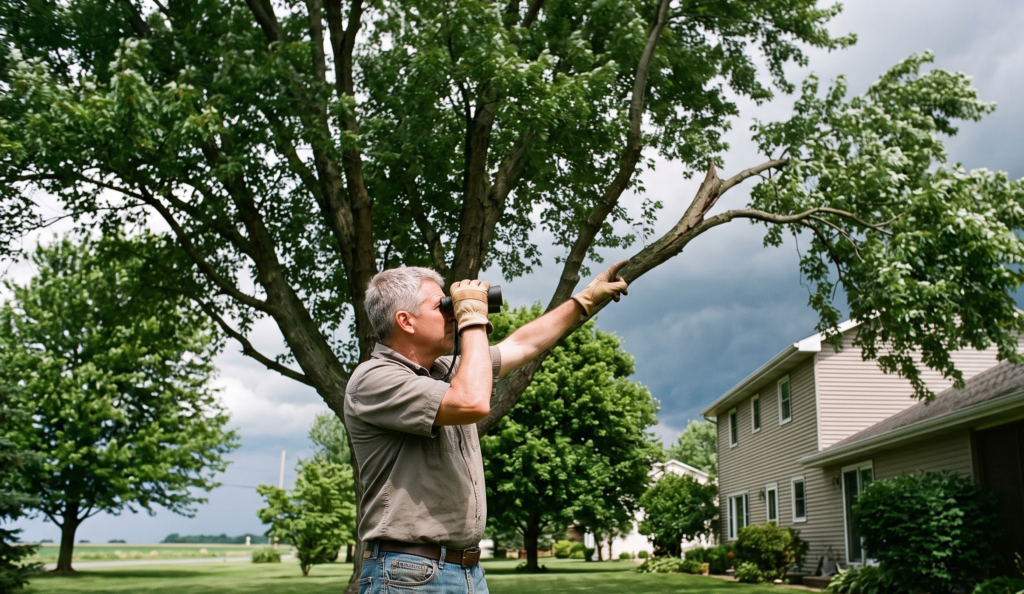
You do not need to climb into your canopy to conduct a basic visual hazard assessment. Take a walk around your yard on a calm day with a pair of binoculars and look for these telltale danger signs:
1. The “V-Shaped” Union (Codominant Stems with Included Bark)
Where two large branches meet, look at the junction angle:
- Healthy Union (U-Shape): Strong branch unions resemble a wide “U” with a visible raised ridge of bark (the branch bark ridge) pushed outward.
- Hazardous Union (V-Shape): Stems that grow close together form a tight, narrow “V.” As both stems expand, bark gets pinched between them (known as included bark). Instead of wood fusing together, the bark creates a wedge that acts like a seam waiting to split under heavy wind.
2. Deadwood, Dieback, and “Hangers”
Dead limbs are brittle, lack tensile flexibility, and summer gusts snap them instantly:
- Deadwood: Look for branches devoid of leaves, missing bark, or exhibiting grey, dried-out wood while the rest of the canopy is thriving.
- Canopy Dieback: Thinning foliage or bare twigs at the outer margins of a branch indicate vascular stress, fungal infections, or internal root decline.
- Widowmakers/Hangers: Inspect the mid-to-upper crown for broken limbs that snapped during previous winter winds and remain suspended among living branches.
3. Fungal Conks and Mushroom Growth
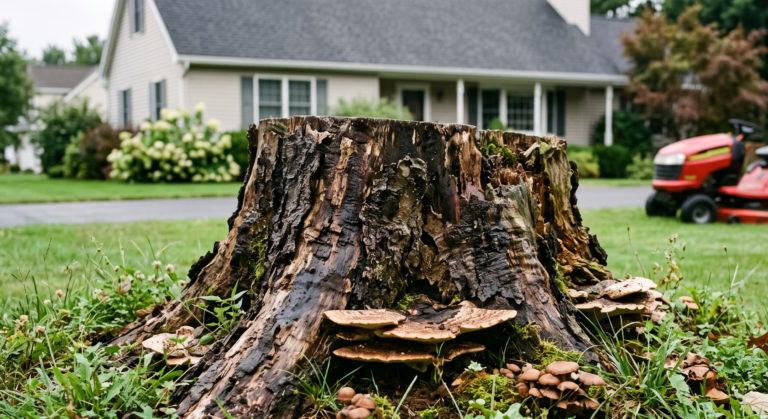
If you see bracket fungi (shelf mushrooms) or toadstools growing directly out of a branch junction, limb underside, or base of the trunk, the interior wood is undergoing active decay. Fungi consume lignin and cellulose—the structural backbone of wood fibers. A limb with heavy fungal fruiting bodies is often hollowed out or punky inside, regardless of how green its leaves appear.
4. Deep Bark Cracks, Seams, and Cavities
Vertical cracks running along a limb or trunk signal that the structural integrity of the wood has sheared:
- Cracks that penetrate completely through the bark into the inner sapwood are high-risk zones.
- Hollow cavities created by old pruning cuts, rot, or woodpecker activity weaken the branch’s load-bearing capacity. If more than 30–40% of the interior wood cross-section is decayed or missing, the branch has a high probability of storm failure.
5. Overextended, End-Heavy Horizontal Limbs
Some species—such as Silver Maples, Willows, and Red Oaks—tend to produce long, horizontal lateral limbs that stretch far past the main canopy. These branches carry high “lever-arm” forces:
- When heavy foliage, rainwater, and wind push down on the tip of an overextended branch, the leverage exerted on the connection point near the trunk is magnified exponentially.
- End-heavy limbs that arch directly over driveways, bedroom roofs, sheds, or power lines should be evaluated immediately for weight-reduction pruning.
6. Heavy Infestations and Pest Boring
Keep an eye out for fine sawdust (frass) gathered around limb crotches or oozing sap wounds. Pests like wood-boring beetles compromise structural wood from the inside out, turning sturdy limbs into brittle, honeycomb-like shells.
7. Sudden Leans and Ground Heaving
If a branch or a major leader has suddenly changed its angle after recent weather, or if you spot fresh mounds of raised turf and exposed roots on the opposite side of a lean, the root anchor has severed. This is an urgent red flag requiring prompt professional attention.
Frequently Asked Questions
Q: Can a tree branch that is covered in green leaves still break during a storm?
A: Yes. Leaves only indicate that the outer sapwood and cambium layer are transporting water and nutrients. The structural heartwood inside the limb can be completely decayed, hollowed out, or fractured while supporting a lush, green canopy.
Q: What should I look for if two large trunks grow from the same spot?
A: Check the union where they meet. If they form a sharp “V” shape with bark curling inward between them (included bark), they do not have a strong wood-to-wood bond. High winds can force them apart like a wishbone.
High-Risk Tree Species Common in Western New York
While any poorly maintained tree can lose branches, several fast-growing or soft-wooded species common throughout Hilton and the greater Rochester area are notoriously vulnerable to summer storm damage:
| Species | Primary Structural Weakness | Storm Hazard Level | Recommended Maintenance |
| Silver Maple (Acer saccharinum) | Brittle wood, weak narrow V-crotches, prone to interior rot | High | Crown thinning, end-weight reduction, structural cabling |
| Willow (Salix spp.) | Fast-growing, weak soft wood, holds massive leaf water-weight | High | Regular deadwooding, selective clearance pruning |
| Boxelder / Ash (Fraxinus spp.) | Brittle branches; Ash trees weakened by Emerald Ash Borer | Critical | Hazardous limb removal; full tree removal if dead |
| Callery / Bradford Pear | Multiple codominant leaders originating from a single focal point | Critical | Structural thinning or preemptive removal before splitting |
| Eastern White Pine (Pinus strobus) | Brittle lateral limbs, dense needle mats that capture wind | Moderate to High | Hazard pruning, dead branch extraction |
Frequently Asked Questions
Q: Why are Bradford Pear trees so susceptible to summer storm splitting?
A: Bradford Pears naturally develop multiple competing leaders that join together in tight, crowded unions. As the branches gain girth and weight in summer, they naturally push against each other and easily peel open in moderate winds.
Q: How can I tell if an Ash tree is too hazardous to save?
A: If the canopy exhibits more than 30–50% branch dieback, or if there is extensive bark peeling revealing D-shaped exit holes from the Emerald Ash Borer, the internal wood becomes extremely brittle and prone to unprompted failure.
What Homeowners Should—and Shouldn’t—Do
When homeowners discover a questionable branch hanging over their roof, the temptation is often to pull out a ladder, rope, and chainsaw. Tree work under tension is extremely hazardous:
What You Can Safely Do:
- Perform a Ground-Level Walkthrough: Walk your perimeter after strong wind events and note any changes in canopy shape, cracked bark, or fallen debris.
- Keep Drop Zones Clear: Move outdoor furniture, vehicles, grills, and children’s play structures away from the drip-line of questionable branches when severe weather is forecast.
- Document Property Conditions: Take clear photographs of mature trees and existing structures for insurance and maintenance records.
What to Leave to Certified Arborists:
- Ladders and Chainsaws: Cutting overhead limbs using a ladder is one of the leading causes of severe residential injuries. Branches store tension; cutting a compromised limb can cause it to kick back violently or swing unpredictably.
- Work Near Power Lines: Any branch touching or within 10 feet of utility lines poses lethal electrocution risks. Only utility-certified crews should handle these hazards.
- Flush Cutting or “Topping”: Cutting branches flush against the main trunk destroys the branch collar, preventing natural wound compartmentalization and opening the tree to rot. Topping trees creates weak, weakly anchored epicormic shoots that break easily in storms.
Frequently Asked Questions
Q: Can I prune a heavy branch over my shed with a pole saw myself?
A: It is strongly discouraged. Overextended branches are under high internal stress. Without proper rigging ropes to support the weight, severed limbs can kick backward, bounce unpredictably, or swing directly into buildings and people.
Q: Is it safe to trim tree limbs that touch overhead electrical wires?
A: Never. Tree branches contain moisture and conduct electricity. Contact your local power utility or an arborist certified for line clearance to assess branches within 10 feet of power lines.
How Professional Arborists Mitigate Storm Risk
A professional tree care evaluation does not mean cutting down your favorite shade trees. Experienced arborists have multiple tools and techniques to preserve valuable trees while removing safety hazards:
- Crown Cleaning & Deadwooding: The systematic removal of dead, dying, diseased, or broken branches throughout the canopy, eliminating immediate hazards.
- Crown Thinning & Weight Reduction: Strategically removing selective lateral branches near the edges of overextended limbs reduces dynamic wind drag (the sail effect) and relieves structural lever loads.
- Cabling and Bracing: For valuable, mature trees with tight V-crotches or codominant stems, arborists can install flexible, high-strength steel or synthetic cabling systems in the upper canopy. These cables limit branch movement during violent wind gusts, preventing the tree from splitting down the center.
- Targeted Tree Removal: When rot, decay, or root upheaval has advanced beyond safe structural tolerance, clean, controlled dismantling protects surrounding structures.
Frequently Asked Questions
Q: What is tree cabling and bracing, and how does it prevent storm damage?
A: Cabling involves installing high-strength steel cables or synthetic ropes in the upper two-thirds of the canopy between codominant stems. It redistributes wind loads across multiple trunks, preventing heavy limbs from splitting away during squalls.
Q: Does crown thinning harm the tree?
A: When performed properly by a certified arborist following ANSI A300 standards, crown thinning removes no more than 15–20% of live foliage. It improves airflow and reduces branch weight without starving the tree or triggering frantic epicormic regrowth.
Finding Trusted Tree Service Near Me in Hilton & Monroe County
When severe thunderstorm warnings flash across Lake Ontario, searching for an emergency tree service “near me” shouldn’t feel like a gamble. Property owners along the lakeshore and across the northern suburbs need local crews with the heavy equipment, rigging experience, and rapid response times required to handle hazardous limbs safely.
Branching Out Tree Service operates right here in Hilton, NY (14468), providing prompt pre-storm hazard assessments, selective tree trimming and pruning services, and hazardous tree removal services across:
- Hilton Village & Town of Parma: From properties along Walker Road, Route 259 (Unionville Station), and Route 18 to older residential neighborhoods with towering, 70-foot Silver Maples.
- Hamlin & Lake Ontario Shoreline: Lakefront lots along Edgemere Drive, Moscow Road, and Hamlin Beach state corridors subject to direct lake squalls and saturated beach soils.
- Town of Greece & North Greece: Mature suburban properties near North Greece Road, Latta Road, and Long Pond Road needing clearance pruning around service drops and roofs.
- Spencerport, Brockport & Clarkson: Rural and semi-rural acreage along Route 104 (Ridge Road) and Route 31 requiring large-scale deadwooding, canopy thinning, and storm-damage prevention.
Whether you need a preventive safety check before storm season or urgent clearing after a line of squalls moves through, our local team is minutes away.
Frequently Asked Questions
Q: How do I find a reputable tree service near me in Hilton before storm season starts?
A: Always verify three credentials before hiring: proof of active commercial liability and workers’ compensation insurance, dedicated arboricultural rigging equipment, and verified local references across Monroe County. Branching Out Tree Service provides proof of insurance and free on-site estimates for every job.
Q: Which neighborhoods around Hilton receive same-day storm damage response?
A: We provide prioritized emergency hazard clearing throughout Hilton, Parma, Hamlin, North Greece, and Clarkson when heavy limbs block driveways, rest on roofs, or endanger power lines.
Protect Your Property with Branching Out Tree Service in Hilton, NY
Summer storms develop rapidly over Lake Ontario, leaving little time to react once weather alerts sound. Identifying structural vulnerabilities early gives you the chance to schedule controlled tree care before wind and rain trigger a costly emergency.
If you notice hanging limbs, narrow V-crotches, cracked stems, or hollow cavities in your trees, call Branching Out Tree Service. Owned and operated locally in Hilton, NY (14468), our fully licensed and insured crew brings over a decade of hands-on arboricultural experience to every job. We provide comprehensive tree pruning, canopy thinning, hazardous limb removal, and 24/7 emergency storm response across Monroe and surrounding counties.
Local Office & Service Hub
Contact Branching Out Tree Service today to schedule a thorough property hazard walkthrough and free written estimate.
Frequently Asked Questions
Q: How quickly can Branching Out Tree Service inspect my property before storm season?
A: We prioritize pre-storm safety evaluations and emergency risks throughout Hilton, Greece, Parma, Hamlin, and Monroe County, usually scheduling walkthroughs within 24 to 48 business hours.
Q: Does homeowner insurance cover the cost of removing a weak branch before it falls?
A: Generally, homeowner insurance policies do not cover preventative tree maintenance or pruning; they typically only cover damage after a tree strikes a covered structure. Preventative trimming is far less costly than an insurance deductible and post-storm repairs