When winter rolls across New York, the sudden transition from autumn downpours to freezing rain and dense lake-effect squalls creates immense structural stress on residential canopies. Safeguarding your property requires a proactive plan for getting trees ready for heavy New York snow and ice loads, ensuring overextended limbs, co-dominant stems, and multi-trunk evergreens can endure freezing temperatures and sustained gale-force winds without breaking. At Branching Out Tree Service, our local crew helps homeowners throughout Hilton and surrounding Western New York communities fortify their landscapes before winter weather sets in. By addressing canopy weight, hidden interior decay, and load dynamics ahead of time, you can protect your roof, keep utility lines clear, and preserve your property’s most valuable shade trees.
The Physics of Winter Damage: Why Snow and Ice Break Canopies
The mechanical failure of a tree branch in winter is a problem of static load, torque, and material mechanics. Normal deciduous branches are flexible structures designed to shed rainfall and flex in summer breezes, but winter precipitation changes branch physics completely:
- Exponential Weight from Ice Glaze: A mere 0.25-inch glaze of radial ice adds roughly 500 pounds of dead weight to an average mature tree canopy. When freezing rain causes accumulation between 0.5 inches and 1.0 inch, branch weight increases by a factor of 10 to 30 times. Ice provides no natural flexibility; it locks wood fibers into an unyielding, rigid position under extreme gravitational pull.
- Lake-Effect Slush vs. Dry Powder: While light, sub-zero powder blows right through bare branches, the moisture-laden lake-effect snow common along the Lake Ontario shoreline acts like wet cement. It forms heavy horizontal bridges across twig networks, multiplying surface area and capturing subsequent snowfall.
- Loss of Fiber Elasticity: As temperatures drop below 20°F (-7°C), the cellular sap within living wood cells solidifies, reducing branch elasticity. When sub-zero wind gusts hit an ice-encrusted bough, the wood cannot flex to dissipate kinetic energy. Instead of bending, the brittle lignified fibers fracture instantaneously.
Frequently Asked Questions
Q: At what ice thickness do healthy tree branches begin to fail?
A: Sound hardwood limbs can usually tolerate up to a quarter-inch of ice. At one-half inch to three-quarters of an inch of ice accretion, structural strain causes noticeable sagging and moderate branch loss. Accumulation exceeding one inch routinely triggers widespread catastrophic failure, even on mature, seemingly healthy trees.
Q: Why does early-winter wet snow cause more damage than mid-winter blizzards?
A: Early-season storms often hit while trees still hold unfallen autumn leaves, which dramatically increases surface area and traps heavy slush. Early storms also tend to occur near the freezing mark (30°F–32°F), where snow contains a much higher moisture ratio than dry, mid-winter powder.
Which Tree Species Are Most Vulnerable in Upstate New York?
Decades of field service across Monroe County reveal distinct structural patterns regarding which trees survive ice events and which split under load.
| Tree Species | Risk Level | Primary Failure Mechanism | Structural Solution |
| Bradford / Callery Pear | Extremely High | Weak V-shaped crotches; brittle grain structure | Crown reduction or phased proactive removal |
| Silver Maple & Boxelder | High | Fast growth leads to weak wood, cavities, and included bark | Canopy thinning and non-invasive cabling |
| Weeping Willow | High | Heavy water content and dense twig surface area | Weight reduction on primary lateral scaffold limbs |
| Arborvitae & Leyland Cypress | Moderate–High | Multi-stem forms splay outward and collapse permanently | Spiral protective strapping or burlap wraps |
| White & Bur Oak | Low | Dense grain, broad U-shaped branch unions | Maintenance deadwood removal only |
| Eastern Hemlock | Low | Downward branch deflection naturally sheds heavy snow | Minor clearance trimming around structures |
High-Risk Upstate Species
- Bradford / Callery Pears: Known for dense upright branching and severe included bark, these trees frequently split down their center under modest snow loads.
- Silver Maples & Boxelders: Their rapid growth creates soft, spongy timber that rots internally, leaving hollow structural limbs susceptible to wind torque.
- Upright Multi-Stemmed Evergreens: Arborvitae hedges catch wet snow on their outer needles, forcing secondary stems outward until they split at the base.
Naturally Resilient Species
- Native Oaks (White, Red, Bur): Deep root systems, wide branch angles, and dense cellular structures allow them to resist extreme lateral pressure.
- Ginkgo & Bald Cypress: Open canopy spacing offers minimal surface area for ice build-up.
- Eastern Hemlock: Their naturally supple branches droop downward under weight, allowing snow to slide off before load capacity is exceeded.
Frequently Asked Questions
Q: Can a weak silver maple be protected without cutting it down?
A: Yes. If the root plate and main trunk remain sound, crown thinning combined with dynamic tree cabling reduces end-weight torque and prevents large lateral limbs from snapping off onto adjacent roofs or outbuildings.
Q: Why do Bradford Pears split down the center so frequently?
A: Bradford pears naturally develop multiple vertical stems with narrow, V-shaped crotches containing “included bark.” Because the wood cannot form a solid interior bridge at the union, heavy ice acts as a wedge, forcing the trunk apart.
Essential Fall and Early Winter Tree Preparation Steps
Winter tree protection begins well before the first freeze warning. Taking proactive measures during late autumn keeps your canopy balanced and resilient.
1. Structural Pruning: Crown Thinning and Deadwooding
Pruning during dormancy is the single most impactful preventative measure:
- Crown Reduction & Thinning: Certified tree crews thin out weak interior branches and shorten over-extended lateral limbs, reducing the aerodynamic drag and surface area that collects ice.
- Eliminating Co-Dominant Leaders: When two trunks compete for dominance, removing or subordinating one leader removes the built-in fault line prone to splitting.
- Deadwood Removal: Decaying limbs possess zero structural elasticity. Clearing out dead, diseased, or dry wood prevents unpredicted failures over driveways and sidewalks.
2. Installing Dynamic Cabling and Bracing
Valuable shade trees with structural imperfections often benefit from hardware stabilization:
- Dynamic Synthetic Cabling: High-strength synthetic lines installed in the upper canopy allow natural movement in light breezes—encouraging strong wood development—while locking into place to catch branches before they overextend under snow weight.
- Through-Rod Bracing: For lower trunk crotches showing stress fractures, threaded steel rods are installed through the heartwood to bolt split stems back together securely.
3. Hydration Soaks and Mulching
Winter drought (desiccation) is a primary reason branches become brittle:
- Pre-Freeze Soaking: Provide deep root soaks to conifers and hardwoods throughout October and November. Wood cells fully loaded with water hold up to freezing temperatures with significantly less cellular collapse.
- Root-Plate Mulching: Lay down 2 to 4 inches of aged organic mulch outward to the drip line, keeping it 3 inches away from the root collar. Mulch buffers soil against rapid freeze-thaw cycles that can heave root systems out of the ground.
4. Protecting Ornamental Evergreens
Multi-stem arborvitae and foundation yews can be tied together with wide arborist strapping or wrapped in breathable burlap. Avoid narrow wire, fishing line, or nylon string, as these can cut directly through frozen bark.
Frequently Asked Questions
Q: When is the best time of year to prune trees for winter preparation in New York?
A: Late fall through mid-winter is optimal. With leaves off the trees, arborists can easily see internal branch defects, crotch angles, and fungal cavities, all while the dormant tree experiences zero stress from sap loss.
Q: Does tree cabling harm the tree trunk or stop it from growing?
A: Professional hardware installations comply with ANSI A300 standards and do not girdle bark or cut off circulation. Synthetic cables are placed high in the canopy to provide dynamic tension relief while expanding naturally with the tree’s growth rings.
What NOT to Do During a Heavy Snow or Ice Storm
Homeowners often inadvertently cause permanent damage to their trees while trying to help during an ongoing storm:
| Common Mistake | What Happens to the Tree | Safe, Recommended Alternative |
| Whacking frozen branches with a broom or shovel | Shocks brittle wood fibers, causing clean cross-grain fractures and destroying next spring’s buds. | Gently lift the branch from underneath with a broom handle to dislodge loose snow only. Never strike frozen ice. |
| Topping canopy branches in late autumn | Stimulates weak, clustered epicormic shoots (water sprouts) that break easily under minor snow. | Perform proper crown reduction that preserves branch collars and structural integrity. |
| Piling salt runoff around tree roots | High sodium levels leach into the root zone, desiccating root hairs and preventing spring water uptake. | Use calcium magnesium acetate (CMA) or plain coarse sand on nearby steps, walks, and driveways. |
| Attempting DIY trimming near utility lines | Ice-weighted utility lines can sag several feet into branches, creating severe electrocution and arc risks. | Keep back at least 30 feet and call your electric utility or an arborist with aerial line clearance certification. |
Frequently Asked Questions
Q: Should I pour hot or warm water on frozen branches to melt the ice?
A: Never. Hot water causes severe thermal shock to cold cambium tissue, and the runoff will quickly cool and refreeze into thicker ice sheets, making the weight problem worse.
Q: How do I know if a bent branch will recover once the snow melts?
A: If there are no visible split lines, lifting bark, or splintered fibers at the crotch union, healthy hardwoods and conifers have natural wood elasticity and will gradually straighten back up during the spring thaw.
Post-Storm Assessment: Spotting Hidden Tree Hazards
Once the storm clears, walk your property at a safe distance and look for subtle warning signs:
- “Hangers” and Lodged Limbs: Look up into the middle and upper canopy. Partially severed branches resting on lower limbs can drop without warning as the ice bond thaws.
- Heaved Soil at the Root Flare: Inspect the soil around the base of the trunk. If you see lifted soil plates, freshly exposed root tips, or cracked turf on the windward side, the entire root plate may have shifted.
- Internal Tension in Bent Trunks: Bent saplings or limbs pinned under snow contain enormous spring-loaded energy. Cutting them with a chainsaw without professional release cuts can cause the branch to snap back violently.
Frequently Asked Questions
Q: Can a tree recover if half of its main canopy breaks off?
A: If more than 40% to 50% of the living crown is lost, the tree will struggle to produce enough energy through photosynthesis to close its wounds before wood rot sets in. A safety evaluation is necessary to determine if the tree can be pruned safely or if removal is required.
Q: Does homeowner’s insurance pay for storm-damaged tree removal in New York?
A: Insurance typically covers removal costs only if the fallen tree or large branch strikes an insured structure, such as your house, garage, fence, or shed. If a tree falls onto open lawn without damaging structures, cleanup costs are generally the homeowner’s responsibility.
Reliable Winter Tree Care and Storm Response Near You
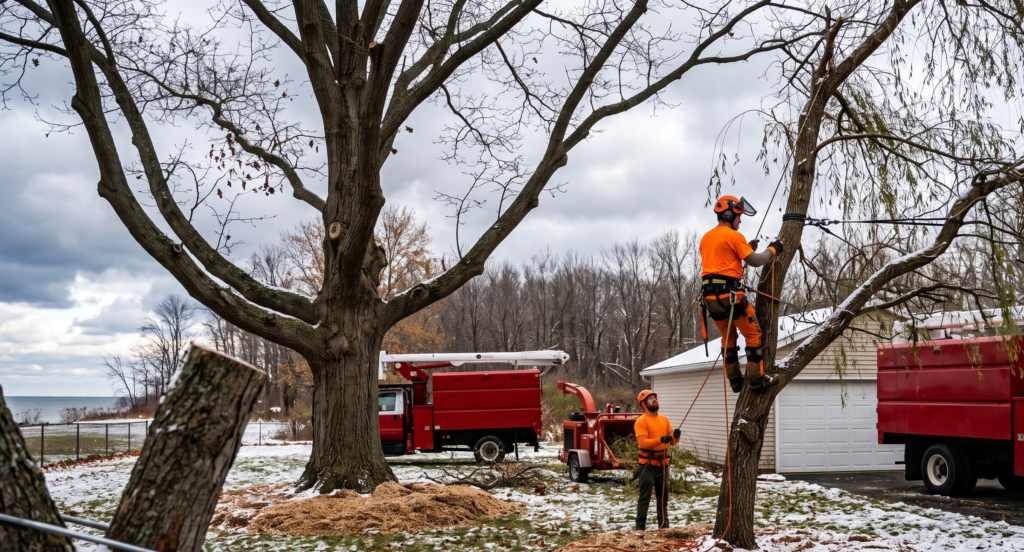
When a lake-effect squall sweeps across northern Monroe County, having dependable tree care nearby ensures emergencies are handled promptly. Operating from Hilton, NY, Branching Out Tree Service provides emergency hazard clearing, structural cabling, and seasonal pruning throughout the Lake Ontario shoreline corridor.
We dispatch our crews throughout the local area:
- Hilton & Village of Parma (along Route 259, Parma Center Rd, and Walker Rd)
- Hamlin & Clarkson (Lakeshore Road, Route 19, and the coastal plain)
- Greece & North Greece (Latta Rd, North Greece Rd, and English Rd corridor)
- Spencerport & Ogden (Route 31, Gillett Rd, and canal communities)
- Brockport & Surrounding Monroe County Neighborhoods
Whether you need “emergency tree removal near me“ after a winter blizzard takes down a large limb, or you want a preventative structural assessment, our local team is nearby and ready to help.
Find Branching Out Tree Service in Hilton, NY
Frequently Asked Questions
Q: How quickly can your Hilton crew respond to winter storm damage?
A: Because our trucks, rigging tackle, and chippers are stationed right on Walker Road in Hilton, we provide rapid emergency response across Hilton, Parma, Hamlin, and Greece during heavy lake-effect snow and ice emergencies.
Q: Do you service windswept properties right along the Lake Ontario shoreline?
A: Yes. Properties on the lakeshore experience sustained wind shear that exacerbates ice loading. We regularly inspect and secure large lakeside willows, maples, and pines to keep them safe against wind and freezing spray.
Protect Your Canopy Before the Next Storm Strikes
Winterizing your landscape protects both your property’s safety and the long-term value of your mature shade trees. Don’t wait for heavy snow to expose structural defects in your canopy.
Contact Branching Out Tree Service today:
- Phone: +1 585-667-8733
- Office & Yard: 75X5+3W Hilton, New York, USA
- Online Booking: branchingouttreehiltonny.com