When winter finally loosens its grip on Monroe County and the breeze off Lake Ontario begins to soften, our local landscapes start waking up. For Hilton homeowners, early spring is the single most critical window to inspect your property, nurse dormant trees back to vigor, and catch potential safety hazards before full leaf canopy develops. From salt spray along Route 18 to heavy, wet lake-effect snow loads that stress mature oak and maple branches, Western New York yards endure a unique winter beating.
Investing a morning into early-season tree care protects your home value, prevents storm damage, and ensures your shade and ornamental trees stay healthy all summer long.
Below is an arborist-approved spring tree care checklist tailored specifically to the microclimate, soil types, and native species found across Hilton and the greater Town of Parma community.
1. Inspect for Winter Storm & Lake-Effect Snow Damage
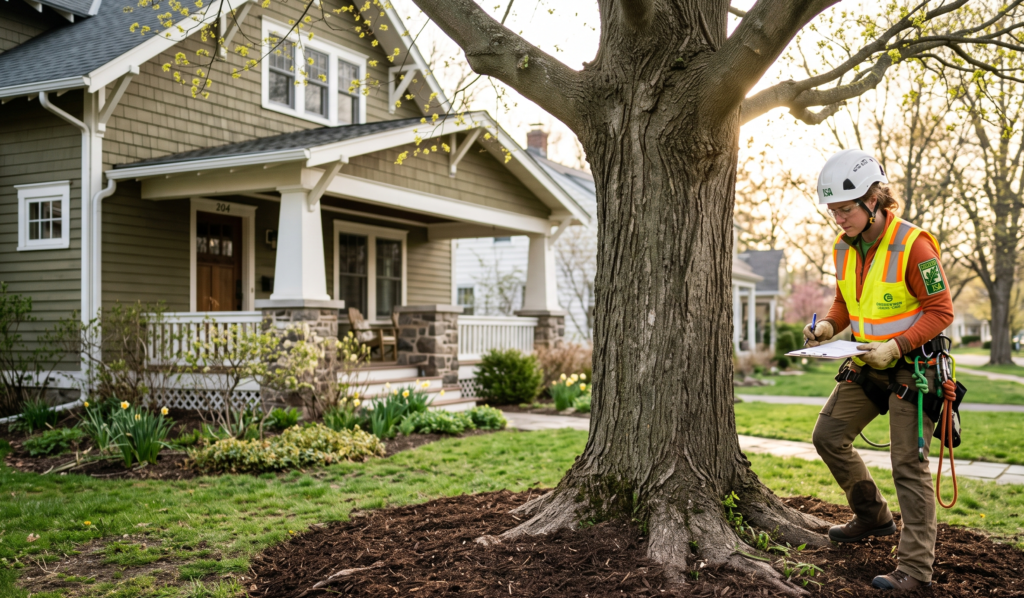
Before bud break turns your canopy into a wall of green, take advantage of the open view through bare branches. Winter storms in our pocket of upstate New York frequently leave behind structural weaknesses that aren’t obvious from your kitchen window.
- Scan the Canopy for “Hangers”: Look for broken, unattached, or split limbs hung up in lower branches. These dangling hazards easily dislodge during typical April gust fronts and fall onto rooflines, driveways, or play structures.
- Inspect Branch Unions: Look closely at V-shaped crotches on mature red maples, silver maples, and green ashes. Trapped moisture repeatedly freezes and expands inside tight unions, creating deep vertical stress fractures.
- Examine the Trunk Flare: Clear away remaining slush or dead turf around the base of the trunk where it meets the soil line. Look for frost cracking, sawdust-like frass (which indicates boring beetles), or signs of rodent bark-girdling that took place beneath winter snowbanks.
- Assess Root Ground Heave: High winds blowing across flat farmland and open lake approaches can rock saturated root systems. Check the windward side of your trees for mounded turf, freshly exposed roots, or radial soil fissures. Any leaning tree with fresh soil upheaval requires prompt professional evaluation.
Frequently Asked Questions
Q: Can a cracked branch heal on its own if left alone?
A: No. Trees do not heal damaged vascular tissue the way animals do; they seal off injured wood through compartmentalization (CODIT). A cracked limb remains structurally compromised permanently and serves as an open gateway for wood-rotting fungi and boring insects. Broken or split limbs should be pruned back to sound wood or the branch bark collar.
Q: How do I tell if ground heave around a leaning tree is dangerous?
A: If you see newly exposed feeder roots, raised turf on the side opposite the lean, or cracked soil following high winds, the root plate has sheared. In saturated lake-plain soils, a heaving tree has lost anchoring stability and poses an imminent tipping risk, requiring emergency arborist mitigation.
2. Schedule Early Spring Pruning (Deadwooding & Structural Thinning)
Late winter into early spring—just before leaf buds swell—is the premier window for structural pruning. At this stage, sap flow is awakening, canopy wounds compartmentalize rapidly with the spring growth surge, and fungal spores and insect vectors are still largely dormant.
What to Prune Right Now:
- The “Three Ds”: Remove any limb that is Dead, Damaged, or Diseased. Cutting away compromised wood eliminates nesting habitat for carpenter ants and wood-rot pathogens.
- Crossing and Rubbing Branches: Continuous friction between intersecting limbs wears through defensive outer bark, creating chronic friction wounds. Choose the structurally dominant branch and prune the competing one back to the lateral branch union.
- Suckers and Water Sprouts: Clip away vertical shoots emerging from root flares, rootstocks, or along main scaffold limbs. These draw resources away from the primary canopy without contributing to structural architecture.
Critical Arborist Warning for Hilton Oaks: To protect our local canopy against Oak Wilt (Bretziella fagacearum)—a lethal vascular fungus spread by sap-feeding nitidulid beetles—never prune mature red, white, or bur oak species once spring temperatures consistently rise above 50°F (typically April through July). Prune oaks while the weather remains consistently cold.
Frequently Asked Questions
Q: Is it harmful if sap begins bleeding from branch cuts on my maples or birches?
A: Heavy sap flow in late winter and early spring is completely harmless. It is driven by root pressure pushing water and carbohydrates upward through the xylem as the tree exits dormancy. The weeping stops naturally once leaves unfold and begin transpiring.
Q: Can I prune spring-flowering trees like crabapples and magnolias right now?
A: You can safely remove dead, hazardous, or broken branches at any time. However, extensive aesthetic thinning or shaping in early spring removes the flower buds set during the previous growing season. For maximum blooms, prune flowering varieties immediately after petal drop.
3. Clear Debris and Remediate Salt-Laden Turf
Road de-icing operations along Route 259, Route 18, and neighborhood subdivisions wash heavy concentrations of sodium chloride directly into roadside root zones, scorching tender feeder roots.
- Rake Matted Turf and Debris: Rake away wet, dense leaf mats and broken twigs from around the dripline. Wet surface debris traps stagnant moisture, incubating foliar diseases like anthracnose and apple scab.
- Flush High-Sodium Margins: If you have front-yard shade trees or ornamentals near the pavement or driveway apron, generously irrigate the soil with fresh water once the frost line disappears. Flushing leaches accumulated road salts below the top 6 to 12 inches of soil where seasonal root development occurs.
- Aerate Compacted Clay: Properties across Hilton, Parma, and Greece commonly sit on dense, glaciated clay soils that compact under snowpack and foot traffic. Core-aerating compacted turf out to the dripline restores gas exchange to subterranean mycorrhizal networks and fine root hairs.
Frequently Asked Questions
Q: What are the primary symptoms of road salt injury on residential trees?
A: Salt injury manifests as delayed spring bud break, scorched or curling leaf margins in early summer, and systemic branch dieback concentrated on the side of the canopy facing road spray or driveway drainage.
Q: Does spring precipitation wash out winter road salt on its own?
A: While rainfall dilutes surface salinity, deep clay soils retain sodium cations tightly. Slow, targeted water flushing is often required to break down high sodium concentrations and move chloride beneath the active feeder-root horizon.
4. Master Proper Spring Mulching Technique
Mulching regulates root temperature, minimizes moisture loss, and prevents mower strikes. However, improper mulching is one of the most common causes of tree decline in residential landscapes.
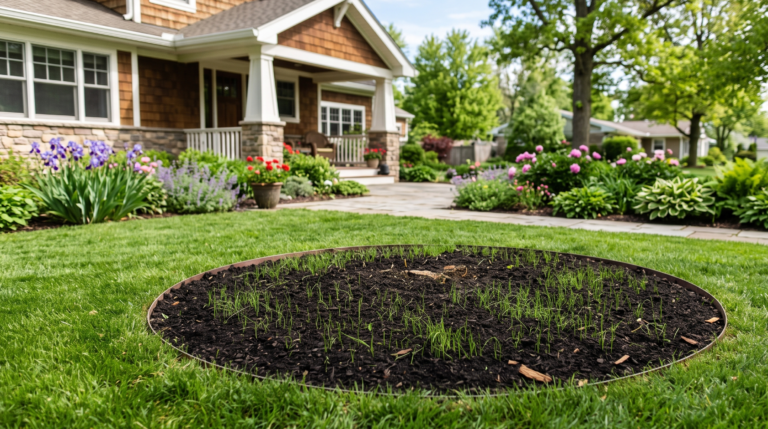
Follow the “Donut” Rule, Avoid the “Volcano”
Never mound wood chips against the trunk bark. Bark is meant for open air; burying it against wet wood chips suffocates gas exchange tissues (lenticels), promotes wood-rotting bark decay, shelters chewing rodents, and leads to stem-girdling roots that slowly strangle the base of the tree.
- Layer Depth: Spread high-grade organic shredded hardwood mulch 2 to 3 inches deep (no more than 2 inches on heavy clay soils).
- Spread Diameter: Extend the mulch circle outward to the edge of the branch canopy (the dripline) whenever practical.
- Expose the Root Flare: Leave a 3- to 4-inch buffer of bare soil between the edge of the mulch bed and the trunk base. The natural flare where the trunk widens to meet the ground must remain visible and exposed to the air.
Frequently Asked Questions
Q: Should I shovel out old mulch before putting down new wood chips this spring?
A: If your remaining mulch bed is still 2 to 3 inches deep, do not add more on top. Use a rake to break up hard, crusty, or hydrophobic mulch mats to restore water and air penetration. Only top-dress with a light half-inch dusting if you are refreshing faded appearance.
Q: Can I use fresh, unaged wood chips from a tree service on my yard?
A: Fresh arborist wood chips make clean, functional mulch. When applied to the soil surface (and never mixed into the planting hole), they break down naturally, nourish beneficial soil fungi, and do not rob nitrogen from deeper tree roots.
5. Assess Soil Moisture and Prepare Hydration Strategies
Spring weather around Lake Ontario can be unpredictable. Waterlogged yards in early April can quickly transition into dry, breezy spells in May that dehydrate shallow root systems—particularly on recently planted or young trees.
- The 2-Inch Moisture Check: Push a screwdriver or your finger 2 inches into the soil beneath your mulch bed. If the earth is cool and damp, the root zone holds sufficient moisture. If it feels hard, crumbly, or powdery, a deep watering cycle is needed.
- Deep, Infrequent Watering: Avoid brief, daily lawn sprinkler passes; shallow moisture encourages weak surface rooting that suffers during August droughts. Use an adjustable soaker hose placed around the outer third of the root dripline, running on low for 1 to 2 hours once every 10 to 14 days during dry spring stretches.
Frequently Asked Questions
Q: Do mature shade trees in Hilton need supplementary watering during spring?
A: Fully mature, established trees rarely need extra water during typical Western New York spring conditions. However, if early spring brings sustained wind and weeks without rain, a targeted, deep soaking helps support cellular turgor as the tree pushes out thousands of new leaves.
Q: What is the optimal time of day to water trees?
A: Water in the early morning between 6:00 AM and 10:00 AM. This gives water time to penetrate deep into the clay substrate without heavy midday evaporation and allows any splashed foliage to dry, preventing leaf spot diseases.
6. Monitor for Emerging Spring Pests and Fungal Blights
Rising temperatures wake up overwintering pests and fungal spores just as fresh foliage opens. Early detection keeps localized problems from spreading into full-canopy stress.
- Spongy Moth (formerly Gypsy Moth): Inspect rough trunk bark, fence rails, and under soffits for velvety, tan egg masses deposited during late summer. Scrape egg clusters into a bucket of warm, soapy water before they hatch into hungry caterpillars in May.
- Apple Scab & Hawthorn Rust: Very common on ornamental crabapples and serviceberries across Monroe County. If your flowering trees suffered early defoliation or leaf spotting last summer, protective organic or bio-fungicide sprays must be applied early—starting at bud swell and continuing through petal drop.
- Emerald Ash Borer (EAB): If your property retains untreated ash trees, look for sparse upper foliage, D-shaped exit holes through the bark, and dense clusters of water sprouts along the main trunk. Trunk micro-injections using emamectin benzoate applied between mid-spring and early summer provide reliable, multi-year vascular protection for healthy ash specimens.
Frequently Asked Questions
Q: Is it too late to treat an ash tree showing symptoms of Emerald Ash Borer?
A: If an ash tree has lost more than 30% to 50% of its upper canopy, its internal vascular system is generally too damaged to transport systemic treatments, and safe removal becomes necessary. If canopy dieback is under 30%, professional trunk injections can halt infestation and preserve the tree.
Q: Why does my crabapple lose half its leaves every July, and can I fix it in spring?
A: This premature leaf drop is caused by Apple Scab, driven by cool, wet spring lake breezes. Once the fungal infection shows up as olive-black spots on summer foliage, it cannot be reversed for that season. Preventive management must begin in early spring as soon as green leaf tips first break open.
Hilton Homeowner Spring Tree Care: Quick Reference
| Priority Level | Care Task | Optimal Timing | Key Objective |
| Immediate Safety | Broken Branch / Hanger Removal | March – Early April | Clear dangling hazards above driveways, structures, and walkways. |
| Vascular Health | Structural Pruning | Late Winter – Bud Break | Correct crossing limbs; prune oaks before temperatures exceed 50°F. |
| Root Protection | 2-3″ Proper Mulch Application | Mid-to-Late April | Keep mulch 3-4 inches away from trunk flare; avoid mulch volcanoes. |
| Disease Prevention | Pest & Fungi Scouting | April – May | Destroy spongy moth egg clusters; schedule bud-break sprays for scab. |
| Hydration Balance | Deep Root Soil Hydration | As needed after thaw | Slow, deep soaks along the dripline if spring rains taper off early. |
Reliable Tree Service in Hilton, NY and Surrounding Communities
When high winds whip inland from Lake Ontario or winter storms leave hazardous limbs hanging over your roof, finding dependable, fully insured tree service nearby is essential for keeping your home safe. Branching Out Tree Service delivers experienced arboricultural care, precision pruning, hazardous tree removal, and stump grinding across Hilton, the Town of Parma, and neighboring communities throughout Monroe County.
Communities & Neighborhoods We Routinely Serve:
- Village of Hilton & Town of Parma: Core residential neighborhoods, West Avenue, Lake Avenue, Parma Center, and rural parcels along Route 259.
- Hamlin & Lakefront Corridors: Shoreline windbreak maintenance, storm damage mitigation, and canopy care along Route 19 and the Lake Ontario State Parkway.
- North Greece & West Rochester Borders: Mature canopy preservation, structural cabling, and deadwooding along the Route 18 and Latta Road corridors.
- Spencerport & Clarkson Margins: Comprehensive land clearing, emergency limb removal, and residential pruning across the northern Erie Canal beltway.
Whether you live in the 14468 zip code, manage a shoreline property in Hamlin (14464), or need storm-damaged limbs evaluated in Spencerport (14559) or North Greece (14612), our crews are equipped with bucket trucks, compact lifts, commercial chippers, and crane support to handle any tree care challenge safely.
- Primary Phone: +1 (585) 667-8733
- Address: 259 Walker Rd, Hilton, NY 14468
- Direct GBP Profile / Reviews: Visit Branching Out Tree Service on Google Maps
- Website: branchingouttreehiltonny.com
When to Call a Certified Local Arborist
While clearing light ground twigs, pulling weeds, and spreading mulch are great weekend projects, high-canopy work and major structural evaluations require commercial safety gear, rigging equipment, and comprehensive insurance coverage.
Climbing mature hardwoods, operating around overhead utility lines, and assessing concealed trunk decay are hazardous tasks. If you spot a split trunk flare, heavy deadwood hanging above your roof or garage, sudden tree lean, or signs of root failure, contact a professional tree care service right away. Local arborists have the training and machinery to safely trim, cable, or remove hazardous trees—protecting your landscape investment and keeping your home safe.