When severe weather sweeps across Oneida County and Monroe County, mature trees face immense physical stress from lake-effect gales, heavy wet snow, freezing rain, and sudden microbursts. Towering specimens like mature silver maples, northern red oaks, eastern white pines, and legacy sugar maples are prized community assets that provide shade, curb appeal, and historical value. However, their vast branch architecture and dense canopies make them vulnerable when New York storm fronts stall overhead. At Branching Out Tree Service, our certified crews see firsthand how seasonal extremes compromise limb junctions, saturate root systems, and turn sound-looking giants into immediate hazards.
Understanding how severe weather destabilizes mature trees helps homeowners detect structural weaknesses early, preserve legacy specimens, and safeguard roofs, power lines, and driveways before the next front moves through.
1. Upstate New York Weather Patterns: The Double Threat to Canopies
Central and Western New York experience some of the most dynamic weather shifts in the Northeast. While Oneida County endures heavy Mohawk Valley snowfall and severe inland thunderstorm corridors, Monroe County absorbs the direct moisture and blunt wind energy coming off Lake Ontario. Both environments produce distinct forces that test tree physiology.
High-Velocity Winds and Microbursts
During summer squall lines and autumn cold fronts, straight-line winds frequently top 50 to 65 mph. A mature tree’s canopy acts like a massive sail. Aerodynamic drag transfers thousands of foot-pounds of torque down through the trunk directly into the root plate. When wind directions shift rapidly during a storm, the twisting force (torsion) causes internal delamination in wood fibers, leading to catastrophic stem failure or full windthrow.
Ice Storms and Radial Glaze Accumulation
Freezing rain is perhaps the most destructive weather event in Upstate New York. Ice glaze forms rapidly when surface temperatures dip just below 32°F while upper air layers remain above freezing:
- 0.25 inches of ice adds substantial weight that pulls outer twigs downward.
- 0.50 inches of ice increases branch weight up to 30 to 40 times, causing horizontal leaders to sag dramatically and snap.
- 0.75+ inches of ice triggers widespread failure of co-dominant stems, snapping large canopy limbs and tearing open trunks.
Heavy, Wet Lake-Effect Snow
Unlike light, powdery alpine snow, early- and late-season lake-effect events deposit dense, water-saturated snow. If an early freeze hits in October or November while deciduous trees like oaks and maples still hold stubborn foliage, surface area multiplies. The snow load quickly exceeds the structural tensile strength of major scaffolds, shearing limbs right at the collar.
Saturated Soils and Dynamic Root Failure
Prolonged rainstorms or rapid spring snowmelt saturate upstate soils—especially the dense clay-loam common across Hilton, Rochester, Utica, and Rome. Saturated soils lose friction and shear resistance. When strong gusts hit a waterlogged root zone, the soil liquifies slightly under pressure, allowing roots to lever upward out of the ground until the entire root plate lifts and tilts.
Frequently Asked Questions
Why do lake-effect snowstorms cause more tree branch breakage than typical winter snow?
Lake-effect precipitation draws moisture directly off the Great Lakes, producing dense, water-laden snow with high specific gravity. This extra weight puts an exceptional load on horizontal lateral branches compared to cold, dry powder.
At what sustained wind speed do mature trees begin to experience structural failure?
Sound mature trees generally flex safely in winds up to 40 to 45 mph. Once gusts exceed 50 to 60 mph, trees with hidden heartwood decay, tight branch crotches, or saturated root zones enter critical failure thresholds.
Does light icing (under 1/4 inch) pose an immediate threat to healthy shade trees?
Light glaze typically causes minor bending in healthy twigs without snapping main structural limbs. However, if paired with sustained 25+ mph wind gusts, even a quarter-inch of ice accumulation can trigger mechanical branch failure.
2. Structural Vulnerabilities in Mature Trees Under Storm Load
A healthy young tree bends and flexes with the wind, but a 60- to 100-year-old tree possesses rigid, massive heartwood. As trees age, internal defects develop that remain hidden until severe weather puts them to the test.
| Vulnerability Type | Mechanism of Failure During Storms | Primary Species Affected |
| Co-Dominant Stems | Two trunks of equal diameter grow side-by-side without strong interlocking wood, creating a wedge of trapped bark. Wind wedges them apart. | Silver Maple, Red Maple, Green Ash, Birch |
| Included Bark | Bark curls inwardly inside a tight V-crotch junction rather than fusing outward, creating an internal seam of structural weakness. | Silver Maple, Linden, Elm, Willow |
| Heartwood & Trunk Decay | Fungal pathogens (Inonotus, Ganoderma) digest inner lignified wood, creating a hollow cylinder that buckles under shear stress. | Sugar Maple, Beech, Norway Maple, Red Oak |
| Girdling & Constricted Roots | Lateral roots encircle the base of the trunk, choking structural anchor roots and leaving one side of the tree unanchored. | Norway Maple, Littleleaf Linden, Pin Oak |
| End-Heavy Scaffolds (Lion-Tailing) | Past unselective pruning removes inner leaves, forcing all dynamic weight to the branch tips and magnifying lever-arm forces. | Oak, Maple, White Pine |
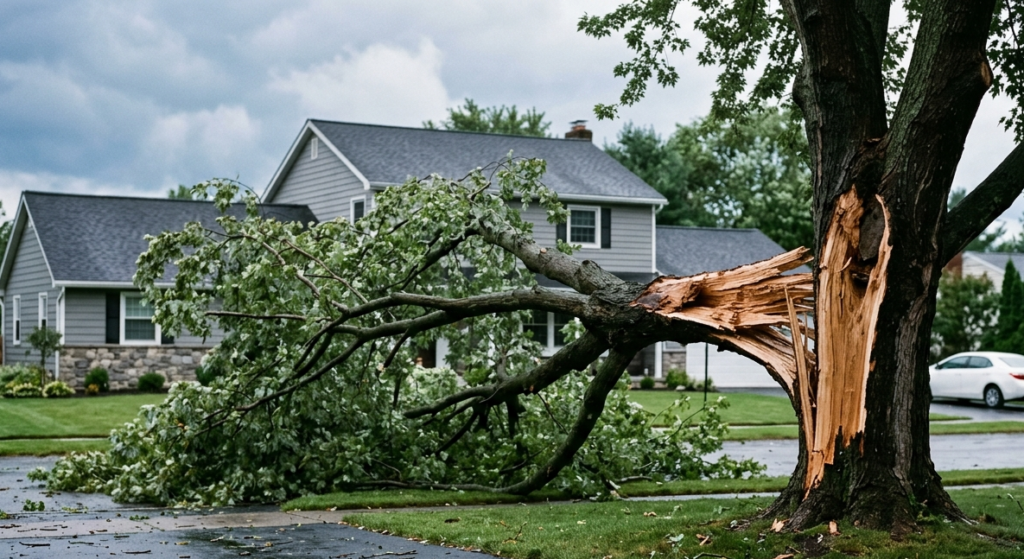
When heavy snow or sustained gale-force winds hit a mature tree with an included-bark union, dynamic leverage pulls the split apart. Unlike a clean pruning cut, a storm-induced split tears down the main trunk, exposing raw vascular tissue, inviting wood-rotting organisms, and threatening anything standing in its fall path.
Frequently Asked Questions
What is included bark, and how do I spot it from the ground?
Included bark occurs where two stems grow closely in a sharp “V” shape rather than an open “U” shape. Look for an inward seam or ridge running down the union where bark is pinched between the stems instead of forming continuous, interlocking wood grain.
Can a tree with internal trunk rot survive a severe wind event?
Yes, provided there is sufficient healthy outer sound wood (known as the shell). As an arborist rule of thumb, when the remaining sound wood shell drops below 30% to 33% of the trunk radius, the risk of catastrophic stem collapse under storm loads rises sharply.
Why does “lion-tailing” make a tree more vulnerable during high winds?
Lion-tailing strips off interior foliage, shifting all wind resistance and physical mass to the very ends of long branches. This increases dynamic torque and removes dampening points, causing branches to whip violently until they fracture.
3. High-Risk Tree Species Common to Monroe and Oneida Counties
While any tree can fail under severe conditions, certain species common to our yards, roadside buffers, and woodlots are biologically prone to storm damage:
Silver Maple (Acer saccharinum)
One of the fastest-growing and most widespread shade trees across Hilton, Rome, and Utica neighborhoods. Unfortunately, silver maple wood is soft, brittle, and notoriously prone to forming multi-leader stems with deep seams of included bark. During glaze ice storms or summer wind bursts, mature silver maples frequently drop 12- to 18-inch limbs directly onto structures.
Eastern White Pine (Pinus strobus)
Prized for its height, soft evergreen needles, and historic prominence throughout Central New York. Because white pines remain fully foliated year-round, winter windstorms catch the crown completely. Their soft wood and long horizontal branch tiers snap readily under heavy, wet snowfall.
Norway Maple (Acer platanoides)
Widely planted as post-war suburban street trees, mature Norway maples tend to develop shallow, tangled root systems and dense, heavy heads. The excessive canopy weight creates wind resistance, while subterranean root constriction makes them susceptible to complete uprooting during wet autumn gales.
Willow (Salix species)
Frequently found near waterways, ponds, and low-lying drainage basins in Monroe County lakefront regions. Their rapid growth results in weak, spongy cellular structures that break cleanly even under moderate wind gusts.
Frequently Asked Questions
Should I automatically remove an older silver maple close to my home?
Not automatically. Silver maples can often be safely retained through selective weight reduction pruning and canopy cabling systems. A certified arborist should evaluate the branch attachment angles and trunk sound-wood ratio before deciding on removal.
Why are white pines more likely to lose limbs in winter than deciduous maples?
White pines retain needles year-round, giving heavy, wet snow and freezing ice a massive surface area to latch onto. Deciduous maples drop their leaves in autumn, allowing winter wind and snow to pass through their branch skeletons with less drag.
Are native New York red oaks and sugar maples generally storm-hardy?
Yes. Oaks and sugar maples possess dense, high-tensile wood that resists shear forces much better than soft maples or poplars. However, because they grow slowly and live for decades, they are prone to internal heart rot and co-dominant leader splits if neglected.
4. Subterranean Stress: What Happens Underground
Homeowners evaluate what they see above ground, but tree stability depends on the root plate:
- Root Shear and Hinging: Structural roots (the thick, woody roots extending outward in the top 18–24 inches of soil) serve as physical guy-wires. When wind pushes hard to the east, the roots on the west side experience intense tensile (pulling) load, while the roots on the east side endure compressive (crushing) force.
- Soil Hydrology Changes: Saturated clay soils fail to hold roots tightly. As the tree levers back and forth during a 6-hour wind storm, roots loosen in their soil channels, creating an underground cavity.
- Delayed Failure: A tree rarely falls at the exact peak of a storm. Often, root fibers stretch and fracture microscopically during high winds. Days or weeks later, during a calm, quiet afternoon, the compromised root structure finally gives way under the tree’s dry weight.
Frequently Asked Questions
How deep do mature tree roots go to hold a tree against high winds?
Contrary to the common taproot myth, over 85% of a mature tree’s root system lies within the top 18 to 24 inches of soil. Trees anchor themselves through a wide, horizontal root plate that spreads two to three times wider than the dripline.
Why do saturated soils increase the risk of tree uprooting?
Water fills the pore spaces between soil particles, acting as a lubricant. Saturated clay soils lose the shear friction needed to lock structural root fibers in place, allowing the entire root plate to tilt upward under canopy wind loads.
What is “delayed windthrow,” and why does it happen after a storm has passed?
During extreme windstorms, roots can snap below ground without fully toppling the tree. Over the following days, gravity and the tree’s own weight gradually fatigue the remaining anchoring roots until the tree suddenly falls on a calm day.
5. Identifying Post-Storm Damage: An Arborist’s Inspection Checklist
After severe weather subsides, inspect mature trees from a safe distance before approaching property lines or walking beneath large limbs:
Immediate Hazard Indicators
- Soil Mounding or Fresh Heaving: Look at the windward base of the trunk. If the turf is lifted, cracked, or showing freshly exposed root flares, the root plate has shifted. The tree is in active failure and requires emergency stabilization or removal.
- Hangers and Widow-Makers: Broken branches trapped high in the canopy can dislodge at any moment without warning.
- Vertical Seams and Bark Cracking: Check main crotches where trunks diverge. Fresh, bright-colored wood showing along an old seam indicates the tree split under wind load.
- Sudden Canopy Lean: If a tree that previously stood vertical has developed an obvious pitch, especially toward a roofline or driveway, internal anchor roots have ruptured.
- Electrical Proximity: Limbs rubbing or hanging near power service drops create fire hazards and electrical path arcs. Never attempt to prune branches near utility lines yourself.
Frequently Asked Questions
What should I do first if a heavy branch is suspended over my driveway?
Immediately cordon off the area underneath to keep vehicles and family members out of the drop zone. Do not attempt to pull it down with ropes or poles; call an arborist with aerial rigging equipment to safely dismantle it.
How can I tell the difference between normal ground settlement and root plate heave?
Root plate heave produces cracked, lifted sod with freshly severed root tips and an obvious new lean in the tree trunk. Normal settlement is gradual, level, and does not alter the vertical angle of the trunk.
Is it safe to cut a fallen branch touching a residential service line?
No. Any tree limb touching or resting near an overhead wire can conduct high-voltage electricity to the ground, creating an immediate electrocution hazard. Contact your local power utility and an emergency tree service.
6. Proactive Storm Mitigation: Protecting Mature Trees Before Disaster Strikes
The safest tree service call is the one scheduled before an emergency response vehicle is parked on your street. Mature trees can be fortified to withstand regional weather extremes using ANSI A300 industry-standard tree care practices:
Crown Thinning and End-Weight Reduction
Rather than indiscriminately “topping” a tree—which destroys its natural structure, ruins curb appeal, and triggers weakly attached shoots—certified arborists use structural pruning. By selectively shortening overextended branches and thinning outer foliage, wind blows through the canopy rather than slamming against a solid wall of leaves. This reduces the lever-arm force on primary unions.
Crown Cleaning and Deadwood Removal
Dead, dying, and diseased wood has zero flexibility. During an ice or wind event, deadwood breaks off instantly. Regular crown maintenance eliminates these airborne projectiles before they land on vehicles or roof decking.
Dynamic and Steel Cabling Systems
For prized heritage trees featuring co-dominant leaders or slight structural fissures, cabling can bridge the gap. Flexible, high-tensile steel cables or synthetic dynamic systems are installed in the upper two-thirds of the canopy. The cables limit the lateral sway of twin trunks during violent wind gusts, preventing the junction from tearing apart while preserving the natural grace of the tree.
Structural Bracing
When an included bark split has begun at a major trunk fork, arborists can install through-bolts and threaded steel rods through the junction to mechanically clamp the union together, reinforced by overhead canopy cables.
Frequently Asked Questions
How does canopy cabling work during high winds?
Cables installed in the upper two-thirds of the tree connect twin leaders, allowing them to support each other. When wind pushes one stem, the cable transfers the load across to the opposing stem, preventing the fork from splitting.
How often do structural tree support cables need to be inspected?
Cabling and bracing hardware should be re-inspected by an arborist every 1 to 2 years, as well as following major storm events, to ensure proper tension and tree health around anchor points.
What is the difference between ANSI A300 structural pruning and tree topping?
ANSI A300 structural pruning selectively reduces specific branches back to lateral branches without damaging the branch collar. Topping cuts off large limb ends indiscriminately, causing widespread decay and creating hazardous, weakly attached regrowth.
7. Emergency Response and Tree Recovery in Hilton and Oneida County
When severe weather snaps limbs or downs an entire tree, handling the aftermath safely requires seasoned personnel, commercial rigging gear, and specialized safety protocols.
Safety and Perimeter Control
Storm-damaged trees are under complex tension and compression. An improper chainsaw cut can release thousands of pounds of stored energy, causing broken limbs to kick back violently. Professional tree crews secure the drop zone, verify electrical clearances, and establish rigging friction points before cutting into compromised wood.
Controlled Rigging and Removals
When a large limb rests on a roof or an unstable trunk leans toward a building, ground drops are not an option. Teams utilize aerial lifts, precision friction brakes, and crane operations to lift sections vertically away from property without causing secondary impact damage.
Complete Debris Processing and Stump Grinding
Safe cleanup doesn’t stop once the hazard is on the ground. Extensive root systems from uprooted trees disrupt yard grades and foundation edges. Heavy-duty brush chippers, log loaders, and deep-reach stump grinders restore the property to grade, clearing every chip and branch so the turf can heal.
Frequently Asked Questions
Can a tree resting on a roof be removed without causing more home damage?
Yes. Tree services use cranes and friction rigging to piece out the tree section by section. By taking the weight off the structure vertically, crews avoid dragging limbs across the roof shingles.
What information should I record for my insurance adjuster after a tree falls?
Take clear photos and videos from multiple angles showing the tree, the point of failure, and the damaged structure or driveway. Avoid touching or moving debris until your insurer and an insured tree removal professional document the scene.
How quickly can an emergency tree service secure a hazardous tree after a storm?
Experienced local emergency crews typically respond within a few hours to establish a safe perimeter, eliminate immediate hazards to life and property, and stabilize damaged trunks before full removal.
8. Finding a Certified Tree Service “Near Me” in Monroe and Oneida Counties
When sudden severe weather downs limbs across your driveway or splits a mature trunk near your roof, typing “emergency tree service near me” into your phone needs to deliver real, local results—not lead brokers or storm chasers from out of state.
Google matches “near me” searches using proximity signals, dispatch corridors, and verified local physical facilities. Branching Out Tree Service operates physical hubs and rapid deployment staging areas designed to serve both the Monroe County lakefront region and our dedicated Oneida County route corridors.
Monroe County / Greater Rochester Proximity Corridors
Headquartered at 259 Walker Rd, Hilton, NY 14468, our Monroe County crews stage along Route 259 (Union St), NY-18 (Roosevelt Hwy), NY-261 (Manitou Rd), and the Lake Ontario State Parkway, serving:
- Hilton & Village of Parma: Fast dispatch along Walker Rd, Wilder Rd, and Parma Center Rd.
- Town of Greece & Charlotte: Coastal lakefront wind hazard response along Edgemere Dr, Beach Ave, and Latta Rd.
- Hamlin, Clarkson & Brockport: Windbreak assessments, rural lot clearing, and structural pruning along Route 19 and Route 104.
- Gates, Chili & Irondequoit: Comprehensive residential canopy maintenance and stump grinding.
Oneida County / Mohawk Valley Service Corridors
Our Central New York regional crew handles mature tree restoration, municipal storm clearing, and dangerous takedowns along Route 5, NY-49, NY-12, and NY-12B, regularly deployed across:
- Rome & Utica: Immediate storm cleanup for urban parkway lots, co-dominant maple removals, and emergency crane work.
- New Hartford, Whitesboro & Marcy: Heritage oak preservation, cabling, and hazardous split-crotch takedowns.
- Waterville, Clinton & Vernon: Rural canopy thinning, windbreak reconstruction, and field clearance.
Direct Google Business Profile Map Verification
Verifying our registered location ensures that your insurance claims and emergency dispatch connect directly with a licensed, insured New York contractor:
Frequently Asked Questions
How fast can a tree crew reach my home during a widespread storm?
For emergencies involving trees on homes or blocking primary access roads, our Monroe County and Oneida County crews prioritize life-safety calls and dispatch within 1 to 3 hours.
Do you provide free on-site tree assessments in both Monroe and Oneida counties?
Yes. We provide free, written on-site evaluations covering structural defects, hazard classifications, and transparent pricing with no hidden travel surcharges.
Why does Google Maps show your location in Hilton if you work in Utica and Rome?
Branching Out Tree Service maintains its primary registered equipment yard in Hilton (Monroe County) while managing regular service routes and emergency deployments across Oneida County. Both regions receive dedicated local equipment and fully insured crews.
Protect Your Property with Branching Out Tree Service
Don’t wait for the next winter gale or summer squall line to expose hidden defects in your canopy. Whether you need preventative crown trimming, structural branch cabling, hazardous tree removal, or 24/7 storm damage emergency response, Branching Out Tree Service brings over 15 years of arboricultural field experience to your home.
- Website: branchingouttreehiltonny.com
- Dispatch Phone: (585) 667-8733
- Monroe County Address: 259 Walker Rd, Hilton, NY 14468
- Regional Service Hubs: Hilton, Parma, Greece, Rochester, Hamlin, Rome, Utica, New Hartford, and Whitesboro.
- Credentials: Fully Licensed & Insured, Free On-Site Assessments, 24/7 Rapid Emergency Response.