Tackling a major weekend project around your yard brings a genuine sense of accomplishment, but when a leaning pine or dead ash branch threatens your roof, taking on a DIY tree removal is one of the most dangerous gambles a homeowner can take. While renting a chainsaw and watching a quick video online might make the task seem straightforward, felling timber is an unforgiving trade where minor miscalculations lead to catastrophic property damage, severe bodily harm, or even fatal accidents. Real tree care demands a deep understanding of wood mechanics, tension, rot patterns, and controlled rigging. Working with a certified arborist ensures that mature trees, dead limbs, and hazardous canopies are dismantled systematically and safely, protecting your family, your home, and your wallet from irreversible mistakes.
At Branching Out Tree Service, our local arborists evaluate trees across Hilton and surrounding communities every day. We regularly witness the aftermath of well-intentioned do-it-yourself attempts: crushed sheds, sliced utility feeds, ruined driveways, and panicked emergency calls. Before you climb a ladder or fire up a saw, let’s break down why taking down a tree yourself is rarely worth the risk, what hidden forces are at play, and why partnering with an insured, certified tree care specialist is the safest decision for your property.
Frequently Asked Questions
Q: Is it ever legal or permitted for homeowners to remove trees on their own property in New York?
A: Yes, in most residential areas, property owners are legally allowed to cut down non-protected trees situated entirely within their property boundaries. However, local town ordinances, municipal preservation codes, or HOA bylaws may require specific felling permits before work begins—especially near public rights-of-way or conservation easements.
Q: Why do homeowners underestimate the difficulty of taking down a tree?
A: Most people view tree removal as a standard gardening chore scaled up. They assume a simple notch cut guarantees a straight fall path, overlooking internal wood density, asymmetric canopy weights, and the violent physics involved when thousands of pounds hit the ground.
The Illusion of the “Simple” Weekend Tree Cut
From ground level, cutting down a backyard tree often looks like basic geometry: notch a wedge on the side you want it to land, cut from behind, and let gravity do the work.
In reality, living and dying wood rarely behaves like a clean wooden post. Every mature canopy holds thousands of pounds of uneven, shifting weight distributed across asymmetrical limbs. When you cut into wood fibers, you are interacting with intense internal mechanical stresses—specifically compression (fibers being pushed together) and tension (fibers being pulled taut like coiled steel cables).
The moment a saw enters a trunk or branch under load, those forces release instantly. Without professional training, a homeowner cannot reliably predict:
- Barber chairing: A vertical splitting of the trunk before the cut is complete, which kicks the butt of the tree backwards at lethal speed.
- Spring poles: Branches pinned under structural tension that whip out violently when severed, easily shattering bones or throwing a worker off balance.
- Directional kickback: Saw blade binding that violently recoils the running chainsaw toward the operator’s chest, neck, or face.
What feels like an afternoon chore can turn into a life-threatening emergency within milliseconds.
Frequently Asked Questions
Q: What exactly causes a chainsaw to experience “kickback”?
A: Kickback happens when the upper tip of the guide bar (the kickback danger zone) touches wood or another solid object, or when wood pinches the saw chain mid-cut. The kinetic energy instantly pivots the running bar upward and backward toward the operator’s upper body.
Q: Can cutting small wedges prevent a tree from splitting upward into a barber chair?
A: Proper face-notch geometry (such as an open-face notch exceeding 70 degrees) combined with a boring back-cut reduces risk, but heavy natural leans or internal wood decay can cause a tree to snap prematurely regardless of surface cuts unless calculated with expert precision.
5 Hidden Dangers of DIY Tree Removal
To understand why arboriculture consistently ranks among the most hazardous professions in North America, you have to look at the hidden factors that unseen rot, gravity, and improper gear introduce into an amateur work zone.
1. Invisible Internal Decay and Heart Rot
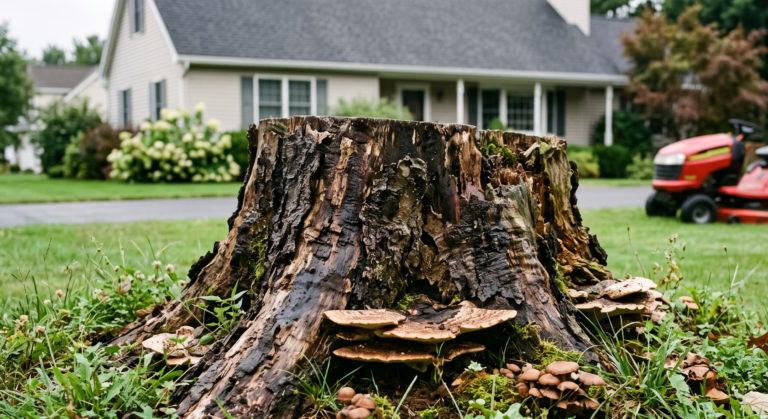
A tree can present a full, green canopy of leaves while its interior trunk is little more than soft pulp or an empty pipe. Fungal infections, carpenter ant colonization, and trunk rot eat away the structural core long before outward signs become obvious to an untrained eye.
When you make a feeling cut into a trunk hollowed by heart rot, standard hinge-wood principles fail completely. The tree does not guide gently into your drop zone; instead, it buckles prematurely, twists unpredictably, or collapses directly on top of the person holding the saw.
2. High-Voltage Utility Lines and Arc Flashes
Overhead power lines are a constant hazard in established residential neighborhoods. Trees that grow alongside service drops or main lines often conduct electricity even without direct contact.
Electricity can easily arc—jump across air gaps—from high-voltage lines directly to a ladder, a pole saw, or moist wood fibers. Cutting a limb that contacts an active line not only risks lethal electrocution but can blow transformers, spark neighborhood-wide power outages, and trigger structural fires. Certified tree crews undergo rigorous electrical hazard training (EHAP) and coordinate directly with local utility companies before making cuts near energized lines.
3. Ladders: The Number One Culprit in Yard Accidents
Homeowners frequently prop an aluminum or fiberglass extension ladder against an unstable tree trunk to trim an overhanging branch.
This creates an immediate death trap. When a cut branch snaps free:
- It can swing unpredictably into the base of the ladder, kicking it out.
- The sudden loss of branch weight causes the main trunk to violently oscillate, throwing the ladder off balance.
- The homeowner is left trying to balance a running, two-handed chainsaw with zero fall arrest or climbing harness tied into an independent anchor point.
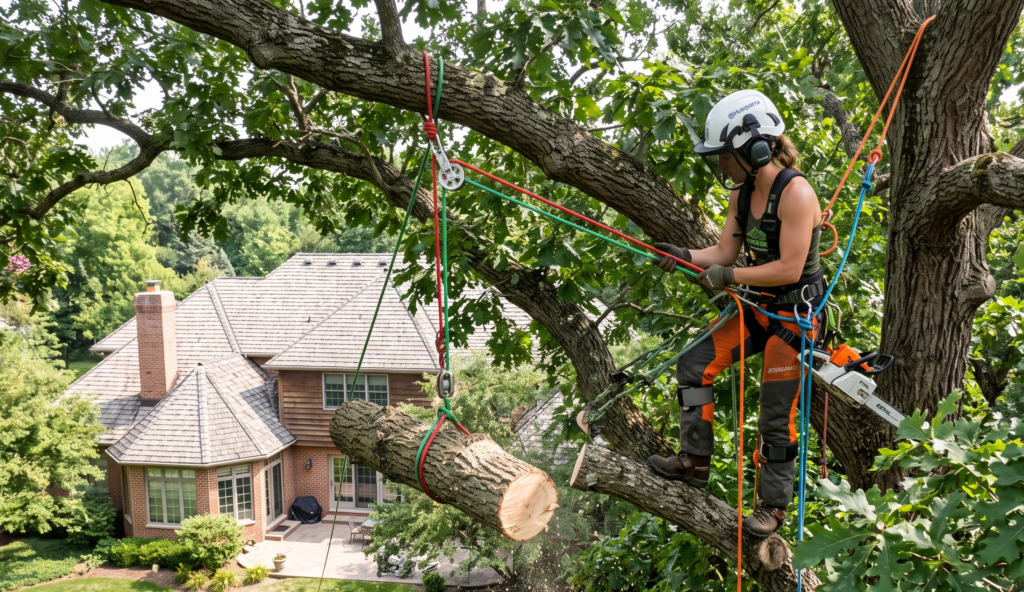
Professional arborists never perform heavy tree felling from free-standing ladders. When climbing is necessary, crew members use certified harnesses, dual-lanyard tie-ins, aerial work platforms, and friction-controlled aerial rigging.
4. Zero Control Over the “Drop Zone”
Felling a tree requires an unobstructed, calculated landing strip that spans more than the total height of the tree, plus a clear 45-degree retreat path for the crew. In a standard suburban or residential lot, obstacles are everywhere:
- Neighboring fences, garages, and pool enclosures
- Buried septic tanks, sprinkler systems, and gas meters
- Overhead telephone and power infrastructure
- Paved driveways that crack under the kinetic impact of multi-ton logs
Without specialized rigging systems—including friction blocks, porta-wraps, and rated bull ropes to lower wood piece-by-piece—a falling limb will take the path of least resistance, often right through your living room ceiling or your neighbor’s vehicle.
5. Inadequate Personal Protective Equipment (PPE)
A pair of sunglasses, gardening gloves, and earplugs do not make a safety kit. Professional tree workers wear specialized ballistic Kevlar chaps designed to instantly bind and stop a chainsaw drive-sprocket spinning at thousands of RPMs. They operate with impact-resistant arborists helmets featuring integrated mesh face shields, class-rated steel toe boots, and shatterproof eye protection. Lacking this gear turns minor slips into devastating physical injuries.
Frequently Asked Questions
Q: Can you tell if a tree has internal heart rot just by knocking on the bark?
A: While sounding a trunk with an arborist mallet can reveal hollow resonance, it requires extensive tactile experience. Arborists frequently use specialized micro-drills or sonic tomographs to map hidden internal decay across trunk cross-sections accurately.
Q: How far away should bystanders stand during a backyard tree felling?
A: Industry safety standards require all non-essential personnel and bystanders to remain at a distance of at least two and a half times the total height of the tree being dropped.
What Does a Certified Arborist Do Differently?
A certified arborist is not just an individual with a saw and a truck; they are trained plant-health technicians and tree-safety specialists credentialed through rigorous industry organizations like the International Society of Arboriculture (ISA).
When you hire a credentialed team like Branching Out Tree Service, our crew approaches your property with engineering-level precision.
| Factor | DIY Approach | Certified Arborist Process |
| Hazard Assessment | Visual guess based on ground view | Comprehensive trunk sounding, root-flare inspection, structural lean calculations, and pest/disease evaluation |
| Climbing & Access | Extension ladders, stepladders | Static and dynamic climbing ropes, canopy saddles, bucket trucks, or specialized lift equipment |
| Rigging & Lowering | Letting limbs drop freely or using hardware-store rope tied to a pickup truck | Friction brake systems, heavy-duty blocks, pulleys, and rated arborists lines to lower tons of wood silently without turf damage |
| Underground Knowledge | Risk of crushing septic tanks, buried lines, or root-damaged utility mains | Detailed site walk, utility mark-outs, and ground-protection mats to safeguard driveways and lawns |
| Debris Management | Piles of hazardous logs left to rot or days of backbreaking manual hauling | Commercial wood chippers, whole-log loaders, stump grinding, and thorough debris cleanup |
| Insurance Coverage | Homeowners bear 100% of the liability for property damage and medical injury. | Comprehensive general liability and workers’ compensation coverage protecting you from any claim |
Frequently Asked Questions
Q: What credentials should I verify before hiring a tree service company?
A: Always verify ISA (International Society of Arboriculture) certification credentials, a current Certificate of Insurance (COI) sent directly from their insurance broker confirming active general liability and workers’ compensation, and relevant state business licenses.
Q: Why shouldn’t rope from a local hardware store be used for rigging branches?
A: Standard retail ropes lack the tensile strength, shock absorption, abrasion resistance, and safety margins needed for dynamic loads. Professional arborist bull ropes are rated for thousands of pounds of falling kinetic energy.
The Real Cost Equation: Is DIY Tree Removal Actually Cheaper?
The primary reason property owners attempt tree felling on their own is the desire to save money. However, an honest financial assessment reveals that DIY removals frequently end up costing multiples of what professional service would have cost in the first place.
| Expense Category | Typical DIY Out-of-Pocket Cost | Professional Arborist Service |
| Equipment Rental / Purchase | $250 – $600 (chainsaw, rated ropes, safety chaps) | Included in service quote |
| Hauling & Waste Disposal | $250 – $700 (trailer rental + local landfill tipping fees) | Included (chipped on-site or hauled) |
| Minor Property Repairs | $1,200 – $4,000 (crushed fences, gouged lawns) | Prevented via zero-impact rigging |
| Major Catastrophic Damage | $5,000 – $35,000+ (structural roof puncture, utility repair) | Covered by commercial general liability |
| Emergency Room Trauma Care | $10,000 – $50,000+ (chainsaw cuts, ladder fractures) | Zero physical risk to homeowner |
Will Homeowners Insurance Cover DIY Accidents?
Many property owners assume their standard policy will cover any mishaps. That is a dangerous assumption.
If an insurance adjuster determines that structural damage was caused by gross negligence—such as an unlicensed, untrained individual taking down a massive tree without proper safety precautions—the insurer can dispute or deny the claim outright. Furthermore, if a falling tree damages your neighbor’s home or injures a bystander during your amateur felling operation, you may face direct civil liability and costly legal battles.
Professional tree companies carry dedicated commercial general liability and workers’ compensation insurance. If anything unexpected occurs, the contractor’s policy covers the cost—never yours.
Frequently Asked Questions
Q: If a branch from my tree falls on my neighbor’s shed during a DIY attempt, will their insurance cover it?
A: Their insurance might initially pay for the repairs, but their insurance carrier will immediately pursue subrogation against you personally because the damage resulted from an active, amateur felling operation rather than an unpredictable act of God.
Q: Are equipment rental deposits refundable if I damage a rental saw on a tree stump?
A: No. Hitting soil, stones, or hidden metal fencing embedded in tree trunks dulls and ruins chains quickly, often leading rental companies to charge steep chain replacement and repair fees.
How Professionals Tackle Complex Removals Step-by-Step
Understanding the systematic method professional arborists follow clarifies why DIY shortcuts are so dangerous. A professional tree removal involves a sequence of technical phases designed to eliminate variables:
- Pre-Work Hazard Assessment: The crew studies wind speed, natural tree lean, structural defects, rot pockets, and nearby targets (homes, sheds, overhead lines, septic fields).
- Establishing Drop Zones and Retreat Paths: Ground workers establish a secure perimeter where bystanders are barred. Two distinct, clear escape routes are cleared behind the tree’s anticipated fall line.
- Piecing Out the Canopy (Sectional Dismantling): In tight spaces, trees are rarely dropped in a single piece. An arborist ascends into the crown and systematically removes branches from the bottom up.
- Controlled Friction Rigging: Large overhanging limbs are tied into dynamic rigging lines. Ground personnel use specialized friction devices on the ground to arrest the falling weight in mid-air, lowering heavy logs safely around delicate landscaping.
- Notching and Felling the Trunk: The final spar is carefully notched using precise face cuts (such as an open-face notch) and a controlled back cut, maintaining a calibrated wooden “hinge” that steers the trunk directly into the designated drop zone.
- Chipping, Hauling, and Site Remediation: Brush is processed into mulch on-site, heavy wood is hauled away, and the work area is raked clean.
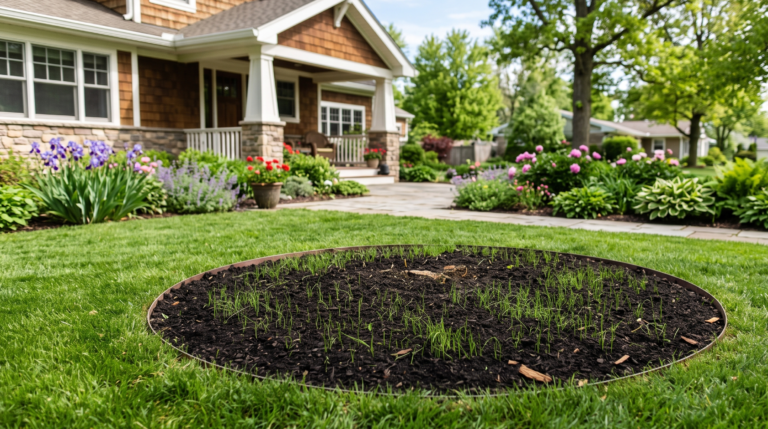
- Stump Grinding: Specialized machinery grinds the remaining stump several inches below grade, breaking up root flares so the yard can be replanted or reseeded.
Frequently Asked Questions
Q: Why don’t arborists just chop down every tree in one complete piece?
A: Most residential yards do not have the horizontal clearance required to drop a 60- to 80-foot tree without striking foundations, fences, septic systems, or landscaped borders. Sectional dismantling keeps the entire process contained and controlled.
Q: Is stump removal automatically included in a standard tree removal estimate?
A: Typically, stump grinding is quoted as a separate, complementary service because it requires dedicated track-driven grinding equipment and underground utility locates before work begins.
What Can a Homeowner Safely Handle Themselves?
While full-scale removals and overhead pruning should always be left to certified tree professionals, homeowners can take on basic yard maintenance tasks safely:
- Pruning Small, Ground-Level Ornamental Trees: Thinning fruit trees or trimming small shrubs where both feet stay firmly planted on the ground.
- Removing Ground Suckers and Water Sprouts: Pruning thin, soft growth sprouting around the base of trees using bypass hand pruners.
- Clearing Fallen Brush and Small Kindling: Clearing small, loose branches scattered across the lawn following moderate windstorms, provided no power lines or tensioned limbs are involved.
- Monitoring Tree Health: Keeping an eye out for fungal conks, dying canopies, cracked bark, or insect infestations so you can call a professional before the hazard worsens.
The Clear Line for Calling a Certified Arborist:
- The tree is taller than 10–12 feet.
- Any part of the canopy hangs near homes, outbuildings, fences, or driveways.
- Overhead electric or telecommunication lines are within 10 feet of the branches.
- The tree shows signs of severe lean, trunk decay, hollows, or fungal growth.
- The trunk or large limbs are under tension following storm damage.
Frequently Asked Questions
Q: What is the maximum branch thickness a homeowner should prune on their own?
A: Homeowners should generally avoid pruning branches thicker than 2 to 3 inches in diameter, especially if they are out of arm’s reach from the ground, as they can pinch handsaws or drop unexpectedly.
Q: Is it safe to use a pole saw to cut high limbs while standing on the ground?
A: Pole saws are convenient, but cutting limbs directly above your head is dangerous. Falling branches frequently slide down the shaft or bounce erratically off lower branches directly toward the operator.
Why Local Hilton, NY Homeowners Trust Branching Out Tree Service
Tree work in Upstate New York comes with unique regional challenges. From heavy lake-effect snow loads and severe freezing rain to windstorms sweeping off Lake Ontario, our local trees endure extreme stress year-round. Rotten ash trees affected by the Emerald Ash Borer and mature hardwoods with split leaders require an experienced eye that understands local species, regional soil types, and seasonal weather patterns.
At Branching Out Tree Service, we pride ourselves on delivering:
- Certified Arborist Expertise: Every tree project is planned and executed according to strict arboricultural safety standards.
- Comprehensive Equipment: From high-capacity chippers to specialized rigging gear, we manage projects safely without chewing up your lawn.
- Full Insurance Coverage: We carry full liability and workers’ compensation coverage for complete peace of mind.
- Prompt Emergency Response: When severe weather drops a limb across your driveway or leans an unstable trunk over your roof, our 24/7 crew responds quickly to stabilize and clear your property.
- Spotless Cleanup: We leave your yard looking better than we found it—hauling wood, chipping brush, and raking away stray debris.
Frequently Asked Questions
Q: Why are ash trees in the Hilton and Monroe County area particularly hazardous to remove?
A: The Emerald Ash Borer causes ash wood to rapidly lose moisture and structural elasticity, making dead ash trees notoriously brittle. They can snap without warning under a climber’s weight, making mechanized bucket removals essential.
Q: Does winter weather prevent professional tree removals in Hilton?
A: Not at all. Winter is often an ideal time for tree removals; dormant trees carry less foliage weight, and frozen turf protects lawns from heavy machinery impacts.
Looking for Professional Tree Removal Near You in Hilton, NY?
When searching for reliable tree removal near me, property owners along the Lake Ontario shoreline and throughout Monroe County need more than just a quick response—they need a fully licensed, fully insured local crew with the specialized machinery to handle tight-quarter felling safely.
Headquartered right here in Hilton, NY, Branching Out Tree Service serves homeowners, property managers, and commercial accounts across the entire northwest Rochester metropolitan corridor. Whether you are dealing with a wind-cracked willow along Route 259, a dead red oak leaning toward a fence line in Parma, or storm debris on Lake Road, our team is dispatched locally to handle the job fast.
Primary Service Areas Across Monroe County & Surrounding Towns:
- Hilton & Village of Hilton (14468): Comprehensive tree trimming, hazardous tree removal, and crane-assisted take-downs.
- Parma & North Chili (14559): Emerald Ash Borer mitigation, lot clearing, and deep-root fertilization.
- Hamlin & Clarkson (14464, 14430): Shoreline wind damage prevention, structural pruning, and emergency tree work.
- Greece & North Greece (14612, 14616, 14626): Canopy thinning, branch overhang clearing near utility drops, and stump grinding.
- Spencerport & Ogden (14559): Preventative storm inspections, split-crotch cabling, and deadwood clearing.
- Brockport (14420): Historic hardwood preservation and residential timber dismantling.
Find Branching Out Tree Service on Google Maps.
To confirm our verified location, view driving directions, or check our latest customer reviews, refer to our official Google Business Profile below:
Frequently Asked Questions
Q: How quickly can your crew reach my property for an urgent tree removal near me?
A: Because our equipment yards are located right in the Hilton/Parma area, our emergency response crews can arrive on-site within 1 to 2 hours for storm-damaged trees threatening homes, driveways, or power lines across Greece, Hamlin, and Hilton.
Q: Do you charge an extra travel or dispatch fee for properties outside the Village of Hilton?
A: No. We offer free on-site tree risk assessments and detailed written quotes across our entire Monroe County service radius without arbitrary travel or fuel surcharges.
Protect Your Home and Safety: Call the Local Tree Experts
Attempting to cut down a mature or compromised tree on your own isn’t just an exhausting chore; it’s a high-stakes hazard that puts your home and physical safety in jeopardy. Let an experienced, certified arborist handle the heavy lifting, dangerous cuts, and precision rigging.
If you have a dead, diseased, storm-damaged, or hazardous tree on your property, don’t take unnecessary risks. Visit Branching Out Tree Service today to schedule a thorough, on-site hazard evaluation and get a transparent, written estimate from your local tree care specialists!
Frequently Asked Questions
Q: How quickly can Branching Out Tree Service evaluate a hazardous tree?
A: For active emergencies posing immediate threats to homes or driveways, emergency crews respond promptly. Standard on-site consultations and detailed estimates are typically scheduled within a few business days.
Q: What happens to the wood and debris after Branching Out completes a removal?
A: Our crews can chip the brush for organic mulch, haul away heavy trunk wood, or buck suitable hardwood logs into manageable lengths for you to season and burn for personal firewood upon request.