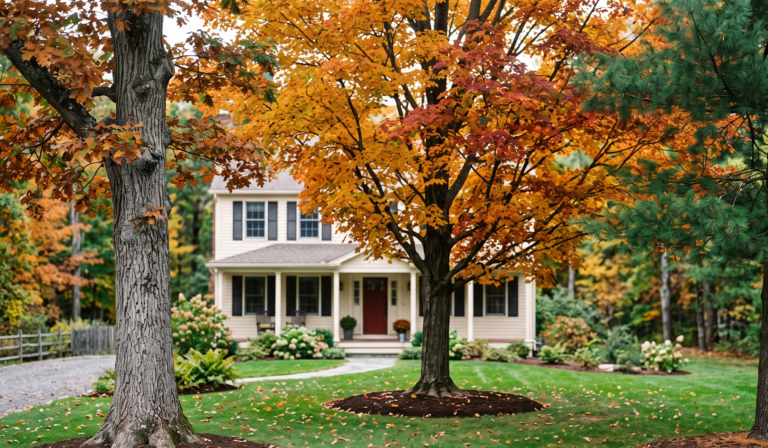
A sudden crack, a violent gust of wind off Lake Ontario, and a heavy thud—few moments shake a homeowner quite like an unexpected tree failure. In Hilton, NY, and throughout Monroe County, severe weather can turn a majestic backyard oak, sugar maple, or weeping willow into an immediate structural hazard within seconds. When heavy timber crashes down, knowing what to do in a tree emergency keeps your family safe, prevents secondary structural collapse, and streamlines your path through complex homeowners insurance claims. Whether a split trunk is resting on your pickets, a massive limb has blocked your vehicle in the driveway, or an entire canopy is crushing your rafters, taking deliberate, measured steps is the key to regaining control.
At Branching Out Tree Service, our ISA-certified arborists and emergency tree crews respond round-the-clock across Hilton, Greece, Hamlin, Parma, and Rochester. Over decades of cutting storm-damaged wood out of living rooms and off blocked access routes, we have seen firsthand how fast panic can lead to dangerous DIY mistakes. This comprehensive guide outlines the exact, step-by-step actions you must take when a tree falls on a fence, driveway, or roof—protecting your life, preserving your property, and setting up an airtight insurance claim.
1. Immediate Safety First: The 360-Degree Hazard Sweep
Before you inspect property damage or reach for a camera, step back and evaluate immediate threats to human life. A fallen tree creates a dynamic, unstable environment where secondary hazards frequently cause more injuries than the initial collapse.
Rule Out Live Electrical Lines
Never approach a downed tree until you have confirmed there are zero utility lines caught in its limbs.
- Look Up and Down: Scan the canopy and the ground. High-voltage lines can snap, become hidden beneath thick foliage, or electrify conductive materials like metal fencing, aluminum gutters, and waterlogged soil.
- Assume Every Wire Is Energized: Even if a line is silent, arcing nothing, or appears insulated like a cable television or telecommunications drop, treat it as lethal high-voltage power.
- Report Immediately: If lines are damaged, down, or sparking, step at least 35 feet away and contact your local utility provider (such as Rochester Gas and Electric / RG&E at 800-743-1701) immediately before calling an arborist. Call 911 if there is active smoke, fire, or immediate structural danger.
Evacuate Structural Impact Zones
If a trunk or major branch has struck your house:
- Evacuate the Upper Levels: Immediately leave rooms directly beneath or adjacent to the impact point. Ceilings, drywall, and rafter systems can experience delayed failure minutes or hours after initial impact under sustained mechanical deadweight.
- Account for Family and Pets: Move everyone to an unaffected wing of the house or evacuate outside to a safe assembly point away from power lines and hanging deadwood (widowmakers).
- Listen for Stress Noises: Groaning timber, popping drywall screws, or shifting roof decking indicate the structure is actively failing under weight. If you hear continuous movement, exit the home entirely.
Frequently Asked Questions
Q: How far away should I stay if a downed tree touches a utility wire?
A: Stay at least 35 to 50 feet away from any downed wire, the tree it touches, and any interconnected conductive surfaces like chain-link fences or saturated turf. Voltage dissipates through ground rings, creating fatal touch-and-step potential gradients.
Q: Should I call 911 or the local utility company first?
A: If there is active arcing, fire, smoke, or someone is trapped or injured, dial 911 immediately. If there is no active fire or personal injury but lines are down, contact RG&E directly to cut power at the nearest line transformer.
Q: Can I walk on my roof to check how deep a fallen branch punctured the shingles?
A: Absolutely not. Trusses and plywood decking can suffer shear failure while appearing intact under leaf cover. Stepping onto an impacted roof can cause instantaneous rafter collapse or lethal falls.
2. Scenario-Specific Action Plans
The severity and tactical response to tree failure depend entirely on where the tree landed. Here is how to handle the three most common residential emergency scenarios across Monroe County.
Scenario A: A Tree Falls on Your Roof
A tree strike on your roof is the highest-priority emergency. It combines severe structural deadweight with immediate building envelope compromise, exposing your home’s interior to catastrophic water and wind damage
Step 1: Check for Compromised Utilities Inside
Go to the basement or main utility service panel only if the pathway is dry and completely free of fallen debris.
- If water pipes have burst from the impact, shut off the main municipal water supply valve.
- If you smell natural gas, leave the house immediately and call your gas utility and 911 from a distance.
- If water is leaking onto lighting fixtures, conduit, or breaker panels, avoid contact entirely and have emergency responders isolate power at the meter.
Step 2: Prevent Secondary Water Intrusion
Once structural stability is confirmed by emergency personnel:
- Place buckets, deep tubs, and plastic tarps underneath active ceiling leaks.
- Move valuable electronics, furniture, and personal records out of the impact zone.
- Do not climb onto the roof to throw a tarp over the hole while the tree is resting on it. Climbing a compromised, load-bearing roof covered in wet wood is hazardous. Professional emergency tree crews handle emergency tarping using specialized bucket trucks and remote cranes.
Step 3: Call an Emergency Tree Service with Crane Capability
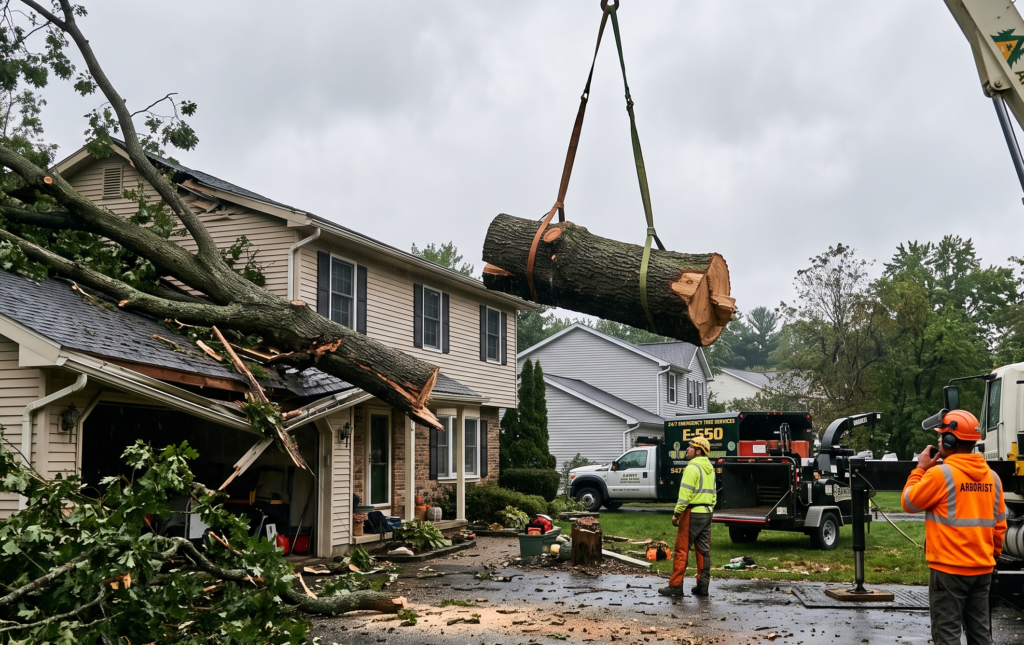
Removing thousands of pounds of timber from a fractured roof requires specialized rigging. If an untrained crew starts cutting blindly with a chainsaw, removing counterbalancing limbs can cause the main trunk to drop straight through the ceiling joists. Heavy-lift cranes and remote-controlled grapple saws lift the trunk vertically off the home without applying downward pressure.
Scenario B: A Tree Falls Across Your Driveway
While rarely life-threatening, a blocked driveway creates an urgent logistical emergency. It traps commuter vehicles, cuts off access to emergency services (ambulances, fire apparatus), and halts daily life.
Step 1: Determine Ownership and Boundary Lines
Before work begins, determine where the tree originated:
- Private Property: If the tree stood on your deeded parcel and fell across your driveway, the responsibility for removal falls on you (or your private homeowners insurance policy).
- Municipal/Town Tree: If the tree stood in the town right-of-way (the strip between sidewalk and curb, or within the public drainage ditch along roads like Route 259 or Wilder Road), contact the Village of Hilton Public Works or Town of Parma Highway Department. Municipal road crews will clear the portion obstructing public roadways and driveway aprons.
Step 2: Avoid Cutting Springpoles and Tension Limbs
A fallen tree spanning a hard driveway surface creates dangerous energy points:
- Bowing Limbs (Springpoles): When a heavy trunk bends branches against asphalt or concrete, those branches store tons of potential energy. Cutting a bent branch without specialized relief cuts causes the branch to snap outward violently, resulting in blunt-force trauma.
- Rolling Trunks: As soon as balancing limbs are removed, a cylindrical trunk can roll down the crown of a sloped driveway, crushing parked cars or pinning operators against garage walls.
Scenario C: A Tree Falls on a Boundary Fence
Fences are common casualties during Monroe County windstorms. When a boundary fence is crushed, disputes between neighbors over liability and clean-up costs often arise alongside property damage.
Step 1: Address Immediate Security Concerns
- Contain Pets: If the fence encloses dogs or livestock, secure the animals indoors or in a temporary run immediately.
- Pool Safety Barriers: In New York State, residential swimming pools must maintain code-compliant barrier fencing. If a falling tree breaches your pool enclosure, erect temporary fencing or safety barricades right away to eliminate accidental drowning hazards.
Step 2: Navigating New York Tree Liability Law
In New York State, property law regarding fallen trees relies on legal negligence standards:
- The General Rule (Act of God): If your neighbor’s healthy tree falls across your fence during a storm or high-wind event, New York law classifies it as an “Act of God.” You must file the claim with your homeowners insurance company under Coverage B (Other Structures). Your neighbor is generally not legally liable for the damage.
- The Exception (Negligence / Prior Notice): If the neighbor’s tree was clearly dead, hollow, visibly leaning, or infested with fungal conks, and the owner knew (or reasonably should have known) of the hazard, they may be found legally negligent. In that scenario, their insurance carrier may be held liable for your repair bills. Having a prior written record or a certified arborist hazard assessment sent via certified mail before the storm provides critical legal evidence.
Frequently Asked Questions
Q: My neighbor’s tree crushed my fence, but they refuse to pay. What can I do under New York law?
A: Unless you have written documentation showing that the neighbor was informed of the dead or hazardous condition of the tree prior to the storm, New York law considers it an Act of God. Your own homeowners policy must cover the fence repairs under Coverage B.
Q: Will the Town of Parma or Village of Hilton clear a fallen tree if it blocks my driveway?
A: Town highway crews will clear the fallen timber from the public road right-of-way up to your property line to restore traffic flow, but they will leave the remaining logs on your private driveway for private removal.
Q: Why shouldn’t a roofing contractor remove the tree from my roof?
A: Roofing contractors specialize in framing, underlayment, and shingles. Removing dynamic, multi-ton tree canopies requires tree-rigging physics, cranes, and tension-release methods that only certified production arborists are equipped to handle safely.
3. The Comprehensive Photographic Protocol for Insurance Adjusters
Filing an insurance claim for tree damage requires thorough, objective evidence. Insurance adjusters inspect submissions to verify whether the tree was sound prior to the storm, identify preexisting neglect, and confirm that the tree struck an “insurable structure.”
| Photographic Angle | Objective | Specific Detail to Capture |
| Wide Establishing Shot | Shows total context and site environment | Capture the tree, your entire house, street signs, and neighbor boundary markers in a single frame. |
| Root Plate & Stump Base | Proves cause of failure | Photograph the root plate, soil heave, fungal conks, internal decay, or clean structural snap at ground level. |
| Direct Impact Points | Documents physical structural damage | Close-ups of cracked rafters, puncture holes, bent fence rails, crushed gutters, or broken concrete. |
| Weather/Environmental Context | Establishes the triggering storm event | Snow accumulation, ice coating, standing pooling water, or nearby municipal storm damage. |
| Interior Secondary Damage | Documents water intrusion | Ceiling plaster cracks, wet drywall, damaged flooring, water stains, and ruined furnishings. |
Practical Documentation Tips:
- Photograph Before Cutting: Do not remove the wood before the scene is thoroughly documented. Take at least 25 to 50 high-resolution photos and steady walkthrough videos from multiple angles.
- Preserve Damaged Personal Property: Do not discard water-damaged personal property until an insurance adjuster inspects it in person. Stack ruined items neatly in a dry portion of the garage.
- Keep an Emergency Expense Log: Retain receipts for temporary tarps, emergency generator fuel, professional board-up services, and emergency tree clearance invoices.
Frequently Asked Questions
Q: Can I start cutting branches off my car or house before taking photos?
A: No. Altering the scene before taking clear photographs can jeopardize your claim payout. Take wide and detailed close-up photos first, showing the branches resting against the damaged property.
Q: Should I take video as well as still photos?
A: Yes. Continuous video walkthroughs with narration can capture spatial scale, structural sounds (groaning timber, dripping water), and the extent of the damage more thoroughly than photos alone.
Q: What if the storm makes it too dark to photograph the damage clearly?
A: Capture initial flash photos and video to document the immediate emergency, then take high-resolution daytime photos at first light before any cutting begins.
4. Navigating Homeowners Insurance for Fallen Trees
Insurance policies treat tree damage with specific clauses and endorsements. Understanding how standard policies approach tree removal prevents costly out-of-pocket surprises.
Key Insurance Distinctions:
- Tree Hits House or Attached Garage: The tree hit an insured primary structure. Your policy covers structural framing repairs, interior water mitigation, and the cost of lifting the tree off the building to make repairs possible.
- Tree Hits Fence or Detached Shed: Covered under “Other Structures” (Coverage B), typically subject to a limit equal to 10% of your primary dwelling coverage, minus your deductible.
- Tree Falls on Open Lawn (No Structural Damage): If a tree falls across your lawn without striking a building or fence, insurance generally pays zero for removal. The homeowner bears the full cost of clearing the wood.
- Tree Blocks Driveway: Many policies contain an emergency debris removal endorsement covering up to $500–$1,000 if a fallen tree blocks driveway access, preventing a vehicle from entering or exiting.
Frequently Asked Questions
Q: If a tree falls on my lawn without touching a building, will insurance pay to haul it away?
A: Generally, no. Standard homeowners policies cover tree removal only if an insured structure is damaged or if the tree obstructs a driveway or accessible ramp.
Q: Does my auto insurance or home insurance pay if a tree crushes my vehicle in the driveway?
A: Damage to your vehicle is covered under your auto insurance policy. Comprehensive coverage, not your homeowners policy, even if the tree stood on your residential parcel.
Q: What is a typical debris removal cap on a standard homeowners policy?
A: Most standard policies cap debris removal for fallen trees at $500 to $1,000 per tree, up to an aggregate limit of $1,000–$2,000 per storm occurrence, subject to policy endorsements.
5. Dangerous Chainsaw Mistakes to Avoid in Storm Cleanup
When severe weather strikes Monroe County, big-box stores sell out of chainsaws as property owners attempt DIY cleanup. Storm-damaged trees are fundamentally different from regular firewood—they represent chaotic systems of mechanical tension and compression forces.
The Three Deadliest Pitfalls:
1. The Compressed Pinch-and-Kickback
When cutting a log supported at both ends, the top of the log is under tension (wood fibers pulling apart) while the bottom is under severe compression (wood fibers squeezing together). Making an uncalculated top-down cut compresses the kerf onto the chainsaw guide bar, locking the chain instantly and causing violent rotational kickback toward the operator.
2. Severing the Anchor Branch
Often, a massive tree rests precariously on a few thin canopy limbs driven into the turf. These “anchor” or “peg” limbs support the entire weight of the log. If an untrained operator cuts one away, the main trunk can shift or roll unpredictably, crushing nearby personnel.
3. Working at Elevated Heights Without Aerial Rigging
Never stand on an extension ladder to cut limbs holding a tree off a roof. The moment branch tension is relieved, the tree shifts, striking the ladder or throwing the operator to the ground. Professional tree surgeons use bucket trucks, spider lifts, or industrial cranes with certified rope rigging systems to control every drop point.
Frequently Asked Questions
Q: What is a “springpole,” and why is it dangerous?
A: A springpole is a sapling or limb pinned under a fallen trunk, bending it like a drawn bow. Cutting into it releases stored energy instantly, snapping the branch outward at high velocity and causing severe injury.
Q: Can I use an electric consumer chainsaw to cut storm-damaged timber?
A: Small consumer saws often lack the guide bar length, torque, and chain speed required to manage bound, twisted storm timber. They easily get stuck in compression cuts, leaving the operator exposed to falling wood.
Q: Why shouldn’t I cut a tree from an extension ladder?
A: Ladders offer zero stability against shifting wood. As soon as a branch is cut, the reduction in weight causes the trunk to flex upward or roll, frequently knocking ladders out from underneath operators.
6. How Professional Emergency Tree Removal Works
When you contact Branching Out Tree Service for emergency tree care in the Greater Rochester area, our crew follows an engineered, methodical extraction process:
- Safety Survey and Utility Check: We check for power line entanglements, confirm structural load-bearing points on the building, and identify escape routes for our ground operators.
- Dynamic Rigging Setup: We secure heavy trunks using high-tensile arborist rigging lines, block pulleys, and cranes to transfer the weight away from your roof, fence, or vehicle.
- Piecemeal Sectioning: Our climbers and crane operators remove branches systematically from the outside in, relieving tension gradually so the main trunk does not snap or roll.
- Clean Extraction & Weather Tarping: Once the log is lifted off the home, our crew sweeps away sharp branches and secures heavy-duty, commercial-grade tarps across compromised roofing decks to prevent secondary rain and snow leaks.
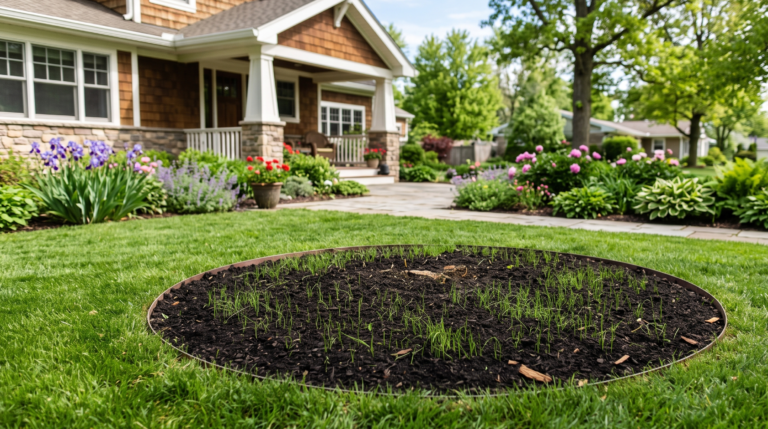
- Debris Hauling & Stump Grinding: We process the brush through heavy-duty commercial chippers, haul away massive timber logs, and return to grind out remaining stumps down below grade level.
Frequently Asked Questions
Q: How does a crane help remove a tree from a house without causing more damage?
A: A crane attaches straps above the tree’s center of gravity before any cuts are made. When our climber makes the cut, the crane lifts the section vertically into the air, preventing the limb from dropping or dragging across shingles and gutters.
Q: Do emergency tree services install tarps on damaged roofs?
A: Yes. Most professional emergency tree contractors provide immediate temporary roof tarping as part of emergency mitigation to prevent interior water damage while you wait for roofers.
Q: How quickly can an emergency tree crew respond in Monroe County during a major storm?
A: During widespread regional storms, response times vary based on life-safety priorities. High-risk situations (trees on homes or blocking primary access) are prioritized, with emergency triage crews typically arriving within 1 to 4 hours.
7. Preventing the Next Tree Disaster: A Pre-Storm Checklist
The vast majority of storm-related tree failures stem from internal decay and structural defects that were visible long before the wind started blowing. Living on the shores of Lake Ontario brings frequent freeze-thaw cycles, high wind shears, and heavy lake-effect snow loads that punish vulnerable trees.
Schedule an Annual Arborist Risk Assessment
Have an ISA-certified arborist inspect mature trees on your property every 12 to 24 months. Key indicators we inspect include:
- Codominant Stems with Included Bark: Trees with two central stems forming a tight “V” shape rather than an open “U” shape are vulnerable to splitting during high winds. Installing non-invasive Cobra cabling and structural steel bracing rods redistributes dynamic wind loads, preserving the tree safely.
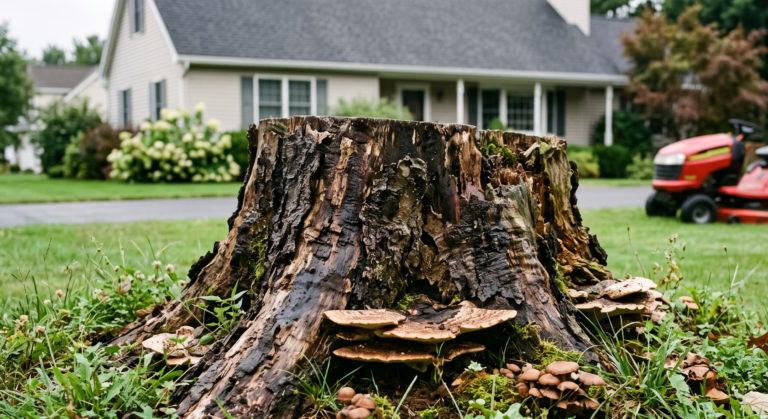
- Fungi and Fruiting Bodies: The presence of bracket fungi, mushrooms, or carpenter ants near the root flare indicates internal heartwood rot. A hollow tree can appear vibrant and green on the outside while lacking the structural integrity to withstand a gale.
- Deadwood Clearance: Removing dead, dying, or diseased branches eliminates airborne projectiles before wind can snap them off into your home.
- Crown Thinning and Weight Reduction: Pruning selective canopy branches allows gale-force winds to pass through the canopy (reducing the “sail effect”) rather than pushing against an impenetrable wall of leaves.
Frequently Asked Questions
Q: Can a tree look completely healthy on the outside but still be rotten inside?
A: Yes. Trees can maintain a lush green canopy using only the thin outer layer of sapwood and bark, while the interior structural heartwood is completely hollowed out by fungal decay.
Q: What is tree cabling, and how does it prevent storm failure?
A: Tree cabling involves installing high-strength steel or dynamic synthetic cables between upper codominant stems. This limits trunk movement during heavy winds, preventing the branches from splitting apart at weak unions.
Q: How often should mature trees near a home be evaluated by an ISA-certified arborist?
A: In high-wind, heavy-snow regions like Upstate New York, mature trees within falling distance of houses or driveways should be assessed every 1 to 2 years, or immediately following severe weather events.
8. Fast-Response Tree Services “Near Me” in Monroe County
When severe weather knocks down heavy timber, searching for reliable, licensed tree removal “near me” means finding a crew that is already working in your neighborhood with the right equipment staged and ready. Because high winds off Lake Ontario hit our lakeshore towns first, Branching Out Tree Service maintains rapid local dispatch routes throughout the northwest Rochester area.
We routinely provide emergency tree removal, crane extractions, and certified dormant pruning across:
- Hilton (Village & Town of Parma): Core service coverage throughout 14468 (Route 259 / Unionville Station / Wilder Rd / Burritt Rd).
- Hamlin & Lakeshore: Fast response along Route 18, Lake Ontario State Parkway, and surrounding rural acreage (14464).
- Greece & North Greece: Complete tree risk assessments and residential limb trimming across 14612, 14616, and 14626 (Latta Rd / Long Pond Rd / Dewey Ave).
- Spencerport & Ogden: Specialized crane removals and hazard limb mitigation along Route 31 and Route 259 (14559).
- Brockport & Clarkson: Rapid dispatch along Route 19 and Route 104 (14420).
Whether you are dealing with a split oak blocking your driveway or need an arborist to evaluate codominant maples before the next freeze-thaw storm, our local crews are based minutes from your property.
Frequently Asked Questions
Q: How fast can Branching Out Tree Service reach my property in Hilton or Parma?
A: Our primary operations yard is located directly in Hilton, NY (14468). For critical residential emergencies along Route 259, Route 18, and surrounding Parma roads, our assessment crews can typically arrive within 45 to 90 minutes.
Q: Do you service lakeshore properties along the Lake Ontario State Parkway?
A: Yes. We regularly stage crane and bucket trucks for Hamlin Beach, North Greece, and Hilton waterfront properties subject to severe shoreline wind shears.
Q: Are estimates for emergency storm damage assessments free?
A: We provide on-site safety assessments and written estimates for insurance claims across our primary Monroe County service radius.
9. Our Monroe County Service & Dispatch Location
Use the interactive map below to confirm our central dispatch location and review our coverage radius across Hilton, Greece, Hamlin, and Parma.
Frequently Asked Questions
Q: What specific zip codes do you cover from your Hilton dispatch center?
A: We cover 14468 (Hilton), 14464 (Hamlin), 14559 (Spencerport), 14420 (Brockport), 14612 (North Greece), 14616 (Greece), 14626 (West Greece), and the broader Monroe County region.
Q: Can equipment like cranes access tight residential backyards in older suburban neighborhoods?
A: Yes. We operate compact articulated lifts and specialized outrigger matting systems designed to traverse residential turf without damaging driveways or septic fields.
Q: Are your crews fully licensed and insured specifically for Monroe County?
A: Yes. We maintain comprehensive commercial general liability and workers’ compensation coverage tailored to heavy municipal and residential tree removals in New York State.
Safe, Reliable Storm Cleanup Across Monroe County
When severe weather hits Upstate New York, you do not have to face fallen timber and structural damage alone. Branching Out Tree Service provides reliable, fast-response emergency tree removals throughout Hilton, NY, and surrounding communities.
- 24/7 Emergency Tree Dispatch: Ready to mobilize heavy cranes, grapple trucks, and certified crews when disaster strikes.
- Full Insurance Liaison Support: We supply comprehensive photo documentation, detailed work logs, and direct itemized invoicing to keep your insurance claim moving smoothly.
- Safety First, Always: Fully licensed, bonded, and insured with top-tier commercial coverage to protect your home and property through every phase of removal.
Keep our emergency number stored in your phone before bad weather arrives. If a tree threatens your roof, fence, or driveway, reach out to Branching Out Tree Service for safe, prompt property restoration.